

In my review of Ethan Mollick’s Co-Existence, I said I liked the transparency of him explaining how he used AI in the writing process, and I figured I owed a similar article on how I use AI for writing book reviews.
This is what it looks like:
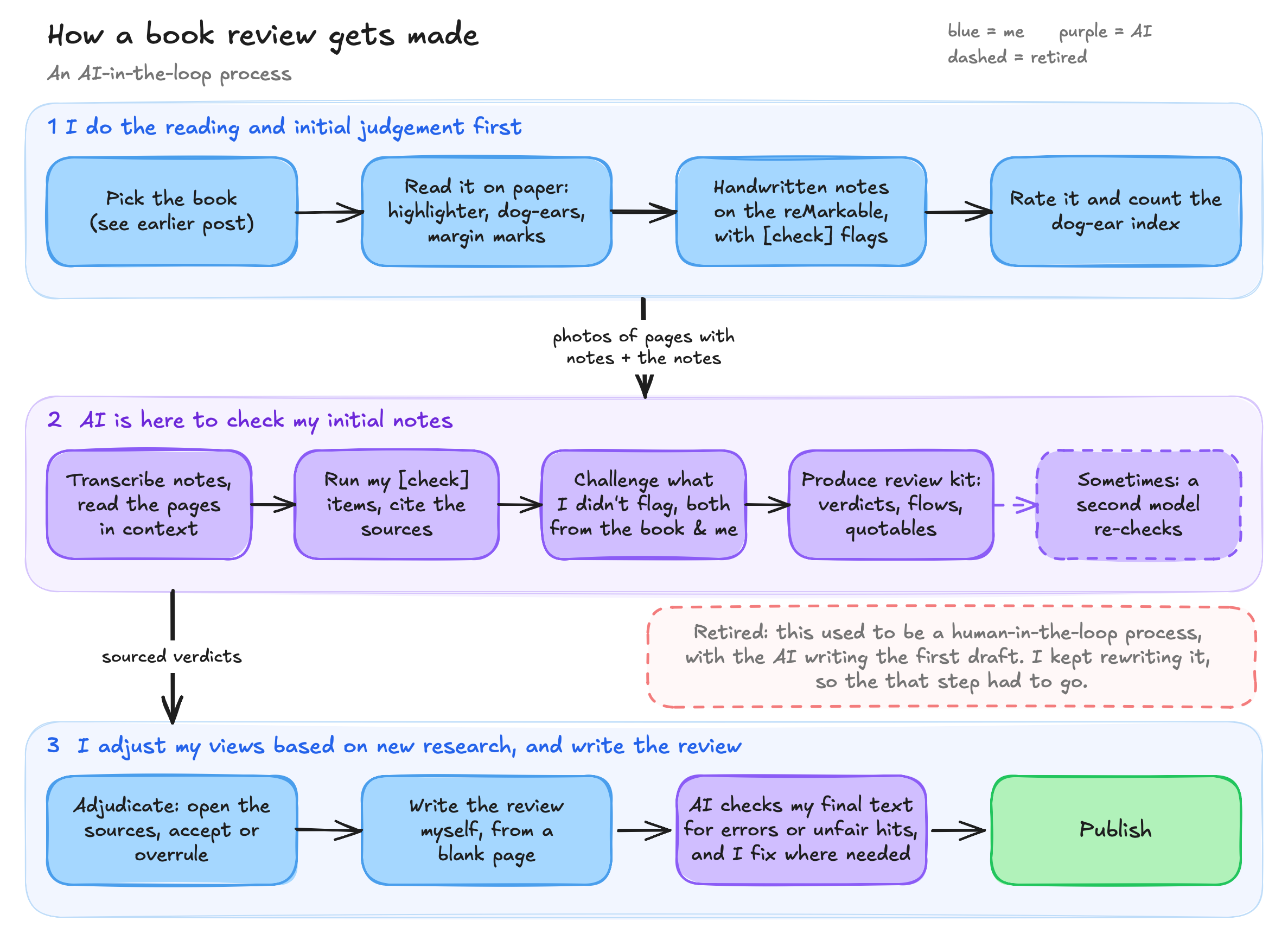
Let’s go through that.
I’ve already written earlier about how I select the books I review and my philosophical approach to it, so see that post for the first step.
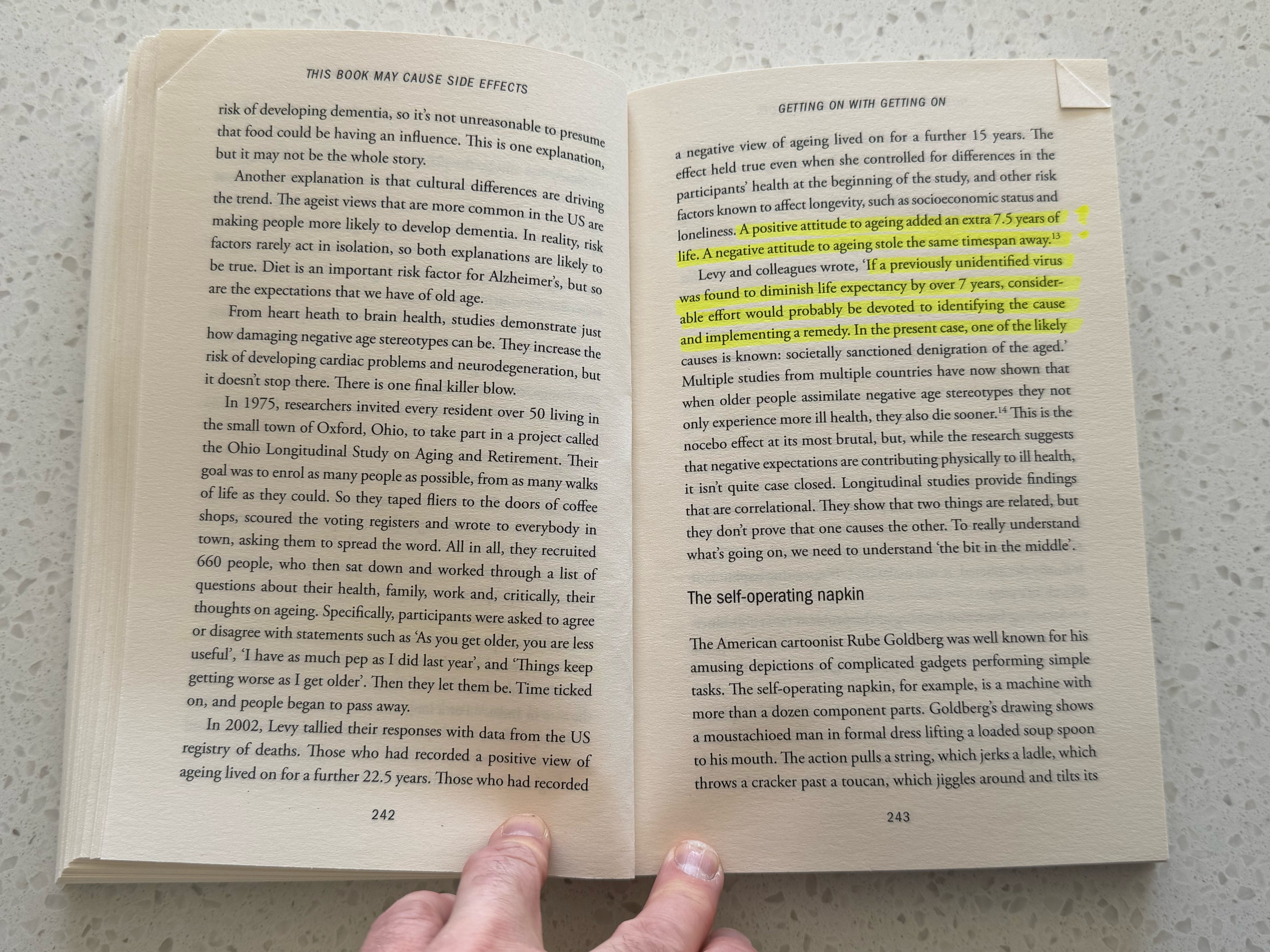
I then read the book; I highlight important pages, dog-ear really important pages, and hand-write notes on my reMarkable tablet.
So the book ends up looking like this, with highlights, dog-ears, and sometimes margin notes:
And my notes on the tablet will end up looking like this:
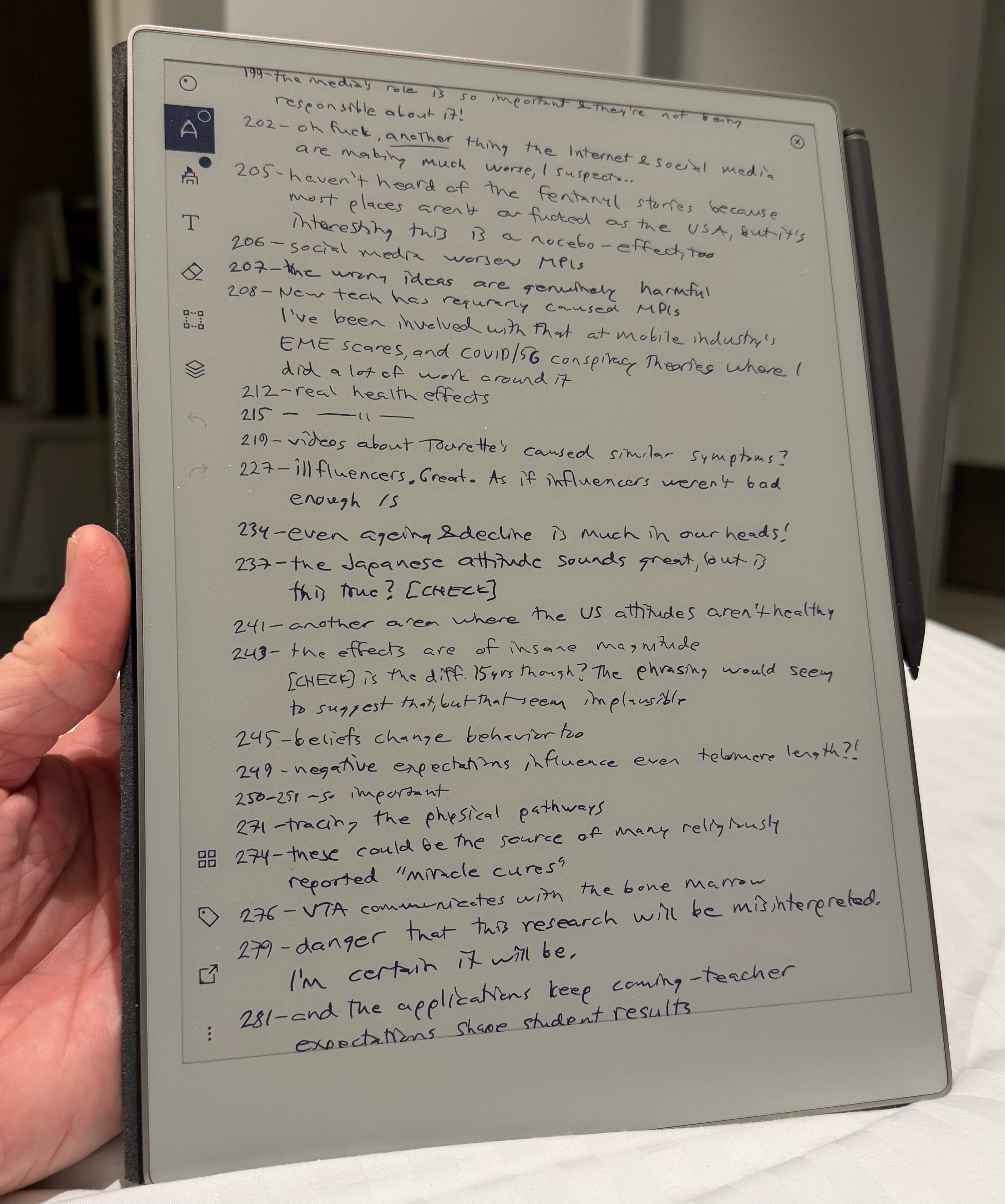
There will be lots of notes – dozens, usually, for every book. And you may notice something in those notes; a [CHECK] tag, which are instructions to my AI. What’s more impressive is that it can actually read my handwriting!
Once I’m done reading, I give the book a preliminary rating, and I count the dog-ear-index.
Then I take a photo of every page that I have made notes on, and upload those and my reMarkable notes to folder that Claude has access to.
Using Claude with a Skill I’ve developed for it, it will then go through all my hand-written notes, the page photos, all my highlights, and does the following things:
Reads the marks in context. A highlight is a pointer to the surrounding passage. As margin notes, a lightning bolt means I disagree strongly, an exclamation mark means I agree strongly or think it’s an important point, and a question mark means I’m not sure about that passage.
Runs research on every [check]-item. It fires up a separate research agent on whatever I flagged (which in turn can call e.g. Elicit, Consensus and Scite MCPs for research), finds as reliable sources as it can, and gives a verdict: was the book right, was the book wrong, was I right, was I wrong, or does it remain unresolved.
Challenges what I didn’t flag. This covers factual claims in the book and in my own notes.
Hands back a review kit. The kit holds the check dossier, two or three possible structures and bullet-point-style outlines, points worth including with page references, margin ideas at risk of getting lost, and candidate quotes copied exactly from the book pages.
On particularly thorny issues I may run the research brief by another model. I then go away and write the review. Then we go back to the AI, which then:
Reads what I wrote. Once I’ve written the review myself, it does a final check for factual errors, spelling errors, grammar points, unfair criticism and anything important from my notes that went missing.
Watches for my standard complaints. It keeps me honest about penalizing the book about any internal contradictions it has, US-centrism, datedness, thin sourcing, padding, and the difference between “not good” and “not for me”.
Finishes the admin. It writes a private memo onto my Obsidian of what I thought of the book for my own notes.
And voila, that’s how my book reviews happen.
If you’re interested in what the result of those checks look like, here are some examples:
When I was right
Pilcher p.243, my note said: “[CHECK] Is the diff. 15 yrs though?”.
No, it’s 7.5. Levy 2002: median survival 22.6 vs 15.0. The book’s ‘added 7.5 / stole the same timespan away’ describes one gap from both ends. It’s correlational; the 2023 meta-analysis says the link is robust but small.
Pilcher p.237, my note said: “The Japanese attitude sounds great, but is this true?”.
Mostly not. North & Fiske 2015 meta-analysis (37 papers, 23 countries, 21,093 people): attitudes to older people are more negative in the East, worst in East Asia.
Kingsnorth p.181, my note questioned the 70% figure.
Sami’s instinct is right, with better ammunition than expected: the figure is traceable — to a worst-case hypothetical (all proposals approved) presented to a committee in 2021 … The author had a real point available and chose the fake number instead.
When I commissioned research with [check] (example from Incorruptible)
Several exist. Main vehicles: charitable CLG or trust ownership (Word Investments, HCA 2008), mutuals/co-ops with Mutual Capital Instruments (2019), and bespoke employee ownership trusts (no tax regime). Examples: Thankyou (100% Thankyou Charitable Trust), Sanitarium (SDA Church), Goodstart, Paul Ramsay Foundation (diluted from 36% to about 18–21% of Ramsay Health Care). The Canva founders’ pledge is a pledge only; no structural lock is disclosed.
Missing: statutory purpose trusts. Non-charitable purpose trusts are invalid, and the perpetuity limit is 80 years everywhere except SA. Watch the announced 6% Giving Fund payout floor.
When I tried to give an inconsistent rating on Braver New World:
Your meta-post says you penalise factual errors “mercilessly”. The fact-check turned up a lot:
“paying dividends” on Finnish schools, with no evidence behind it
the 1.2 billion figure, from a source de Haas debunks
Taiwan’s 10% personal payments, really close to 40%
the generously defined Vienna 60%
“over half have parents born abroad” (48.2%)
Toronto’s “hyper-diverse” credited to the OECD
Essmart’s founding story, which leaves out Jue and Stenson
a misread Health Affairs paper
a Karnataka village placed near Delhi
By your own published standard, that list argues for 3.5.
When I was flat-out wrong
In ‘Braver New World’, on p.140, my margin note said “Students get a voice on meals? UM NOT SO!”.:
Refuted (for today). 77% of basic-education schools report that pupils take part in meal planning (OPH/THL monitoring, autumn 2025), and the 2017 national school-meal recommendations call for it. Your memory is probably right for your own school years.
… and so on. The fact-checking reports are actually quite fascinating reading.
So that’s the article I felt I owed you, as a bit of a Part 2 to the previous meta-article about me reviewing books. It’s very much of an AI-in-the-loop process, with the AI reading everything, checking everything, and arguing with me about a fair bit of it.
But the writing and the opinions are still mine; including, it turns out, the wrong ones, some of which this process hopefully helps weed out.
Thanks for this Sami- I am trying to capture my process for fact checking my research and I am not as disciplined as you 😊, but somewhere in my own thinking the process exists and I am discovering it organically and letting it flow until it settles and hopefully I will have a repeatable go-to approach. You have given me a few ideas and so immensely grateful for your insights. 🙏