

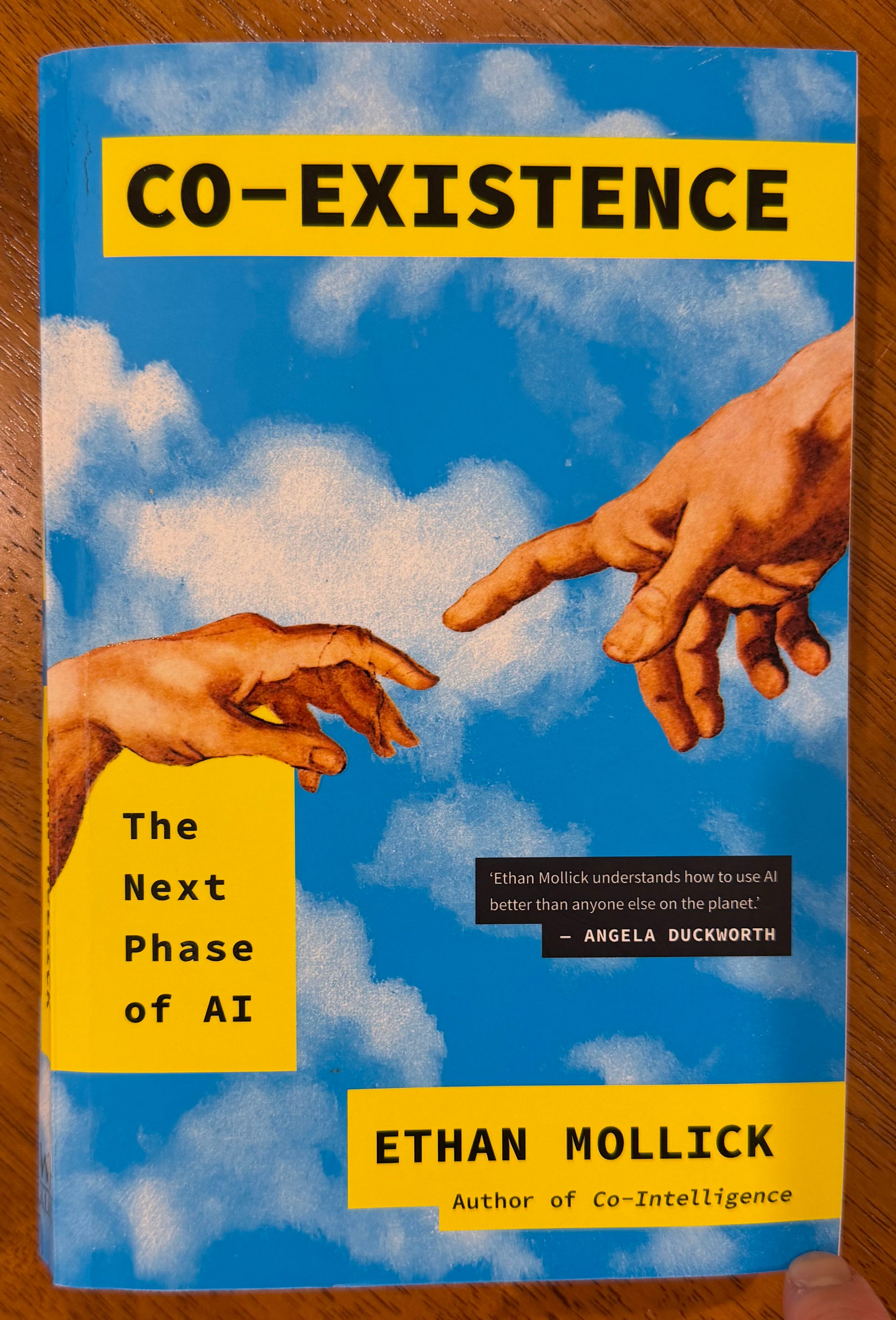
Ethan Mollick has, for years, been my go-to recommendation for “normal people” who want to understand and learn about AI; he’s a pragmatic thinker with a lot of good advice and I respect his work.
So as not to bury the lede: his latest book, Co-Existence, is going to be the book I will tell most people to read.
Also, a heads-up: this is the second stop on a short tour of new AI books. Normal, more varied service resumes after a few more.
Mollick opens the book by explaining exactly how he used AI to help write it. Every author should explain their process with equal transparency and clarity. And then he talks about the frustrations all of us writers live with in the age of AI:
My last book contained 128 em dashes—the “—” I’ve always overused and loved. Now, every time I use one, I hesitate. AIs are notorious for leaning on the em dash, and I want you to know that this is my work, not a machine’s. My reluctance to use my favorite punctuation is more than a minor nuisance; it has begun to change how I write. Even certain sentence constructions now give me pause, especially the familiar “It’s not just X, it’s Y” construction that AIs also favor. So my writing is suddenly shaped by both the actual use of AI and a desperate desire to show you that I really did write this book.
AIs may not be so liberal with em dashes anymore, but they have some new ‘tells’. I, too, nowadays spend an annoying amount of brain power trying not to sound like a machine. I even hesitated over the word “delve” while taking notes for this review, and “delve” stopped being an AI tell years ago. This is annoying, and makes the writing process less pleasant.
Co-Existence covers most of the important things people need to know, and that we can know at present, as we enter the era of co-existence with AI, in two hundred very readable pages; how LLMs work, the ways of working with AI, what Mollick believes our human advantages might still be, what’s up with the apparent lack of productivity benefits from AI, and what it might mean for our society. All done in an accessible, suitably simplified way, so you don’t need any technical background to read this.
As such, there’s lots to like here. The point that sometimes the struggle is the whole point and you shouldn’t skip it with AI is very valid and important, as is the observation that sometimes it’s difficult to tell when it is important.
So is his take on the Bitter Lesson, which is computer scientist Richard Sutton’s observation that brute computation keeps beating carefully encoded human expertise. We’ve seen that if you give AI enough examples and compute, and it can learn to produce almost anything – but almost anything with one qualifier: where quality can be clearly specified and measured. But Mollick also shows where the lesson stops:
So, what about decisions where “good” is contested, contextual, or unclear? What about situations where the right answer depends on values that different people weigh differently? What about problems where optimizing for one measurable thing damages something else that’s harder to measure? The Bitter Lesson is silent on these because these aren’t problems that can be solved by throwing more computation at a clear objective. This is where process starts to matter again. This is where humans start to matter again.
The same holds at the organizational level, where outputs are rarely the whole story either. Accelerating one task tends to just shift the work to the next bottleneck without speeding up the whole, which is a good lesson for many organizations.
As usual for Mollick, there are also some new metaphors to play with. I’m not sure I like conjurer as much as I did the other ones, but not everything lands.
Speaking of what didn’t land, prompting. In the education chapter, Mollick writes that “the elaborate prompting techniques that once mattered have largely stopped working,” – which is something I agree with, although the elaborate techniques never were that amazing – and also that teaching prompt engineering as the core AI skill “is like teaching students in 2001 to use a card catalog.”
That I don’t really agree with; there are still benefits to be had by more thoughtful prompting, so I was pleased to discover, eighty-odd pages earlier, that he cites an experiment where “Individual differences in how people wrote their prompts explained 73 percent of the variation in negotiation outcomes.“
So which is it? Does prompting matter or doesn’t it? Both, to be fair, and he explains why:
The magic isn’t in phrasing the request properly anymore, it’s in what you give the AI to work with and how well you can explain what you need.
Nuance is something that Mollick is good at, and it’s especially nice to see in a book that’s both aimed at the popular audience and is relatively short. He constantly reminds us that things are always a little bit more complicated than you think, and there are no hard and fast rules.
Mollick has some guidance not just for individuals, but also organizations. One piece of organizational advice I wasn’t really sold on was setting up the Lab; “a centralized effort to figure out how to use AI in your organization“. This sounds a whole lot like the corporate innovation labs of the last two decades, of which I have intimate personal experience and I would like to point out that they rarely work as well as they do on the consultants’ PPT deck.
The education lessons are sensible but not very different from what the world is already doing. Consciousness and alignment get a few pages; I didn’t expect more, or even this, but if you’re into those, much better books exist on both. And on AI companions, he’s right that we’re running an experiment “on a billion people, without a control group.” It’s one we shouldn’t be running on children. I’ve made my case on that earlier.
I read this straight after If Anyone Builds It, Everyone Dies, which made for an interesting contrast. Yudkowsky and Soares saw one ending; Mollick had four possible future scenarios in his previous book, and in this one points out that two of the four scenarios are now “largely off the table”. What’s left is the Escalator, where a still-jagged AI keeps getting better every year, and the Eschaton: superintelligence, “the end of the world as we know it.“
But both books agree that sitting still is the worst option. “In either case, the worst thing you can do is nothing”, Mollick concludes, offering guidance on what we need to do depending on which scenario we believe is likely. I’d go further. Thinking about who controls these systems, what values they embody, and how we preserve the things about human life that matter – actions he recommends if we believe we’re approaching the Eschaton future – is something we need to do urgently, irrespective of the future we think we’re heading into.
Mollick remains a leading, pragmatic voice in preparing the world for our alien intelligences; for most people, this is a great book to read.
Rating: 4.5 out of 5 for a general audience; 3 out of 5 if you’re already deep in AI
Dog-ear index: 10
Who is it for: Anyone who wants one book on where AI is now and how to work with it, especially without a technical background. I didn’t learn much from it, and if you’re deep in the field, you’re unlikely to either, but you’ll gain some valuable perspectives, and you’ll know exactly which book to hand everyone else.
[reminder: I highlight important parts of the books I read, and dog-ear the really important pages. The dog-ear index is simply the average number of dog-eared pages per 100 pages]
Product link for reference only; please support your local bookstore where possible: https://www.amazon.com.au/Co-Existence-Next-Phase-Ethan-Mollick/dp/0753562367/