

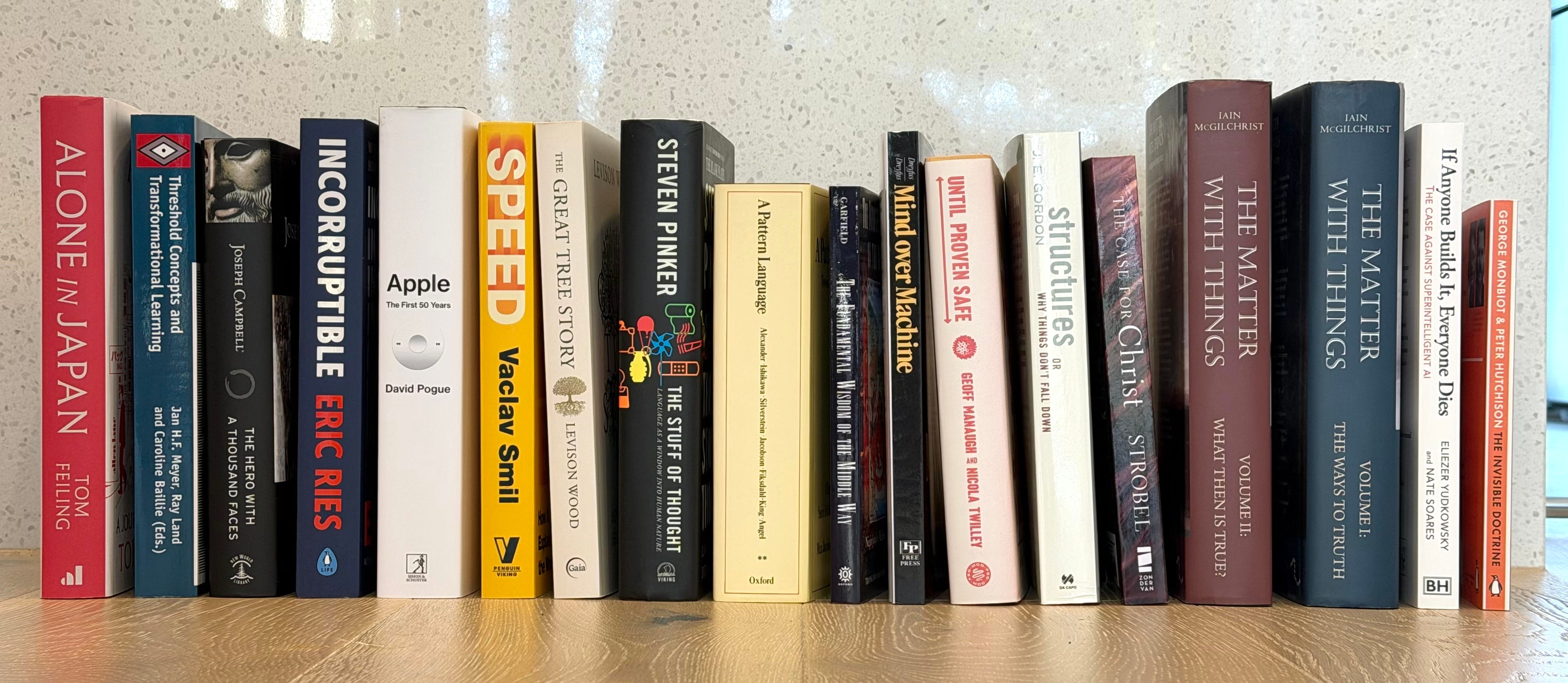
Something a bit different this week: no book review, but a meta-post about them.
I figured I would write down the fine print that has always been implicitly attached to my reviews. Every review I post comes filtered through one particular brain, with particular tastes, allergies, and blind spots. I’ve disclosed these piecemeal over the years, but they deserve a proper home.
So here it is: how select my books, how I review them, and what to adjust for when reading me.
Broad strokes first: I read mostly non-fiction, and my approach is primarily analytical rather than experiential. I read mainly to update my understanding of the world, less so to be moved, though the best books do manage both. This says nothing about the worth of other ways of reading or writing; it’s simply the lens I bring.
The direct consequence: some books that others find valuable or even life-changing don’t necessarily land at all with me.
Book reviews are subjective. All of them, everywhere, always; mine are no exception. Me not appreciating a book doesn’t mean you shouldn’t or couldn’t find tremendous value in it, and holding different views on the same book is not just fine, it’s expected. I’m not issuing verdicts; I’m offering one data point, along with enough documentation about the measuring instrument that you can calibrate.
(This is also why every review ends with “Who is it for”. Whether a book is good or bad is the wrong question; the right question is whether this book and this reader, at this time, are a good pairing. But even that section is just an opinion of one guy.)
I am allergic to factually inaccurate claims. Obviously not everything important is factual. Some books I’ve rated highly wouldn’t survive peer review and aren’t trying to; wisdom and evidence are different genres, and I try to review each by its own rules. But when a book does appeals to facts to make its case — and authors love appealing to what they think are facts — those facts need to be right. When they’re wrong, I penalize the book for it mercilessly, because if the facts change, you owe it to yourself and everyone else to change your mind.
I’d cite the famous Keynes quote here — “When the facts change, I change my mind. What do you do, sir?“ — except there is, it turns out, no good evidence Keynes ever said it. I learned this while writing this very post, and duly changed my mind about the quote’s authorship.
Some specific sub-allergies: false dichotomies, anecdotes doing work only data can do, US-centric observations presented as universal human experience, and deepities and pseudo-profound bullshit (a technical term; see Pennycook et al., 2015, on its reception and detection).
I’m careful about what I read, because I’m influenced by everything I read. There is no such thing as reading a book and remaining unchanged; that’s rather the point of the exercise.
This is also how lies get embedded into people’s minds as truths. Repetition makes claims feel truer (even claims that contradict what you already know) and the biggest jump comes from the second exposure. Worse, repeated information eventually starts to feel like something you always knew. Critical reading at first contact helps, but the more reliable defense is upstream: be careful about what you put in, and how often.
As Terry Pratchett wrote (in Diggers, 1990, and unlike Keynes, he verifiably did):
“The trouble with having an open mind, of course, is that people will insist on coming along and trying to put things in it.”
This also means the biggest bias in these reviews enters before a single page is turned: at selection.
So, for the record, this is how books make it to my reading pile:
An annual research theme. Most years I pick a topic to go deep on (one recent one: Managing Collapse; cheerful stuff), and a decent chunk of that year’s reading serves it.
Trusted authors. Some have earned near-automatic purchase status.
Trusted friends. When some friends recommend books, they tend to get picked up. You know who you are.
Other books. References, rebuttals, and loose threads inside one book queue up the next three.
Long-form auditions on podcasts. Hearing an author think for hours in a long-form interview beats any blurb. (Fifteen-plus hours of Matthew Walker on sleep preceded Why We Sleep.)
Bookstore grazing. Deliberately unstructured browsing where titles are allowed to ambush me, at bookstores in Melbourne and Sydney whose staff curation abilities I trust. This looks like impulse, and technically it is, but the impulse runs on a picker trained by every book that came before it, so I trust it. Mostly.
Deliberate steel-manning of all sides. Sometimes I pick up a book arguing for a point of view I strongly disagree with because I always want to get the steel-man version of both sides of the argument, even on – or maybe especially on – topics that are considered ‘settled’.
A few consequences of all this curation worth disclosing.
First, my ratings tend to cluster in the 3.5-to-4.5 range. This is not because I’m soft on the books, but because deliberate selection means true duds rarely make it through. (When one sneaks in, I will let you know. Usually at length. Like very recently.)
Second, the reading pile has a certain demographic. I generally pay no attention to the authors’ genders or backgrounds, but it does skew male and is weighted heavily Anglophone. I won’t be imposing gender quotas on my reading list, but I will endeavor to pay more attention to diversity in all its forms.
Third, the more you read, the smaller the update any single book makes. These days even a great book tweaks my neural network rather than overhauls it, and I consider that the quiet payoff of volume: read only one great book, and you’re liable to take everything from it; to let it become too big a part of your personality, or your entire understanding of a topic.
The antidote to being captured by one book is the next twenty.
I try to read broadly around a topic. Few topics worth reading about have exactly two sides, but I do try to read multiple angles: degrowth advocates and constraint realists, collapse literature and hope literature, books on faith as a non-believer. If a topic matters to me, one book is just a beginning, not the entire journey of discovery.
I try to read broadly to avoid this:
hominem unius libri timeo
(I fear the man of a single book)
Related: I’ll sometimes note I “didn’t learn much“ from a well-researched, well-written book, and subsequently rate it lower than it should have arguably been, simply because I’ve already read deeply in its territory.
That’s a statement about me, not the book. Hence, again, “Who is it for“ section which can be more important than the star-rating.
The mechanics, for completeness: I read physical books wherever possible, and I read them with intent. Important parts get highlighted; the really important pages get dog-eared; and the rare really really important ones get a second dog-ear at the bottom corner. The dog-ear index — the average number of dog-eared pages per 100 — is my attempt at quantifying how much a book struck a chord; the chord is often, but not always, positive. It’s unscientific and unstandardized, and it still tells you more than most star ratings do.
So there you have it: the practice, biases, and the measuring instrument, documented.
Adjust your readings of my reviews accordingly.
And thanks for being here!
This is so very you Sami. And inspiring too in its thoroughness.