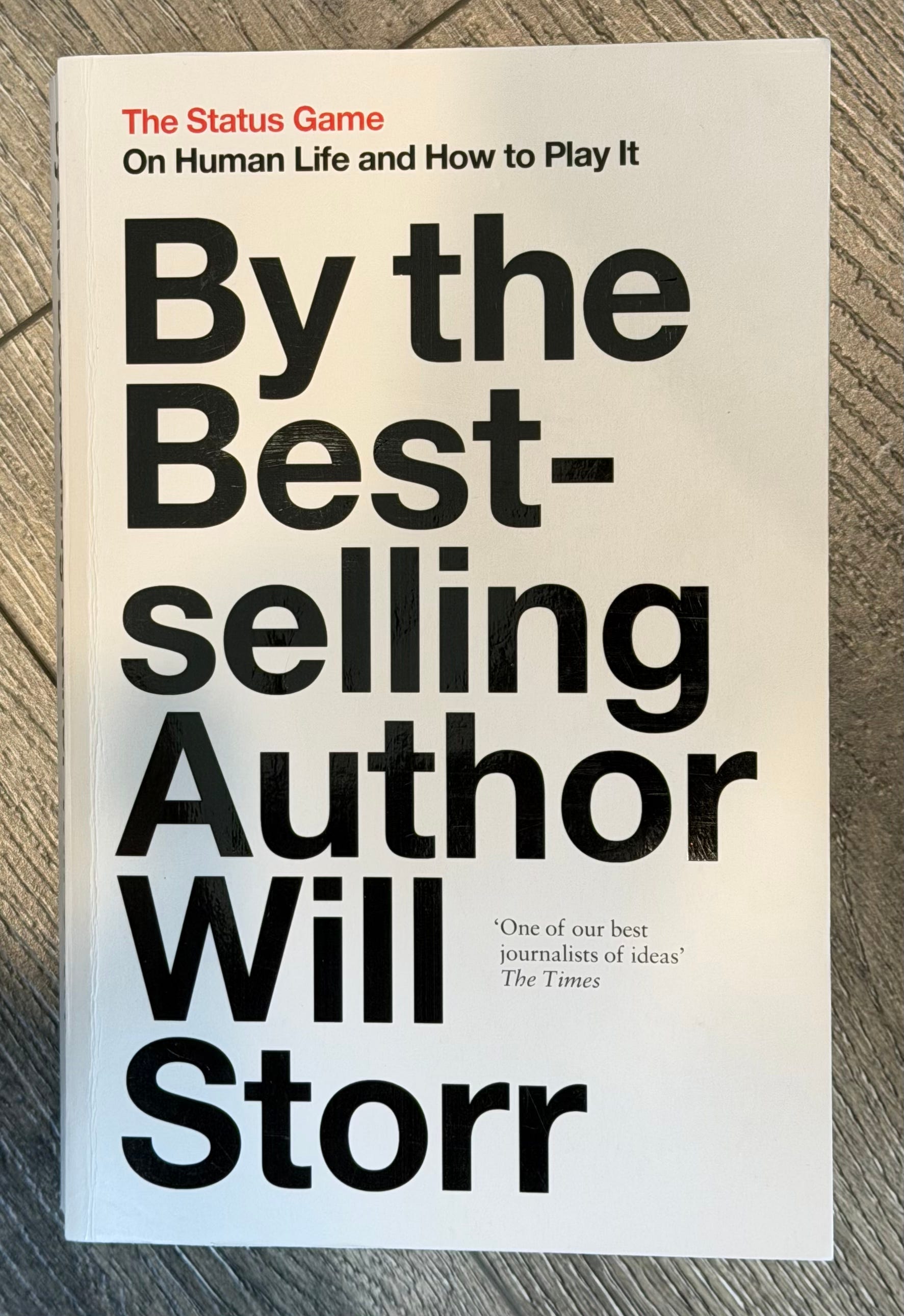
Review: The Status Game
Review of The Status Game: On Human Life and How to Play It by Will Storr
There was a certain irony in reading a book about status games while sitting in Economy class, knees in the back of the seat in front of me, wishing I would have a little bit more room and hoping for everyone’s sake the person in front of me doesn’t recline his seat.
Will Storr’s The Status Game arrived at precisely the right moment to make me excruciatingly aware of how often I, and all of us, play these games - and how futile our denial of that fact is.
We are all playing status games. We can quibble about the definition of how exactly both the words ‘status’ and ‘game’ are defined, but that’s mostly immaterial. You play status games; I play status games; we as a species play heaps of status games.
From the premodern societies of Papua New Guinea to the skyscraper forests of Tokyo and Manhattan, humans form groups and compete for standing within them. We play political games, religious games, corporate games, hobby games, social media games.
The variety feels infinite, and escape not only feels but IS impossible. We cannot escape playing games because that’s who we are.
This might sound cynical, but Storr argues we make a fundamental error when we tend to reflexively categorise our desire for status as shameful.
Status games have driven humanity to extraordinary heights - innovation, art, vaccines, moral progress. The game compels us to scheme and strive, but also to lift strangers in distant moral battles. The shame and the pride, the plummet and the high - they’re features, not bugs.
Storr identifies three distinct flavours of status game: dominance, virtue, and success. Dominance games are the oldest - status through force, intimidation, coercion. Virtue games award status for moral righteousness, holding sacred beliefs, being on the ‘right’ side. Success games reward competence, achievement, and skill.
Most groups blend these, but the mix matters enormously; healthier societies and groups tend toward success games, where you gain standing by being genuinely useful. Dangerous ones drift toward dominance and virtue, where status comes from defeating enemies and enforcing orthodoxy.
Recognising which game you’re actually playing (and we’ll come back to this later), not which game you think you’re playing, turns out to be critically important.
I am allergic to books that seem to fit the pattern “when all you have is a hammer, everything looks like a nail”, and at first I felt there was a bit of that here. But if you loosen up your interpretation of the exact semantics, it is remarkable how pervasive these games really are in our societies, and recognizing that is fascinating, useful, and confronting.
Storr traces the status game through virtually everything, and it’s actually helpful. Wars become more comprehensible through the lens of humiliation and national standing - even WWII looks different when viewed this way. The Catholic church’s prohibition on cousin marriage inadvertently laid groundwork for Western modernity. Reagan and Thatcher kicked off the neoliberal status game, creating a world where we see ourselves as failures even when providing a good living. Social media suddenly makes perfect sense, too: it’s simply the status game made frictionless and global.
Do status games explain everything? No, of course not. But I do believe this book will help us be less wrong.
I found myself uncomfortably implicated throughout. I recognized myself from the note about playing fleeting micro-status games in hotel lifts, for God’s sake - silently noting room numbers, making micro-judgments about floors. Petty? Yes. Silly? Absolutely. Pointless? Definitely.
But I still do it, and pretending otherwise is self-deception.
The book takes a darker turn when examining what Storr calls “tight games” - groups where the rules become rigid, dissent becomes betrayal, and the sacred beliefs cannot be questioned.
Cults are the tightest games, but the dynamic appears everywhere: the New Left and New Right both play virtue games that weave hostile dreams. As games tighten, anyone expressing doubts or disagreements is expelled. Nuance becomes suspect; complexity becomes betrayal. You’re either with us or against us, and “it’s complicated” is no longer an acceptable answer.
Sound familiar? It should - we’re watching this tightening dynamic play out across our societies in real time.
One of the most striking sections traces what happens when societies attempt – in vain – to abolish status games entirely. The path leads, with grim inevitability, through Lenin and Stalin to catastrophe. Humans are not natural seekers of equality, Storr argues, and argues well with evidence - a hard truth that progressive idealists (including, at times, myself) need to sit with.
Trying to eliminate the games just makes the games deadly.
So what do we do? Near the end of the book, Storr offers seven rules for navigating the status game wisely. One of the key insights isn’t to play fewer games - it’s to play MORE. The danger lies in over-investment:
People who appear brainwashed have invested too much of their identity into a single game. They rely on it wholly for their connection and status, the maintenance of which requires them to be filled up with its dream of reality, no matter how delusional. Not only does this put them at risk of committing harm to others, they risk catastrophic collapse themselves. If the game fails, or they become expelled, their identity – their very self – can disintegrate.
Hat tip to high-control groups with the above again, which aim to do exactly this – make their game the only one its adherents play. On the contrary, those individuals who play multiple diverse games, and have complex self-identities across multiple domains, tend to be happier, healthier, and more emotionally stable. The protection lies in diversification.
I won’t spoil all the rules here because the groundwork that comes before them is what makes them impactful, but one more ‘action item’ for all of us relates to recognising what kind of games we play, and when a game has turned dangerous:
It’s possible to sense what kind of game we’re in by observing the ways in which status is typically awarded. Tyrannies are virtue-dominance games. Much of their daily play and conversation will focus on matters of obedience, belief and enemies. Is the game you’re playing coercing people, both inside and outside it, into conforming to its rules and symbols? Does it attempt to silence its ideological foes? Does it tell a simplistic story that explains the hierarchy, deifying their group whilst demonising a common enemy?
I have strong opinions about how things in the world should be - opinions that often contradict how things demonstrably are. This book landed smack in the middle of that tension; there are lots of things in the status games that I don’t want to be true, but the weight of evidence is overwhelming that this is how the world is. The best we can do, probably, is try to harness our nature and steer us to play the better games while accepting human nature.
Storr doesn’t let us off the hook, but he doesn’t condemn us either.
Nobody wins the status game. They’re not supposed to.
The meaning of life is not to win, it’s to play.
Rating: 5 out of 5
Dog-ear index: 12
Who is it for: Anyone who’s ever felt the sting of status loss or the rush of status gain (so, everyone); those interested in why social media is the way it is; people puzzled by political polarisation; and anyone who’s ever played a petty game in their head in a hotel lift and felt slightly ashamed about it afterward.
[reminder: I highlight important parts of the books I read, and dog-ear the really important pages. The dog-ear index is simply the average number of dog-eared pages per 100 pages. Product link for reference only; please support your local bookstore where possible: https://www.amazon.com.au/Status-Game-Will-Storr/dp/0008354677 ]


Sami, halfway thru your xlnt review I got to thinking about Isabel Wilkerson's book Caste: The Origins of Our Discontents (2020), and how caste systems manipulate status to create power differentials everywhere. I'd love to see a remix of these two books, or an optimistic path forward that draws on them both.