

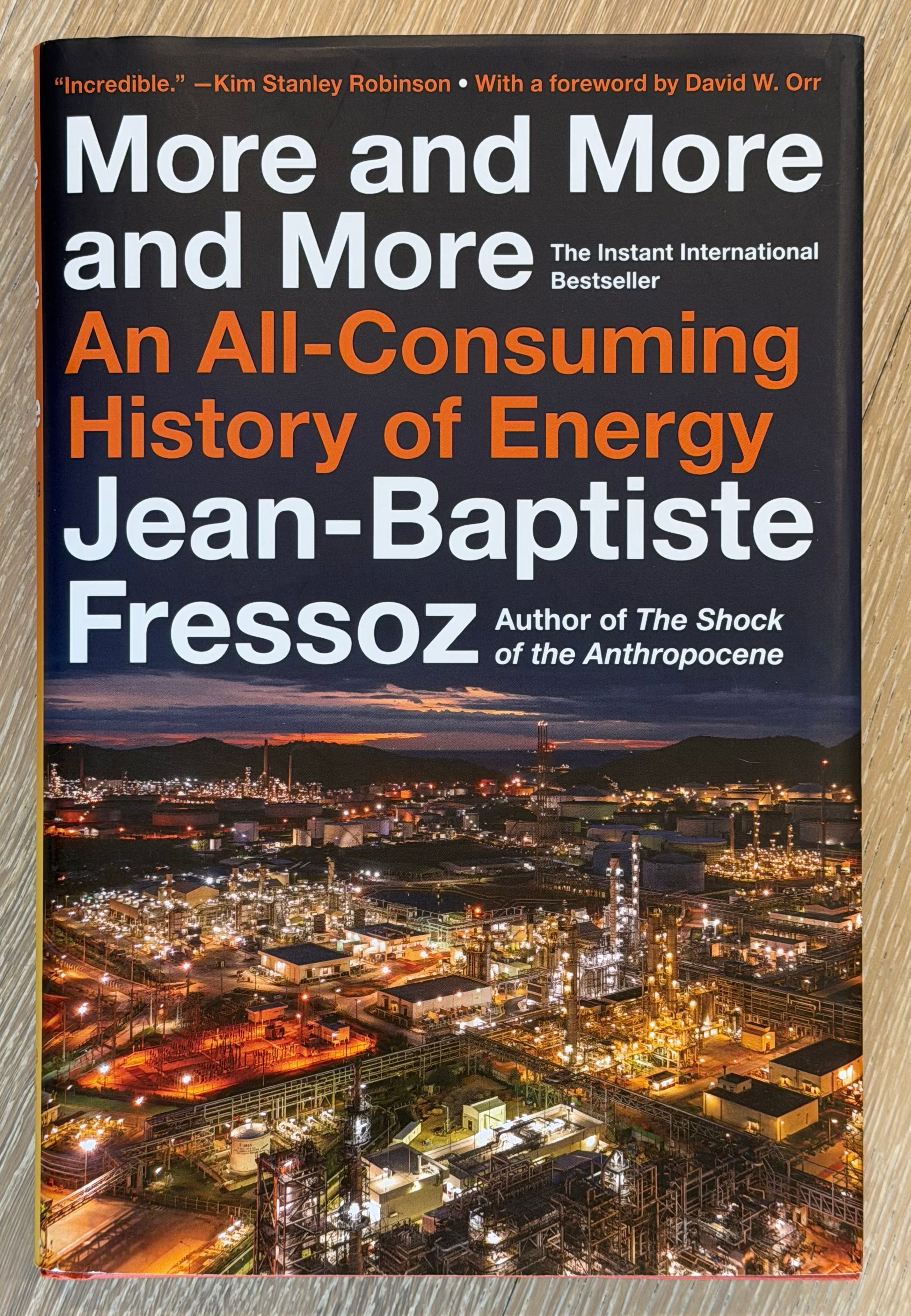
I came to this one expecting is to nicely bookend Material World that I just read (review here). They’re certainly thematically aligned: Conway had walked me through the stuff civilisation is built from and with; Fressoz was going to do the same job for the energy that moves it, and skewer the comforting story we tell ourselves about a clean transition along the way.
Or so I thought. The thesis is sharp, the timing is right, and there is a very important argument here. The execution, unfortunately, is some rungs below the book it ought to sit next to on the shelf.
Fressoz’s core claim is that the energy transition, as it lives in policy decks and net-zero plans and TED talks, is largely a mirage. We do not, historically, transition between energy sources. Instead, we pile new ones on top of the old ones.
The proportional charts are lying, because in the absolute stuff just gets added on top. Coal didn’t kill wood; humanity is burning more wood for energy today than it was in the nineteenth century. Oil didn’t kill coal; we are mining more coal globally than ever. Nuclear didn’t kill anything. Solar and wind are not - not yet, anyway - killing fossil fuels.
The pattern, on the historical evidence, is one of accumulation rather than replacement. This is highly uncomfortable, but it’s also very much backed by data.
Fressoz puts it cleanly:
“Faced with the climate crisis, we can no longer be satisfied with a history written in relative terms. A ‘transition’ towards renewables that would see fossil fuels diminish in relative terms but stagnate in terms of tonnes would solve nothing.”
I agree with this. Wholeheartedly, in fact. And yet I still walked away with serious reservations and three stars. What’s up with that?
Because the book argues for its thesis in a way that keeps undermining itself. The most basic move in a this hasn’t really been a transition argument would be a chart of cumulative or current consumption of each energy source that runs all the way to the present day. Fressoz, bafflingly, keeps cutting those charts off decades ago.
Most of the charts in the book end in the 1960’s, or 1970’s, or in any case decades ago. On page 172 he is, and I am not making this up, citing research from the 1970s as core evidence in a 2024 book about now. The contemporary data exists. The IEA has it. The Energy Institute has it. Our World in Data has it. Why are we not seeing it?
The narration suffers from a related problem. The figures, when they appear, are sometimes striking. One of the best moments is when Fressoz reveals that:
“...in a perfect twist to the transitionist narrative, one of the world’s largest producers of charcoal happens to be the French company Vallourec, a leader in steel tubes for the oil industry. Here, wood is used to produce the steel used to extract oil.”
Conway would have built a whole chapter on this complexity; Fressoz gestures and moves on. The pleasure of Material World was the patient, almost cinematic descent into each industry. More and More and More reads as if assembled from (old) lecture notes.
Then there is the framing on emissions, which lurches into something close to tendentious. Fressoz states: “Even today, nuclear power plays only a marginal role in the world’s energy supply, half that of firewood.” On the raw numbers (nuclear at around 4 per cent of global primary energy) that is defensible.
But choosing absolute primary-energy share as the basis of comparison elides what nuclear actually does per gram of CO2, where it sits next to wind and solar at around 12 grams per kWh, two orders of magnitude below coal. The chapter never makes that move, and the passage reads as if it were drafted by someone who already knew the conclusion they wanted.
What pulled the rating down is the closing argument. By page 220, Fressoz is announcing:
“Transition is the ideology of capital in the twenty-first century. It turns evil into cure, polluting industries into the green industries of the future, and innovation into our lifeline. ... The seductive power of transition is immense: we all need future changes to justify present procrastination.”
That is a sharp, defensible claim. Transition as ideology is the most useful sentence in the book. But the surrounding pages keep flirting with a stronger and worse version of that claim, in which the energy transition is essentially nothing.
That is a step too far. Most non-specialist readers do wrongly conflate climate action with the energy transition, and pushing back on that conflation is fair game. Pushing all the way to nihilism is not, especially when the economic signal of transition is, in fact, beginning to show up in the live data.
Even a laggard like Australia is shifting its emissions profile, and the reason is that renewables have become the cheapest new energy on Earth. Economics is a powerful force. It is the powerful force. That story deserved at least a paragraph.
The reason it isn’t a two-star demolition is that the polemical framing, for all its overreach and its evidentiary gaps, is a useful counterweight to the “we’ve basically solved this, we just need to scale“ school of climate optimism. I would rather have this book in the discourse than not. I just wish it had been written with the same care that Conway brought to its companion.
Here, in the shortest form I can put them, are the claims worth taking from it:
History’s “energy transitions“ were not transitions - they were accumulations. Coal piled on top of wood; oil on top of coal; renewables, so far, mostly on top of fossil fuels.
The reassuring share-of-mix charts hide that absolute tonnes of every fuel that has ever mattered are still mostly either flat or rising.
New energies tend to enable more use of the old ones, not replace them. Wood is burned to make steel that drills for oil.
Decarbonising electricity generation, amazing and necessary as it is, isn’t going to solve climate change. Electricity is ~41% of emissions; cement, steel, chemicals and agriculture are the harder half.
+2°C is not on the table. (Duh.)
That’s it. If you’re on board with those, you don’t need to read the book.
Rating: 3 out of 5
Dog-ear index: 5.5
Who is it for: Energy- and climate-policy people who want a sceptical pressure-test of their own transition assumptions, and foresight practitioners looking for a sharp counter-narrative to the “smooth glide path to net zero“ story. Skip if you have already internalised the additivity argument from better-argued sources, or if there’s any risk you’ll walk away thinking the energy transition isn’t worth pursuing. That is not what the evidence in this book actually supports, even where the prose flirts with it.
[reminder: I highlight important parts of the books I read, and dog-ear the really important pages. The dog-ear index is simply the average number of dog-eared pages per 100 pages]
Support your local bookstore. If you must use Amazon: https://www.amazon.com.au/More-All-Consuming-History-Energy/dp/0063444933/