

The materials in the glass between you and these words is older than civilisation and stranger than fiction. It started as sand somewhere, got blasted to 1,500°C in a furnace in a process nobody fully understands, doped with chemicals from a salt mine, polished to optical flatness with grit from a mountain in North Carolina, and shipped through three continents before it ended up smudged with your thumbprint.
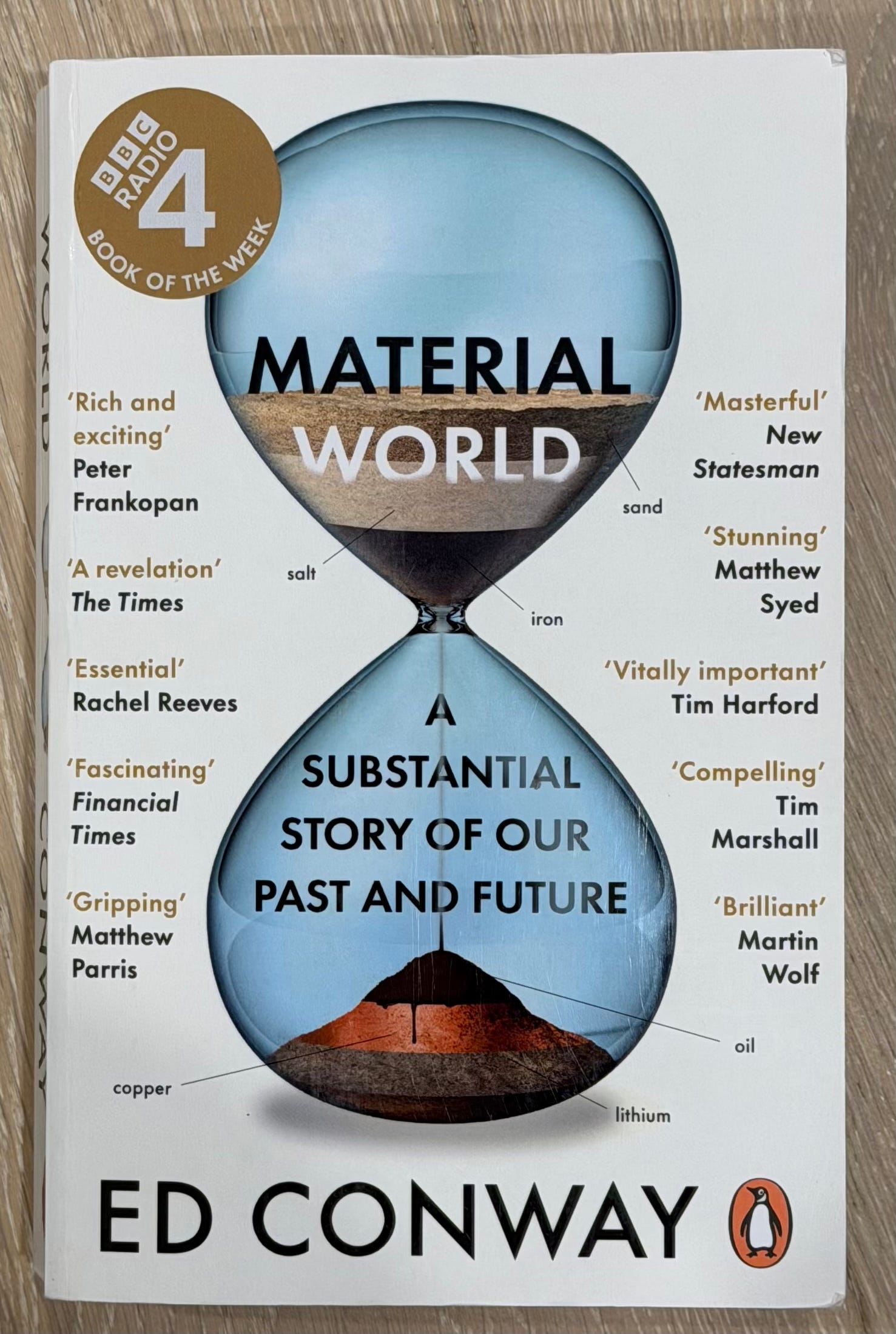
Ed Conway’s Material World is a book about the amazing journeys our everyday materials take; journeys which you probably never think about - and, after 443 pages, you can’t not think about.
This is the book’s whole game, played out across six substances fundamental to our lives: sand, salt, iron, copper, oil and lithium. Take a thing you barely think about, follow the supply chain back through the planet, and try to convince you that the ground beneath civilisation is far more complex, fragile, more political, and more astonishing than you could ever assume. This is one of the books that really should be mandatory reading for everyone.
I came to this book somewhat primed. A long-standing suspicion of mine — reinforced by the core of this Children of the Magenta work, by every supply-chain wargame I’ve run with clients, and by living through enough black swans to stop being surprised by them — is that not paying enough attention to the resilience of these simple, cheap basics is the single biggest failure of modern capitalism and a large part of why current ignorant global politics will end up so painful.
Each of the six materials gets its own section, each section tracks the substance from its geological origin through to the most absurd and miraculous use case humanity has dreamed up for it. Glass turns into the bones of the internet. Sand turns into silicon, which turns into the chip you’re holding. Salt turns into chlorine and caustic soda, without which essentially no modern industrial process works. Iron, in Conway’s lovely phrase, becomes “the bones of our society.” Copper carries the electrons. Oil — still, even as we try to leave it behind — quietly runs the entire show.
Conway is at his best when he turns a small fact into vertigo. Let’s start with a quote about the mind-blowing scale of materials:
“In 2019, the latest year of data at the time of writing, we mined, dug and blasted more materials from the earth’s surface than the sum total of everything we extracted from the dawn of humanity all the way through to 1950.”
A few other random facts that flattened me:
There are 80 tonnes of concrete for every person alive.
The world’s high-purity quartz, without which the advanced semiconductor industry physically cannot exist, comes from essentially one mine in Spruce Pine, North Carolina. China has tried for decades to find an alternative. China has failed.
The breakthrough that fed the world wasn’t the Green Revolution; it was steel. Cast-iron mouldboards, then steel ploughs, dropped the time to plough a hectare from “more than a day’s work” to three hours per hectare. That’s the whole story of leaving subsistence behind.
Australia produces roughly twice as much iron ore as the world’s number two, and about three times as much as China. Whatever you think the geopolitics of the next thirty years are, the rocks under the Pilbara are quietly enabling the global economy.
Conway is also a careful enough writer to refuse the easy industrial-bashing narrative or the easy techno-optimist one. The chapter on concrete patiently explains that putting a concrete floor in a Mexican home cuts childhood parasitic infection dramatically, because the parasites no longer cycle through dirt floors. This is going to be a deeply uncomfortable book for anyone who has built an identity around being against industrial civilisation — Conway is not interested in absolving anyone, but he insists you reckon with what concrete and steel and chlorine have actually done for the bottom four billion humans.
Being low-impact, it turns out, is very, very hard.
He is equally clear-eyed on what we’ve broken. The chapter on the Pilbara doesn’t flinch from the Juukan Gorge destruction. The grades on extractable ore are falling fast enough that the environmental impact per useful tonne is increasing exponentially. The sea floor, he notes drily, is starting to look “very tempting.”
The whole arc is a quiet argument that the next thirty years are going to be defined by whether we can make the Material World cleaner and more equitable, or whether we keep papering over the cracks until something snaps.
What really got me is how fragile everything is; it’s pretty blatantly obvious that some very powerful people have no clue whatsoever about these matters, and are playing a very, very dangerous game with all of our lives.
A modern silicon chip circumnavigates the world multiple times before ending up in your device. Every single one of the six materials has, somewhere in its supply chain, at least one chokepoint that could ruin a decade. We have built our entire ethereal economy on top of an industrial economy that almost no one in the ethereal economy can describe.
Conway puts it plainly in the conclusion: “these things usually happen” when there is enough time, effort, and collaboration. The unstated corollary — and the one I kept underlining in the margins — is that without that collaboration, they don’t happen at all.
Our Material World runs on global cooperation. The political project that says otherwise is an illusion, a luxury belief paid for by the very supply chains it pretends to despise.
I have only mild critiques of Material World. Conway is so committed to wonder that he occasionally lets a profile of an oil exec or a salt-mine manager run long when a paragraph would do. And his optimism anchored in Wright’s Law, the empirical regularity that the cost of a technology falls by a predictable percentage every time cumulative production doubles is potentially a bit too optimistic — but make no mistake, he is not a techno-utopian.
These six substances helped us survive and thrive. They helped us make magic. They can do it again.
Conway shows us the staggering, beautiful, fragile machinery of modern life. Read it. Then look around your room. Almost nothing in it is what you thought it was.
Rating: 5 out of 5
Dog-ear index: 10
Who is it for: Just…everyone. That’s it. Read it.
[reminder: I highlight important parts of the books I read, and dog-ear the really important pages. The dog-ear index is simply the average number of dog-eared pages per 100 pages]
Support your local bookstore. If you must use Amazon: https://www.amazon.com.au/Material-World-Substantial-Story-Future/dp/075355917X/