

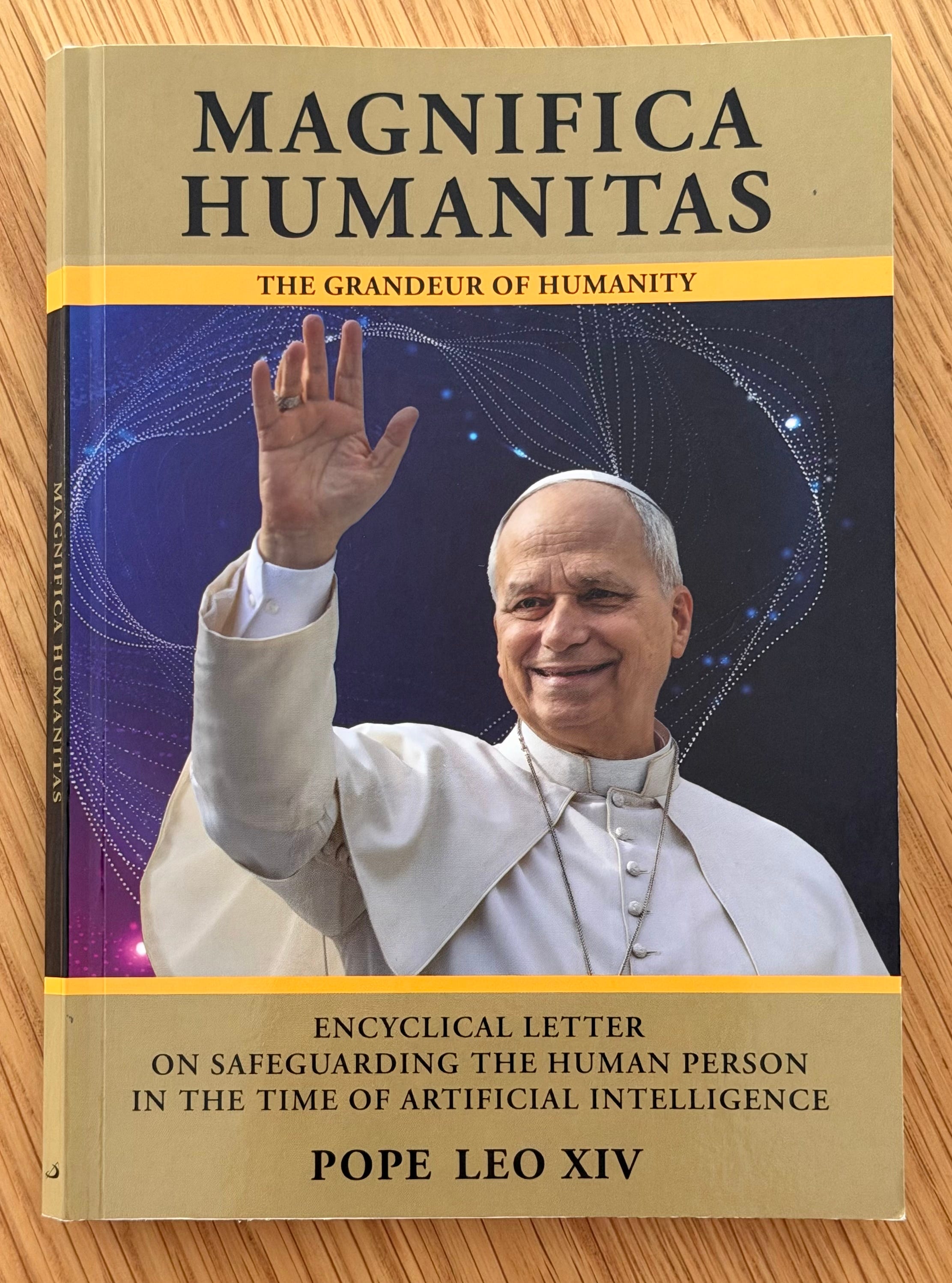
The AI book sprint continues, but with a very different take. Pope Leo XIV’s first encyclical, published earlier this year, got a lot of attention with its focus on artificial intelligence. I would suspect many of the commentators didn’t actually read the whole thing, but I felt like I had to.
Much of this book(let?) is about limits. It defends the limits of being human; limits of what we hand over to machines; limits on who holds the power; limits on the pace of change. These are parts I broadly, sometimes violently, agree with. It then turns to other matters, and on those, there are more disagreements.
Magnifica Humanitas took the crown of having the highest dog-ear index yet: 18.4 – a papal encyclical, read by a non-believer, so that’s a bit of an outlier.
The book is addressed to Catholics, as encyclicals are, but even more so, all Christians, and everyone of goodwill. As someone who has practically reviewed religion itself as a concept (How God Becomes Real, A Most Peculiar Book), I belong firmly to the third group. Yet, some of the dog-ears belong to material I strongly agreed with, so there is no doubt a bit of confirmation bias in all this, too.
Pope Leo XIV points out how technology is not an enemy of humanity, but it is also never neutral; in that, he sounds very much like Kranzberg’s First Law: “Technology is neither good nor bad; nor is it neutral.”
We can all agree that to err is human, and that humans are sometimes weak; we also know that very often, this weakness is seen as something to fix.
building for the common good means accepting the limits and weakness of humanity without considering them an error to be corrected. Today, the human desire for fullness of life is at risk of being misled by deceitful goals, such as the prospect of a technology that promises to free us from all weakness, and models of wellbeing that leave behind entire populations. All too often, we place our hope in unlimited “upgrades,” in forms of progress that exacerbate inequalities, and in immediate solutions incapable of healing people’s wounds.
The ideology we now have as pervasive is measuring our worth by efficiency, and by productivity. Pope Leo XIV rightly takes a rather dim view of this.
I see this spirit in myself; while I strive to ‘produce’, and to have a ‘growth mindset’, and while I can also empathize with the common mindset of ‘optimising’ various features of one’s life, overall, I very much agree with this view that human weaknesses are not something that should be “corrected”. We have to accept humans as we are. We must flourish through these limits that we have, as frustrating as they sometimes are.
We need this for individuals, for societies, and for systems; my piece about the Grace Margin earlier was an element of this, as important and sensitive decisions “risk being fully delegated to automated systems that do not know ‘compassion, mercy, forgiveness, and above all, the hope that people are able to change’”.
Speaking of upgrades, Magnifica Humanitas also handles transhumanists and posthumanists (views that I emphatically do not share) with unusual empathy; ‘we recognize a yearning that is of concern to us, namely the need for a fuller life, less exposed to limitations and suffering’.
I was delighted that Magnifica Humanitas takes a balanced approach to AI in education; recognizing its benefits, but also highlighting the risks.
One of my strongest agreements with the text came from its point about education:
Educating people about the use of AI, then, involves teaching them to decide when and for what purpose it ought not to be used. The speed and ease with which answers or summaries can be obtained risk extinguishing the desire to ask questions, which is a process that bears fruit only over time. As Plato wrote, the deepest and most important things are learned only after much time and effort, by engaging in discussion with others, “striking upon” ideas and experiences together like flint until the spark of understanding is kindled within us. We must learn, then, how to exercise restraint in the use of AI and to protect our young people from the promise of the perfect machine, from that subtle temptation which renders human thought seemingly superfluous precisely when it is most needed.
Amen to that. We 100% cannot afford to extinguish the desire to ask questions – though I have also written about the fact that AI allows us to ask more questions, so this does go both ways depending on how you use the tools.
There’s more on the upsides. To name just a few items that Pope Leo XIV puts succinctly that I wish more people and organizations recognized:
The danger of AI de-skilling is named outright
That automating away work is not good for society; that through work, individuals develop many dimensions of their existence. That our societal developments need to ensure that we enable each person to live with dignity through his or her own work.
Schools do not need to chase the pace of the digital world, but to offer “a shared time for learning and developing trustworthy relationships”
How concentration of power in a few hands is detrimental; in relation to AI, the previous book I read (The AGI Chronicles) shows us who these people are. Leo goes a step further than most here: making the machines more moral doesn’t help much if only a handful of people get to decide what moral means (from what we know of their morals, or lack thereof, I think it’s hard to disagree with this one)
Asking for a slower pace is not opposing progress (echoing the wishes for a slow takeoff, as discussed in the previous review of the AGI Chronicles)
Conceding that nobody understands how these systems really work, and calling them more cultivated than built
Having said that, there are points where I part ways. To mention a few:
The claim that the models reflect the assumptions and biases of their designers. The models are absolutely biased, but they reflect the bias of their training material more than their builders. The text half-knows this; it has just finished telling us these systems are grown more than built (language that might have come from having Anthropic’s Chris Olah on the launch panel).
The claim that ending suffering entirely would end love and desire too. I don’t think so, and others don’t either. For example, as I understand Buddhist teachings, what ends is craving, and suffering with it; loving-kindness remains.
Work. I agree that work gives people far more than a pay cheque, and that sacrificing jobs wholesale for profit is indefensible. But the calls for having resources for retraining need an answer to the obvious question: retrain into what? Until someone decides which work stays human, nobody knows what to train for. We need to do that deciding first.
A practical note: this is an encyclical, and it reads like one. It comes with numbered paragraphs, and AI doesn’t really come into the story until nearly halfway through, after a tour of more than a century of Catholic social teaching. It is also – quelle surprise – a text with a religious framing, and the conclusion is theology. If that’s something you are allergic to and can’t frame right, start at chapter three and stop where the conclusion begins.
To its credit, it holds the Church to the standard it sets for everyone else. In the middle of an argument for truthfulness in public life, Leo XIV admits to shame at what has come out about the Church itself, and repeats Pope Francis’s thanks to journalists “for what you tell us about what goes wrong in the Church, for helping us not to sweep it under the carpet, and for the voice you have given to the victims of abuse.” Many victims will likely find all this too little, too late, and they are entitled to. But hell will freeze over before certain high-control groups admit shame in public and thank their critics.
Which brings me to an impact question: will any of this matter? It is all very eloquent, and the Catholic Church is by no means a small institution. But these questions need answering by people who can act. The encyclical itself observes that the companies driving AI now out-resource many governments, and at least some major governments seem to have abdicated everything to the companies. Moral authority without levers, addressed to people with those levers but no appetite to do anything about it, is a hard sell.
But the text itself sees that objection coming. The thought that the problems are too big and we are too small, it says, is “a polite form of resignation, often disguised as realism”. Ouch. Not everyone has the same power, it concedes, but nobody is off the hook. Then it quotes Tolkien.
What follows near the end are five paths, offered as paths to peace and addressed to everyone, heads of state or not. I won’t spoil them all, but the first is something we can all act on today: disarming words.
The first contribution we can make toward a more humane civilization is to be mindful of our words. “Let us disarm words and we will help to disarm the world.” Words have enormous power, something we experience in our daily interactions; for example, spoken words can change our mood for better or for worse. […] We have a real opportunity to contribute to the common good each time we speak the truth, offer wise advice, support those in need of comfort, denounce injustice and give a voice to the voiceless.
I can’t regulate a frontier lab, and neither can you. We can both watch our words. And maybe we can also direct some of them to our leaders who could do the other things, if, you know, they listened to the only constituents they should be there for – the people.
A quaint notion, I know. There’s that polite resignation again.
Rating: 4.5 out of 5
Dog-ear index: 18.4 (a new record)
Who is it for: people who want a moral vocabulary for AI that is neither hype nor doom, and boards and policy people who need the case for slowing down in quotable form. Not for anyone after technical depth or particularly new arguments in AI ethics.
[reminder: I highlight important parts of the books I read, and dog-ear the really important pages. The dog-ear index is simply the average number of dog-eared pages per 100 pages]
Product link for reference only; please support your local bookstore where possible: https://www.amazon.com.au/MAGNIFICA-HUMANITAS-Safeguarding-Artificial-Intelligence/dp/1565487540/
Note: This is also freely available for download at https://www.vatican.va/content/leo-xiv/en/encyclicals/documents/20260515-magnifica-humanitas.html