

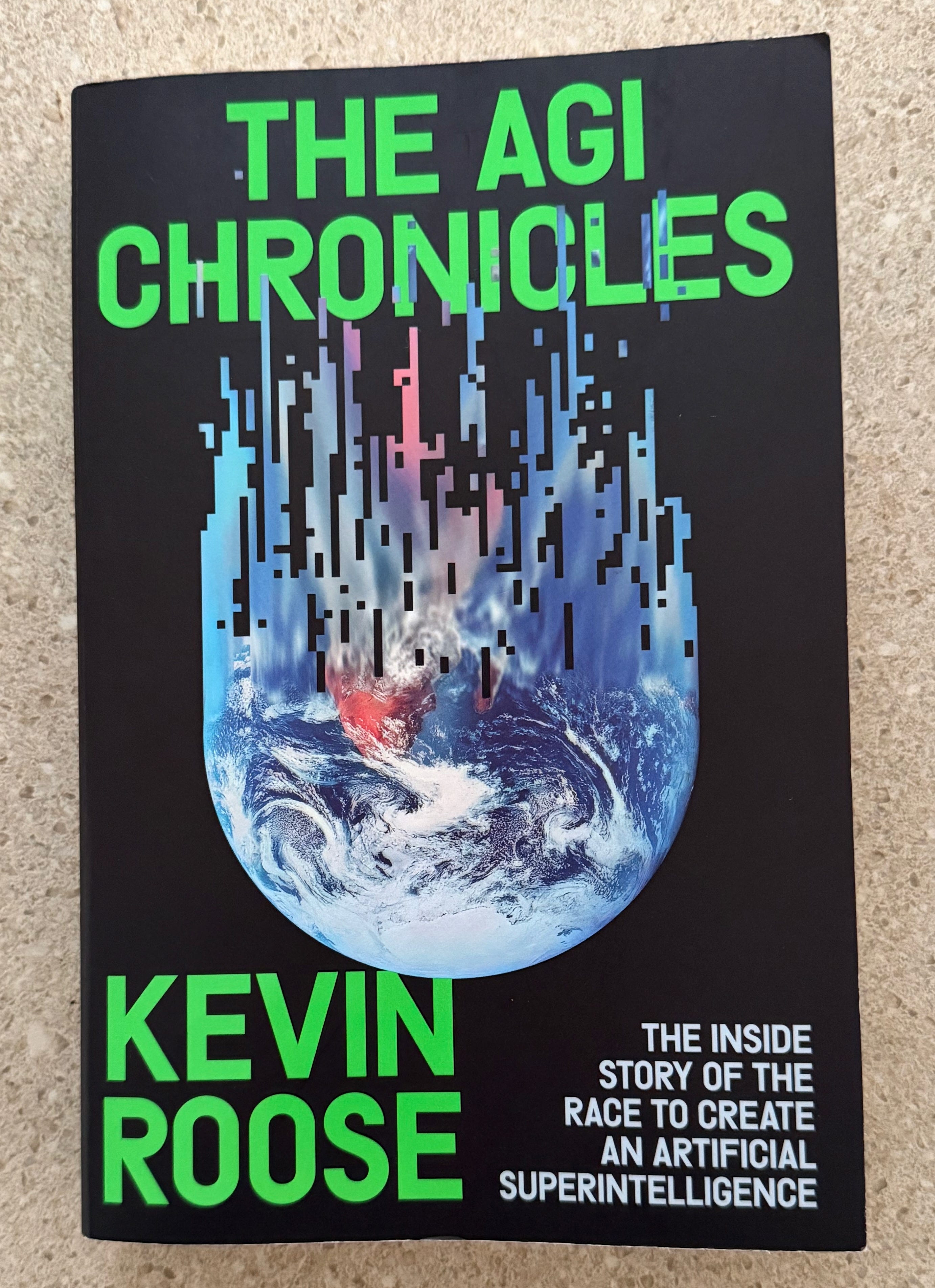
Disclaimers: I am a big fan of Kevin Roose’s work, both the written kind and from his podcasts, Hard Fork and more recently Machine Gods. Much like Kevin, I have in recent years moved from being a skeptic to essentially being AGI-pilled, though what exactly we mean by that is not at all as simple as people think. In addition to all that, I’m a computer scientist by training, work with these tools every day, and advise companies on them, so it’s fair to say I’m not a neutral outside observer.
This is not your typical book about AI. Roose himself said that he could have titled the book “Fuck That Guy” instead – while The AGI Chronicles is indeed a chronicle of sorts, the alternative title will tell you more about the emotions running underneath all of this.
At its core, this is a book about the people building large language models. Not just the technology, although by necessity you will learn a lot about the technology too, but the people, why they are doing what they’re doing, what they think of each other, and how they view the world.
This is a remarkable book and you should read it, because this technology is, whether you like it or not, disrupting a great many things and industries, and I think it’s good for everyone to know what kind of people it’s coming from (and no, they’re not ‘evil’).
Accounts like this usually reach us decades after the events took place – but this one reaches us while the race to AGI is still being run, faster every passing day. Roose said he wanted to write it before the record vanished, and he was 100% right in doing that – these are private companies, messaging platforms set to auto-delete, communications policies becoming increasingly tight-lipped, researchers too busy to keep notes.
And not least because for this technology, there may be no ‘decades later’.
Kevin Roose is one of the few people covering the tech industry honestly and fearlessly – kind of Kara Swisher-ish in that, so it’s no surprise the two are friends.
The engine of AI is sweet & bitter
One of the things that becomes clear is that the motives of people seeking to build, and help build, AGI varied, and none of them were bad, per se: some “believed in the mystical power of deep learning, and wanted to see how far it could go”; some dreamed of using AGI to solve the mysteries of science; some wanted to prevent an AI apocalypse; some wanted to teach the machines to be good; some wanted to get there first so others wouldn’t, and so on. We may now think “what were they thinking?!”, but I found all of them understandable motivations – not necessarily that I’d agree with them, but that I understood them.
LLMs were also technically sweet (Oppenheimer’s phrase, which Roose borrows), and as a computer scientist, I can understand the pull of that too. I, too, have been dreaming of AGI since I was a kid, with Data from Star Trek: The Next Generation the #2 role model after Picard, and tried building a home assistant that could understand speech over 30 years ago. Spoiler: the tech wasn’t ready. It is now.
There was one way the path to AGI could have been harmonious; one that brought people together to unite under a common cause, working collaboratively and for the betterment of mankind.
We are not on that path.
Instead, we are on a path where Amodei of Anthropic and Altman of OpenAI hate each other, Elon Musk keeps changing who he hates, Google Brain and DeepMind spent years feuding inside Google, and many of the arguably most important moves in the industry have been sparked by bitterness, jealousy, and vengeance.
What could possibly go wrong?
Relentlessness, for one.
Relentless is an important word for a couple of reasons. It is, apparently, the favourite word of DeepMind’s Demis Hassabis. It appears that the race to AGI has no finish line, and everyone is stuck in a relentless competition, running flat out just to stay where they are.
But the agents we are building are also, intentionally, relentless. When Roose finally sets coding agents loose on his own laptop, he calls them “creative, careful, and relentless”.
And the thing is, we want them to be relentless; an agent that gives up early is a bad product.
Relentlessness in AI is three different things at once. It is a blessing: a system that doesn’t get bored, tired or discouraged will find solutions a person would have abandoned by lunch. We see examples of this in the book. It is a curse, for the same reason: tell something to get there no matter what and it may take a route you never imagined and would never have approved. We see examples of this, too. And it is necessary. If we want these systems to work on problems we can’t be sure have a solution at all, the agents have to be relentless, and not give up. As you can imagine, this is a space fraught with all kinds of risks. Relentless people built relentless machines; to solve the hardest problems, that is exactly what we asked for.
Does it matter what kind of people are building our tools? Can machines of loving grace be built by humans of bitter spite?
It is an important question and I don’t know the answer, but it seems like at a minimum that will throw some spanners into the works.
While doing it, we are often rewarding brilliant, difficult people with obscene wealth. Sometimes these people come across as very not good. This, however, I would say is a systems issue, not an AI issue. This pattern is by no means unique to AI.
The need for speed
Roose describes how there were three groups of people, who, by 2022, had all agreed on one thing: speed is of the essence. The scientists wanted to move fast because “the puzzle was finally yielding to their methods”. The seekers – who thought we are “witnessing a turning point in the history itself”; the Kurzweil apostles – wanted to move fast “because the singularity was near”. And the survivalists – who “viewed AGI as an asteroid hurtling toward Earth” – wanted to move fast because they were running out of time to solve the alignment problem.
Even compassion could be a reason for wanting to move fast; DeepMind’s Pushmeet Kohli felt powerless when, despite the protein-folding breakthrough, they couldn’t yet solve real-world problems:
“We’d achieved this incredible scientific milestone, but we still couldn’t help this one child who needed it right now.”
And then there was DeepSeek in early 2025, which added another argument for speed: “the West had enemies and couldn’t afford to fall behind.”
This relentless – there is that word again – aim at building AGI as fast as humanly possible, and then a little bit faster, is why we are now witnessing the externalities. When the PS5 that we want to run GTA VI on costs 50% more today than it did six years ago (unheard of in the world of tech) it’s because the demand for AI chips has drowned everything and prices of all electronics have gone through the roof. It’s because of AI you can’t find an electrician if a data centre is being built in your country. And so on. What people see from our drive towards AGI is mostly negative, so is it any wonder they want to put a stop to it?
But it’s not slowing down – if anything, things have sped up in just the few months since the writing of this book finished.
I said earlier that harm was nobody’s driving motivation for AGI, but that doesn’t mean these problems were unforeseen. Extinction and labour concerns were there, vocally, from the very start. So were worries about misinformation. Energy and data and bias concerns were vocal inside Google in 2020, when the vast majority of humanity had no idea what was being developed.
There was no lack of foresight. We saw most of the harms ahead of time, but chose to go ahead anyway. As the race tightened like a ratchet, it was those voices for safety that were, little by little, pushed aside.
None of this was inevitable
For better or worse, nothing in technology is inevitable. Technology of any kind improves only when thousands of people work very hard and have the resources to do so. Effort and capital allocation are both choices:
They were wrong about one thing, though: AGI was not inevitable. Machine intelligence did not emerge out of the primordial ooze, or through a Darwinian process of natural selection, the way human intelligence did.
Transformers, LLMs, the scaling laws, reinforcement learning, agentic coding-all of it was invented, developed, and commercialized by a few hundred people. If those same people had gotten obsessed with supersonic airplanes or regenerative farming, we might be living in a world without ChatGPT, Claude, or Gemini, a world where Al still meant robot vacuums and recommendation engines.
The word ‘inevitable’ is the insiders’ own justification, and it’s part of what enrages the public.
Whether AGI (or ASI) is achievable is almost beside the point here – the definitions are so slippery, varied, and vague, that they are not helpful. In addition, they get constantly redefined, with plenty of people kicking the can down the road as soon as previous definitions are met. As Roose points out, if you showed a top model from 2026 to someone in 2017, they would without a doubt say that this is AGI.
To me, it doesn’t really matter. We are in an age of miracles with the technology we have developed. It’s just that not all the miracles are good. One could argue most of them aren’t.
Roose closes this extremely informative, funny, insightful, but remarkably neutral (in that way very journalistic) book by wishing for a slow takeoff: that the move from human-level AI to superintelligence will unfold slowly, over years or decades, giving us time to course-correct.
I wish for that, too.
I don’t necessarily see that happening, but even if it did, 2027 is going to be a wild ride.
Rating: 5 out of 5
Dog-ear index: 12.2
Who is it for: As stated at the start, I’m biased, but I’m just going to say everyone. This book provides the context, nuance, and recent history we could all use when having opinions about AI. A few chapters get technical, so heads up on that, though you don’t need a CS degree to follow them. It’s told from the inside, by someone the insiders talk to. It’s also, very much by necessity, not just US-centric but SF Bay Area-centric. None of that is a reason not to read it; just know what you’re getting into.
[reminder: I highlight important parts of the books I read, and dog-ear the really important pages. The dog-ear index is simply the average number of dog-eared pages per 100 pages]
Product link for reference only; please support your local bookstore where possible: https://www.amazon.com.au/AGI-Chronicles-Inside-Artificial-Superintelligence/dp/1398555320/