

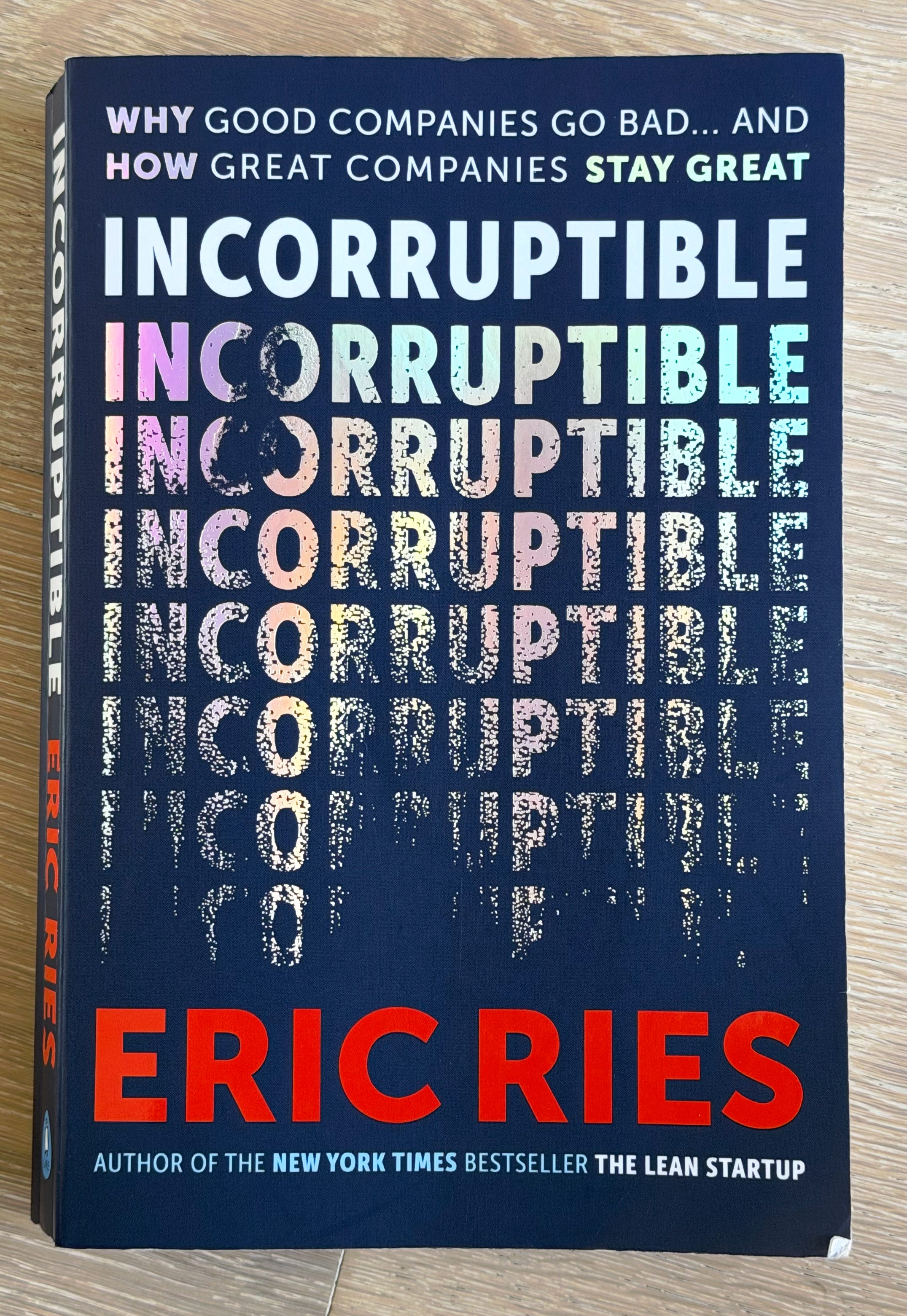
The order in which we learn things matters more than we’d probably like to admit. The works I’d been exposed to leading up to Incorruptible had heavily biased my views, and if I had listened to them any more, they might have dissuaded me from reading it altogether.
I’m glad I didn’t skip it. One of the recent influential books I read on this general domain was James C. Scott’s Seeing Like a State; it was followed up by Dan Davies’ The Unaccountability Machine, and then, most recently, by George Monbiot and Peter Hutchison’s The Invisible Doctrine.
They all built a certain kind of scaffolding. Seeing Like a State showed how big systems ignore (or even in the best case, flatten) whatever can’t be measured. Davies’s frankly a little horrifying book illuminated how we’ve engineered organizational structures so that nobody is accountable for decisions. Then Monbiot and Hutchison took an axe to the whole ideology running the show.
And that’s just the recent stuff. As a child of Star Trek, I was always infused with a kind of dream of post-scarcity economics that was antithetical to the capitalist system we find ourselves in; I’d probably quietly hoped for it to be taken down for decades.
So anyway, by the time I opened Eric Ries’ Incorruptible, I had more or less come to the conclusion that our current flavor of capitalism was both working exactly as designed, and that the design was evil and a huge part of the problem.
So, in the interest of bias disclosure: I went in expecting a fluffy business book about building allegedly ‘incorruptible’ companies that would then be corrupted in the next blink of an eye.
My first reading note, a few pages into the introduction, reads in full: “this story seems bullshit.“
Nice, Sami, a very dispassionate analytical read of the book.
Except that I stand by that note – but I was wrong about the book.
Many may know Ries as the Lean Startup guy. He starts the book with something like an apology: “I taught people how to build something worth protecting—but not how to protect it.” Eh. Still not convinced.
However, what followed was the most practical book about the structural rot in modern capitalism I’ve read – and more importantly, how it can be fought. To my surprise, it turns out it can be fought.
Naming the evil(s)
Ries coins a bunch of terms in this book. I’m usually not particularly happy about authors doing that, but in this case they kind of grew on me over the hundreds of pages. The chief villain is financial gravity: “the psychological pressure that shapes behavior and, eventually, values based on the desire to succeed at future transactions.” Whoever controls capital, livelihoods or valuations exerts a pull, and over time everyone tends to bend toward it.
It’s a force “that no one controls but everyone obeys.” Invisible hand indeed, and not a good one.
The connections to the previous reads are almost uncanny.
“Nobody seems to be in charge,“ Ries writes, which could just as well be the summary of Davies’ entire book. “The gravity stayed invisible, just the way it likes,” he writes later, which is something that Monbiot said in other words. Scott’s work looms over the 3M chapter, where an outside CEO imposed Six Sigma on the research labs: “Researchers who’d spent decades exploring without permission now had to justify every experiment.”
I’ve seen first-hand how fast that kind of process kills innovation and exploration.
That CEO, James McNerney, went on to run Boeing.
Do we all know what happened at Boeing after? Yeah, not great stuff. I hadn’t connected those dots before. Sometimes individuals can indeed have a catalyzing effect – for better, and for worse, and for much worse.
It rings true from the inside in other ways, too.
Ask CEOs what changed most after their IPO, Ries says, and the answer is always the same: “Every employee starts watching the stock ticker.” I can attest to that from both Nokia and Telstra; while I wasn’t at either at IPO, I did witness far, far too much attention being paid to the share price. Nobody cared, except we were forced to care, with KPIs and STIs being tied into it.
I love some practical tools!
What sets Incorruptible apart from is that Ries spends most of the book on what to actually do. The toolkit covers things like a public benefit corporation charter (so directors are legally allowed to weigh mission against short-term returns; PBC and B Corps, btw, are two very different things), to a board mission pledge (because “we demand less commitment from boards of directors than we do from nurses”), to tenured voting, and to what he calls the spiritual holding company: a separate, perpetual entity, such as a foundation, purpose trust, co-op or employee trust, that appoints directors and vetoes mission-critical decisions while investors keep the economics. “What unites them is their function, not their form.“
Another confession: I’m not normally a fan of business books built out of case studies. The case studies tend to be the same tired ones, repeated uncritically, with lessons we’ve heard a hundred times. Here, the case studies are essential, because the argument depends on seeing this work at scale, for decades: Costco, Novo Nordisk, Bosch, Patagonia, Mondragon, credit unions, and Johnson & Johnson’s Credo and its slow erosion. I’d heard of some of them – a great deal about Patagonia, for example – but the details of many others were unknown to me.
And that pragmatic, concrete guidance and proof that it could be done, and it has been done, is what started chipping away at my post-Monbiot fatalism.
The systemic critiques I’d been reading treat the system as a monolith and have remarkably little to say about the enormous outliers sitting in plain sight. Ries: “Yet here are thousands of companies, worth trillions of dollars, proving that everything we’ve been taught about ‘necessary’ corporate governance is merely one option among many.”
Rock solid all around? Not so fast.
That’s not to say I would have been wholesale enamored with the book. I found myself wincing a few times, and going really? a couple of other times. Ries sometimes reaches for the lyrical (”magnetic powers of attraction“), and treats organisations as “an emergent intelligence, every bit as alive as you or me. A superorganism.“ I put question marks in the margin there.
The word spiritual will make plenty of CFOs wince, too, though he defends it quite well.
Then there’s fiduciary duty, something that deservedly gets a very harsh treatment. Ries tells founders that if Philip Morris offers a dollar more per share, “most governance experts believe“ the board must sell: “It’s an ironclad legal requirement.” My note on that page is not printable. Upon checking, the law is a little less ironclad than he makes it sound. Even in Delaware, a board can generally refuse an unsolicited bid unless it has already decided to sell, and his headline example, Vectura, was a British company whose directors are legally required to weigh employees, communities and the environment.
Does this translate to Australia?
One of the challenges of such books offering practical guidance is that it’s written for a certain target audience: American, in this case. Ries writes with American law in mind for Americans. Naturally I wanted to know how much of if it is applicable here, so I did some digging. Short version: the private-company playbook translates well; his listed-company playbook less so.
What I found was this, and perhaps people who know better can correct me where this is wrong:
Directors’ duties leave room for purpose. Duties are owed to “the corporation”; there’s no direct equivalent of Delaware’s Revlon sale-of-control rule, and the AICD’s 2022 guidance says directors can and should consider stakeholders. Shareholders remain central, but long-term interests count. When an Australian board says “fiduciary duty left us no choice”, we should scrutinise whether financial pressure is being presented as legal necessity.
Shareholder power is stronger here, which cuts the other way. Public-company shareholders can remove directors by simple majority; holders of 5% of voting rights can require a meeting; two remuneration strikes trigger a separate spill vote. Board-imposed US-style poison pills are largely unavailable. The ASX’s ordinary rules restrict super-voting shares, though not trust ownership itself. Atlassian’s Nasdaq structure, with ten-vote founder shares, would not comply with those ordinary listing rules.
There’s no Australian public benefit corporation. B Lab’s proposed benefit company legislation never reached Parliament, and it abandoned the campaign in 2020. Australian B Corps instead must embed purpose and stakeholder provisions in their constitutions. Those are legal commitments, but not permanent mission locks. Private companies can strengthen protection through mission-holder consent requirements. Ries’ distinction between structure and certification still leaves me less reassured by the badge, although stronger protections are available.
Spiritual holding companies exist here. Thankyou is wholly owned by a charitable trust; Sanitarium by the Seventh-day Adventist Church. Goodstart Early Learning emerged when a charity consortium acquired 678 centres from the wreckage of ABC Learning: Ries’ golden-goose story run in reverse. What we lack is a straightforward domestic equivalent of Patagonia’s non-charitable purpose trust, since such trusts are generally invalid here. Charitable ownership remains available.
Our mutuals have useful tools - and cautionary tales. The 2019 reforms enabled eligible mutuals to raise equity without demutualising; co-ops had separate outside-capital mechanisms earlier. AMP was a mutual from 1849 until 1998. Twenty years later, it faced the Hayne Royal Commission over fees for no service and misleading the regulator. It fits Ries’ catalogue of failures, without proving demutualisation caused the misconduct.
Our patient capital has a financial mandate. Ries wants citizen shareholders, not tourists. Super funds invest workers’ savings over decades, making them natural candidates. Yet trustees must act in members’ “best financial interests”. That permits long-term stewardship, including attention to financial risks from climate change, but a social mission alone is insufficient justification.
The core lessons for Australian founders are still valid: lock the mission in before you list, or don’t list. As he puts it: “Before, it was too early. Now it’s too late.”
Stuff is getting stress-tested in real time
Ries’ showcase contemporary case is Anthropic, which he advised as it set up its Long-Term Benefit Trust (he’s open about that, and about founding the Long-Term Stock Exchange). The trust holds a special class of shares that elects directors, and since April its appointees have made up a majority of Anthropic’s board.
The case is now being stress-tested in real time: in August one trustee left the trust to join the company as an executive, and recently reports emerged that the co-founders want 50.1% voting control ahead of an IPO, with the trust still choosing most of the board. I’m left wondering what the trust makes of all this, and how the company’s insistence on staying at the frontier in order to shape it is holding up in practice.
Ries also highlights that none of the frontier labs have traditional company structures;
Not one of these companies accepts the standard governance defaults. Though they disagree about the path forward for AI, they all agree on one thing: Standard “shareholder primacy” governance would be catastrophic for stewarding this transformative technology.
I’m somewhat unconvinced that what we’re seeing unfold is responsible stewardship.
Ries’ framework anticipates the problem: “The solution is to combine many overlapping protections.” In aviation safety we call that the Swiss cheese model. No single slice is solid, which is why you need several, and why you keep checking where the holes line up.
I’m not sure if we have enough slices to pile up for some companies.
Going big
In the final third of the book, Ries goes big: protecting individual companies isn’t enough, and “It will require reinventing how we build financial, political, and civic systems.” I didn’t quite expect this level of engagement, but I’m here for it.
This lens brings us back up to systemic issues covered in the other books, but even here, Ries provides actual concrete guidance forward. I appreciate that.
On the table are standards bodies, credit unions, civic tech like Pol.is and, be still my heart, aviation, with the NTSB and just culture as the template for the patient safety board American healthcare still lacks. He doesn’t shy away from the need for societal reform; he just refuses to use it as an excuse to do nothing in the meantime. “Anything can be different if we want it to be“ has put John Kampfner’s Braver New World at the top of my reading pile, so that’s up next.
Incorruptible is also exhaustively referenced, with an implementation guide, templates and a community (I joined). There’s an index, too. All things I appreciate.
The last chapter opens with one of my favourite phrases: “You’re not stuck in traffic. You are traffic.” Its closing argument is aimed squarely at the reader I was when I started: “When they argue for the inevitability of the status quo, they’re trying to shape the gravitational field. If everyone believes reform is impossible, then this becomes true.“
We can’t let ourselves believe change is doomed, because then it is.
Rating: 5 out of 5
Dog-ear index: 14.3 (one of the highest ever)
Who is it for: Founders, before they sign anything their lawyer calls “standard”, or “best practice”. Board directors, and anyone who has ever said “fiduciary duty left us no choice“. Readers who, like me, have read themselves into fatalism about capitalism and need to see the outliers. Australians should bring a lawyer and a pinch of salt for the US mechanics; the exact mechanisms may not directly translate, but the principles 100% do.
[reminder: I highlight important parts of the books I read, and dog-ear the really important pages. The dog-ear index is simply the average number of dog-eared pages per 100 pages] Product link for reference only; please support your local bookstore where possible: https://www.amazon.com.au/Incorruptible-Good-Companies-Great-Stay/dp/0241692024
Thanks for taking us on this interesting journey with you Sami. One thing I kept coming back to is how few publicly listed companies are B-Corps. This is surely because to become one they have to amend their constitution and put it to a vote - by the very shareholders whose status and personal wealth depend on their interests taking precedence over other (equally important) priorities.