

We’re starting to talk about the risks of cognitive degradation when people over-rely on AI; losing existing skills is only a part of the concern, as hiring managers are seeing newcomers who haven’t formed some critical skills in the first place, having grown up leaning on the tools.
The more advanced organisations even acknowledge this in their AI strategies, usually under “risks and mitigations”, and it says something like:
we will ensure our people retain critical human skills
Even so, most still leave the obvious question unanswered:
Which ones?
When asked, the common answer is something along the lines of critical thinking, probably. Judgement. Creativity.
You know, the uniquely human stuff.
Pressed on what would actually go on their list, and what evidence would put it there, the conversation is usually ‘taken offline’ to a discussion that never happens.
Unhelpful.
Losing skills is what enabled civilisation
Losing skills is not new, and it is not automatically bad. Most of us rely on other people to grow our food and make our clothes. Specialisation lets us humans do far, far more collectively than we ever could dream of individually.
But greater productivity never guaranteed greater human capability. In 1776, Adam Smith made the case for the division of labor, but also flagged that repetitive work could erode intellectual capacities; he warned that a person whose working life consists of a few simple operations “has no occasion to exert his understanding“ and loses the habit of doing so. Was a bit ahead of his time, that guy. Or alternatively, we’ve been slow at getting the memo.
His proposed remedy included education.
Plenty of skills have gone in the past century; the twentieth century swapped many more physical ones for more abstract, cognitive ones, and we’ve been fine. -ish.
Our wave today is different in some key fundamental ways.
The skills now on the chopping block are the ones the school was built to protect, and they are being attacked at the source.
We are beginning to amass evidence of this cognitive skill degradation. And in research on AI-assisted reasoning, higher self-reported AI literacy was associated with less accurate self-assessment. Feeling more capable and being more capable can come apart.
In a recent interview with Ezra Klein, Nvidia’s Jensen Huang said he doesn’t think people losing basic math skills matters, that people would become better systems thinkers. I have some thoughts on that, but okay.
He added, on skills, that “We’re going to discover new ones. Just maybe not those. There are a lot of skills that don’t matter.”
Here we are again: which skills, exactly?
Nobody seemed to have an answer beyond the superficial platitudes mentioned above, so I went looking this year. One hundred and sixty literature searches across cognitive science, human factors, labour economics and social psychology later, I discovered a candidate skills list, but also a couple of unexpected threads of evidence.
First, there is no such thing as just staying sharp in general. You can’t just do one hard thing and assume the capability carries over to different skills. The so-called far-transfer literature is kind of brutal: practising one cognitive skill protects that skill and its near neighbours - and nothing else.
Whatever skill you want to keep, you have to keep that, specifically. And worse, you cannot keep very many skills.
Second, the strongest evidence points at one meta-skill: noticing when the machine is wrong. Doing so depends on knowledge of the work being done, and it can erode quietly, because reliable automation will conceal the loss until something goes wrong. Bainbridge called it one of the ironies of automation in 1983: the better the automation, the less practice the person who has to catch its failures ever gets.
Piling on the ironies, people fundamentally suck at watching reliable systems for rare failures, something aviation has grappled with for decades.
But the research also uncovered a list of skills that makes this discussion much more concrete than it often is. Here are three of the 14 candidates I identified:
Sustained attention and comprehension. The ability to follow a difficult argument and reconstruct what it actually says, beyond the executive summary.
Judging evidence. The ability to check whether a claim follows from its sources, and recognise what would change your conclusion.
Independent explanation. The ability to build and explain your own reasoning, including to someone affected by the decision.
Each still needs to be specified for the work in question. For a team using AI to assess suppliers, judging evidence might mean spotting that a recommendation relies on an expired certification, then explaining whether that changes the decision.
Possibly the most common safeguard organisations have in their AI policies, “we have a human in the loop”, offers little reassurance unless that human retains the capability, skills, the time to do the checking - and the authority to challenge the system safely.
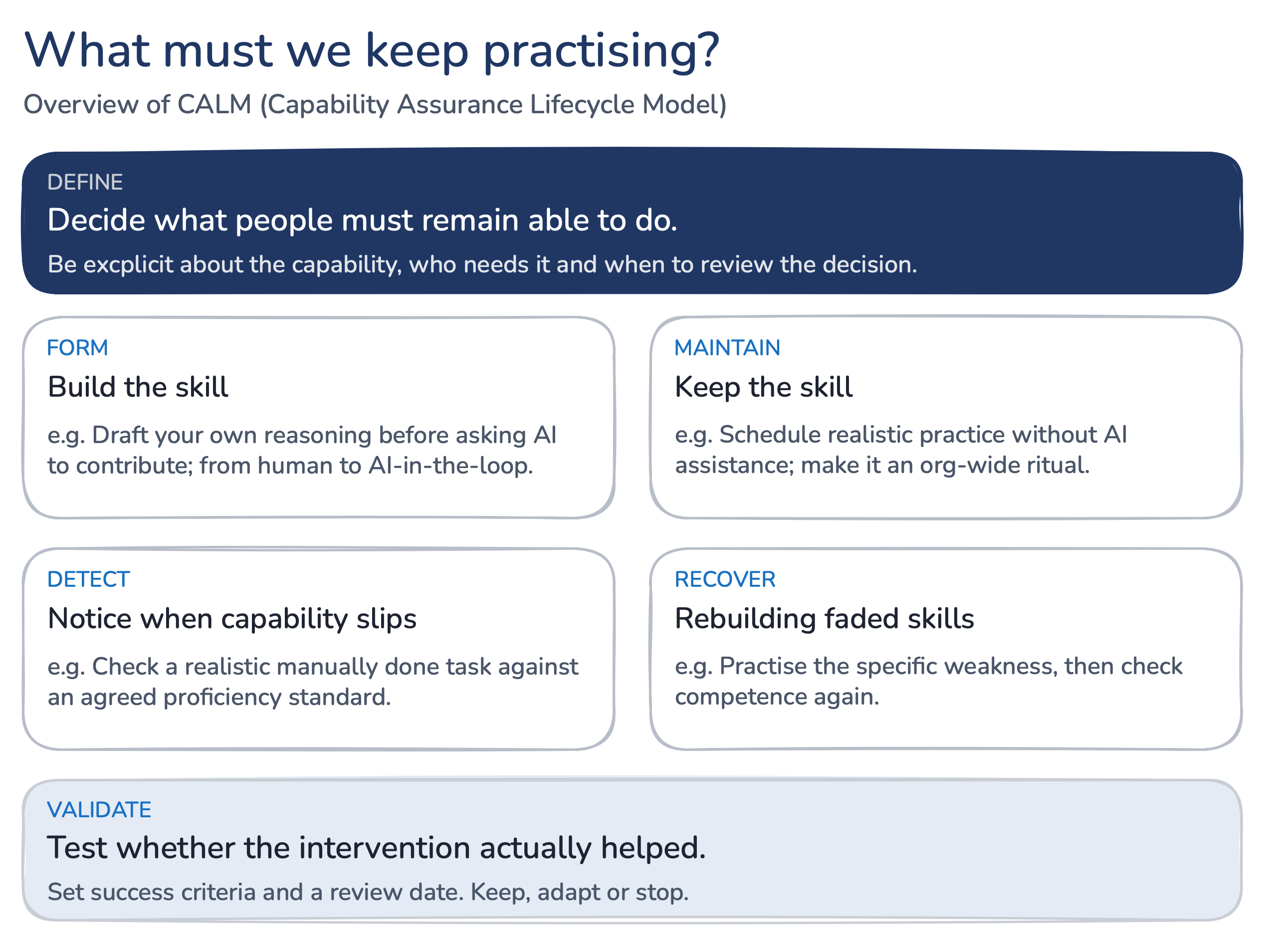
At Transition Level, I’ve been building CALM: the Capability Assurance Lifecycle Model. Yes, it was named using the time-honored abbreviation-first method. It starts by being explicit about what skills, exactly, must stay sharp, then addresses how these skills are formed, maintained, tested and recovered.
Start with one task your team is handing to AI. Name a capability people must retain, what depends on it, and how they will keep practising it. Then decide what would demonstrate that they still can.
And if you want help mapping one team’s essential capabilities and testing how to preserve them while you bring AI tools on board to make things better, that is what you can hire me to do. Let’s talk.