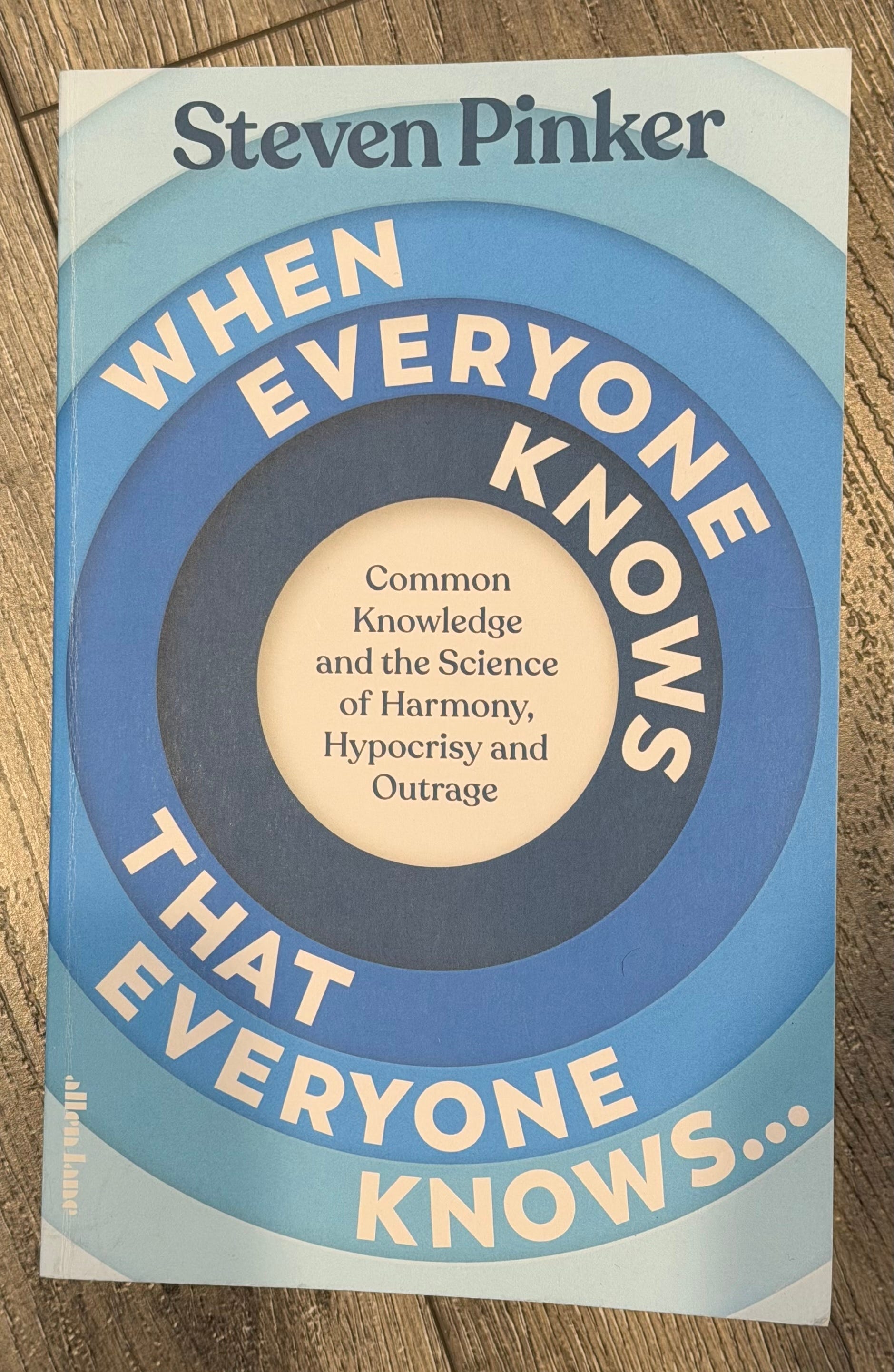
Review: When Everyone Knows That Everyone Knows...
Review of "When Everyone Knows That Everyone Knows… - Common Knowledge and the Science of Harmony, Hypocrisy and Outrage” by Steven Pinker
What’s the difference between a secret everyone knows and common knowledge? Everything, as it turns out. Steven Pinker’s “When Everyone Knows That Everyone Knows... - Common Knowledge and the Science of Harmony, Hypocrisy and Outrage“ explores how this seemingly subtle distinction quietly orchestrates everything from traffic norms to taboos, from laughter to cancel culture, and from status games to political pile-ons.
What is common knowledge anyway? It’s when we all know something but also know the other person knows that. As many of us over-thinkers understand, this can lead into an infinite loop – but does he know I know he knows, and so on, ad infinitum – and few of us can think deeper than five layers of that. Thankfully, we rarely need to.
Why is common knowledge so important? To capture the essence in one quote:
“Once something is not just known but known to be known, it can rewrite the rules.
It can change the collective understanding of how to carry out one’s affairs.”
It’s not enough for something to be true or even widely believed – real social power comes when everyone knows that everyone else knows it; when that happens, whether whatever people know is actually true kind of becomes irrelevant.
Common knowledge also explains why innuendo works - what’s plausibly denied isn’t the intended meaning but common knowledge of the intended meaning. It’s why eye contact is so powerful. And it’s why social media mob violence feel so relentless: when it’s common knowledge that someone has breached a norm, people feel it must become common knowledge that they are punished.
And there we have another insight into why social media is so damaging, and why Gen Z is so anxious; despite unprecedented connectivity, this generation - increasingly along with the rest of us - lives under what Pinker calls a “surveillance regime where peers can snitch to ‘bias response hotlines’ about their ‘microaggressions,’ and a corps of offense archeologists can dig through years of social media posts to unearth shards of bigotry.” The isolation is because of the kind of perverse connection social media creates.
Not everything should be public, and not everything we say or do should remain on record. Pinker traces this dynamic back to Alexander Hamilton’s observation about the Constitutional Convention: closed-door deliberations allowed genuine debate, but “had the deliberations been open while going on, the clamours of faction would have prevented any satisfactory result.“ Too much public knowledge constrains decisions before they’re made, and I can’t help but think that this is one of the reasons why Western societies can’t seem to make any long-term decisions anymore.
On cancel culture, the numbers from university settings are frankly batshit crazy: a majority of faculty under thirty-five support shutting down speakers they disagree with, and a fifth support students using violence to prevent offensive speech. And this is at universities; institutions ostensibly most comfortable with free speech! The mechanism Pinker identifies is chilling - once it becomes common knowledge that someone has transgressed, individual motivations shift from moral judgment to performative condemnation. Like children joining a playground mob to avoid becoming the target themselves, each denouncer may be driven more by self-preservation than conviction.
Speaking of children, Pinker notes that blaming people for outcomes they never intended “is a mindset that children outgrow by the age of eight, and it’s a major difference between archaic and modern regimes of justice.“ Yet cancel culture routinely regresses to this primitive standard, punishing based on how something might be interpreted rather than what was meant.
Elements of the book are bound to elicit some discomfort, which is usually a good sign. Two pages are devoted to questions, the mere expression of which may make you uncomfortable. The fact that hypocrisy is kind of necessary is also an uncomfortable thought; authentic relationships, Pinker argues, actually depend on keeping certain knowledge - even reciprocal knowledge - out of common knowledge. A popular T-shirt reads “I’m not rude. I just say what everyone else is thinking.“ But that’s often exactly what rudeness is. We don’t actually want the algorithmic transparency we claim to value.
Pinker reaches back to John Stuart Mill’s 1859 essay On Liberty to remind us why suppressing unwelcome opinions should never be the goal:
For all we know, it might be true; even if it’s false, it may contain a grain of truth; and even it’s completely false, showing why it’s false gives us a sounder understanding of what is true.
The book wrestles with a genuine dilemma: “the demands of rationality always compel us to seek the complete truth“ but “even the most innocent of us has a great deal to hide.” It is, for example, generally speaking ill-advised to inform your manager that you have fantasized about killing them – yet research shows that we all regularly have thoughts that, if made public, would be considered abhorrent or illicit. The tension between our alleged desire for truth and our need for privacy, between transparency and tact runs through everything from intimate relationships to political discourse.
Understanding common knowledge helps explain why certain social movements succeed or fail, why some taboos persist despite widespread private disagreement, and why social media has made our discourse simultaneously more connected and more vicious. The concept and tool itself - common knowledge - is morally neutral, but its effects shape our entire social world.
As a reading experience, I went through a bit of roller-coaster. The first tens of pages was great, but the middle sagged with too many game theory experiments covered in excessive detail – there was a sense of some academic throat-clearing that could’ve been trimmed by 50 pages without losing anything essential. Having chapter summaries would’ve helped, too. Thankfully, the final chapters redeemed everything.
Rating: 4+ out of 5
Dog-ear index: 8.2
Who is it for: Anyone trying to understand why social dynamics online feel so different from private conversations; anyone who’s wondered why cancel culture is so persistent; and especially anyone who thinks full transparency in public or private sphere with the guise of “just being honest“ is always the right answer.
[reminder: I highlight important parts of the books I read, and dog-ear the _really_ important pages. The dog-ear index is simply the average number of dog-eared pages per 100 pages]
Product link for reference only; please support your local bookstore where possible: https://www.amazon.com.au/When-Everyone-Knows-That-Knowledge/dp/0241618835/


Thanks Sami- nicely done.