

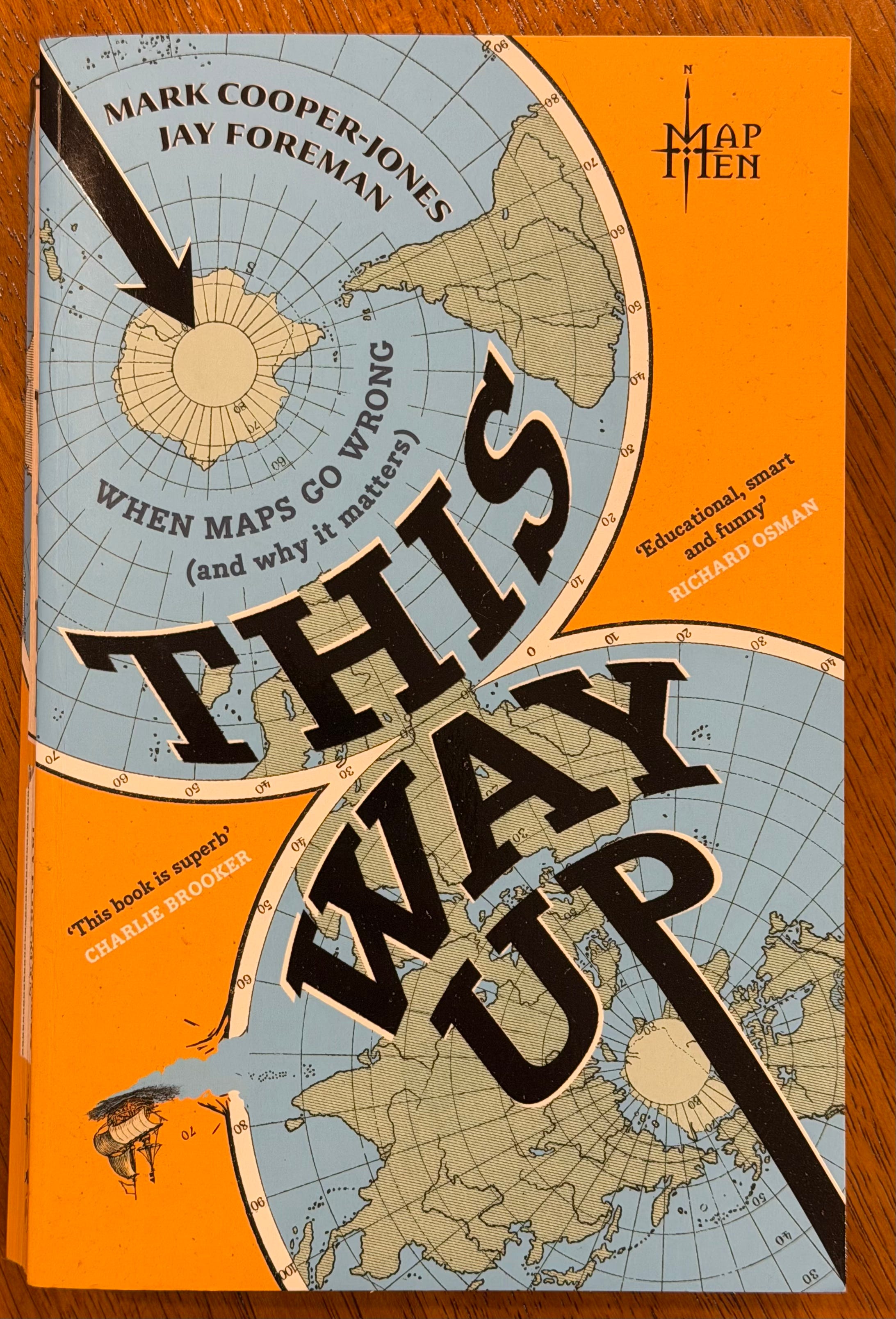
I wanted to love this one. Maps fascinate me and a book subtitled When Maps Go Wrong sounded perfect. So as not to bury the lede, it stings to report that This Way Up went wrong for me in a way its authors never intended: not in its maps, but in its making.
Jay Foreman and Mark Cooper-Jones are the Map Men, a British YouTube duo whose brief explainers are delightful; tight, funny, clever. This book is the print extension of that act.
And that, it turns out, is the whole problem.
The premise is excellent. Every map is a pile of choices, many of which will make it less representative of reality; “no map can possibly be entirely accurate,” and the wrong ones are where the more interesting stories live.
As a tour through cartographic blunders, there are real treats here. The Mountains of Kong was fascinating and something I had not heard of; a phantom range that squatted across roughly forty maps of Africa for nearly a century because everyone kept copying everyone else rather than, you know, going there physically and checking – until someone did and the mountain range made a quiet exit.
Australia’s imaginary inland sea and its invented “Delta,” sketched in by men who assumed the rivers had to drain somewhere grand. Copyright-trap streets are another interesting thing: the gloriously stupid/clever trick of deliberately drawing your map wrong (like little alleys that don’t actually exist) so that if the error shows up on a rival’s map, you’ve caught the thief red-handed.
Japan numbering its blocks instead of its streets. India’s tens of millions of roads with no names at all. I smiled. I dog-eared. Good stuff.
But charming factoids rarely make a book, and this is where the execution turned lazy. There are tens of pages of a fake true-crime podcast transcript, the “Deadly Shortcut,” rendered in full with stage directions and a parody sponsor read. I could not care less about reading a podcast. It’s bonkers.
Elsewhere, whole stretches are handed to dramatised, supposedly-historical letters and dialogue, invented wholesale and presented as period colour. I appreciated none of it.
Only one of these unusual elements caught my attention in a positive way: the book came with a QR code to a Spotify playlist as a soundtrack. I had never seen one in a book before, so that was kind of cute.
However, did I actually listen to it? No. So there’s that.
I finished the book at times entertained, at times annoyed, but having learned little of importance beyond a few factoids. The premise promised insight into how maps shape what we believe; what I got was a clip show of amusing errors, narrated in a register that never decides whether it’s a textbook or a panel quiz. This would have been better either as a leaner book (the same concept at two-thirds the length, minus the cosplay) or a book that took itself and the subject matter more seriously.
To its credit, the book finally drops the act in the closing chapter and makes an actual argument: that outsourcing navigation to a glowing blue dot has quietly dulled us; that the hippocampus does measurable work, and that a 2024 BMJ study found career navigators like taxi and ambulance drivers had the lowest rate of Alzheimer’s deaths of the 443 occupations it examined - tellingly, bus drivers and pilots, who follow fixed routes, showed no such effect.
The cure, the authors note, is free: turn the thing off and get lost.
Stop reading this book immediately. Put it down, and go and do the thing that we as a species have been doing – and been really good at doing – for millions of years. And have an absolutely lovely time while you’re doing it.
Get lost.
That I registered, and violently agreed with, dog-eared, and intend to honor.
It’s a small, good idea at the end of a book that mostly wouldn’t sit still long enough to have one. I loved the concept. I did not love what was done with it.
Rating: 3 out of 5
Dog-ear index: 3.7
Who is it for: Map Men fans who want more of the act in print, and casual map-curious readers who enjoy trivia and don’t mind theatrics. Not for anyone hoping to actually understand cartography, and definitely not for those of us who’d rather chew glass than read a transcribed podcast or a wodge of invented “historical” dialogue.
[Reminder: I highlight important parts of the books I read, and dog-ear the really important pages. The dog-ear index is simply the average number of dog-eared pages per 100 pages.]
AS COMMENT: Product link for reference only; please support your local bookstore where possible: https://www.amazon.com.au/This-Way-Up-Wrong-Matters/dp/0008710287/