

Learning is one of my favorite hobbies, and reading books is an integral part of that. I’ve always thought, pretty simplistically it turns out, that knowing more = better. I’ve taken it as pretty much my job description.
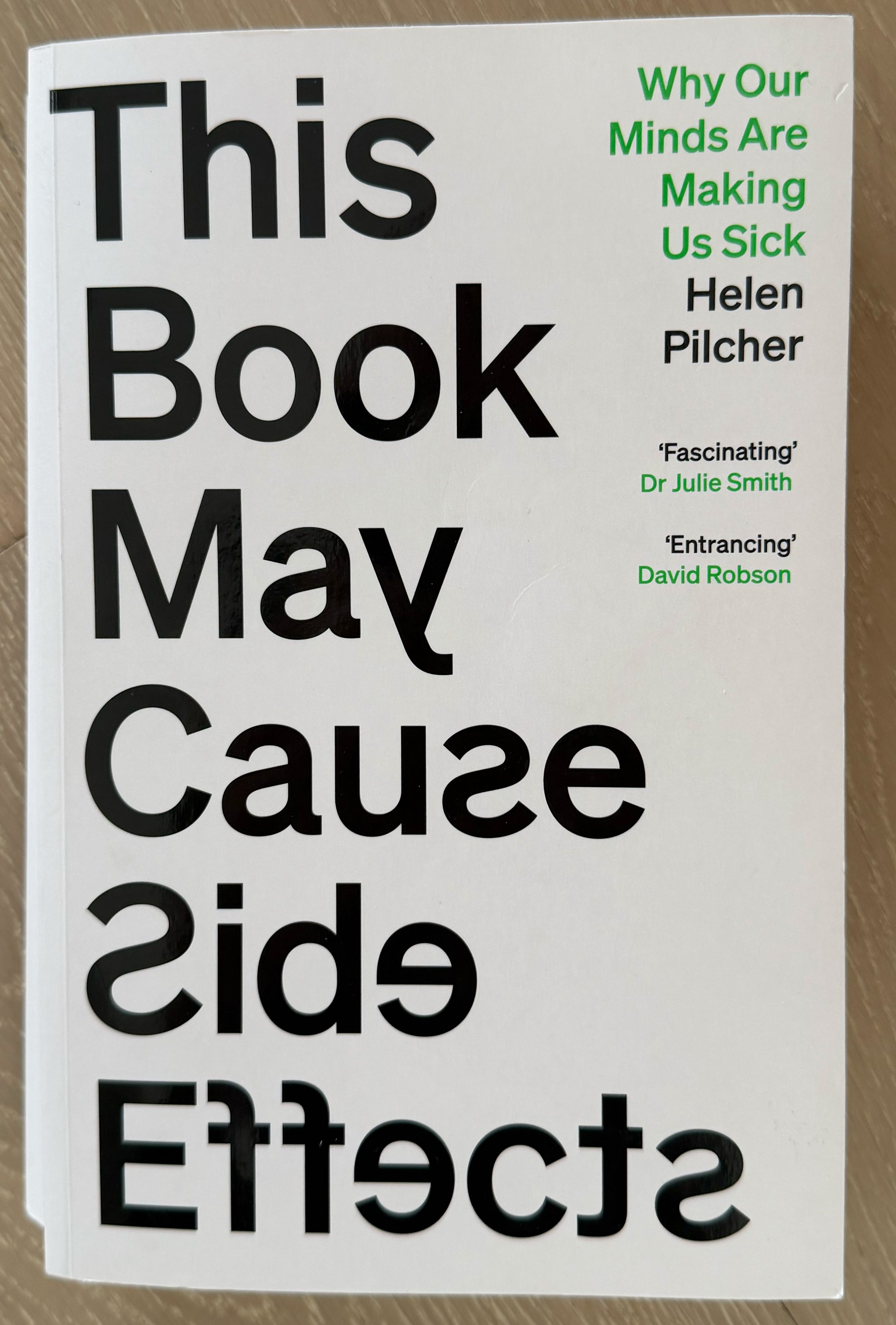
Helen Pilcher’s This Book May Cause Side Effects is the first book that threw some serious shade on it, and made me ask – especially of health information - how much do I actually want to know? Because it turns out that while sticks and stones may break your bones, words can 100% absolutely and definitively hurt you.
In fact, given the right conditions, they can kill you.
The book is about the nocebo effect, which is “the placebo effect’s evil twin“: negative expectations producing real symptoms and real harm.
Setting out to show how important it is in our lives, Pilcher starts by showing that the nocebo effect is likely to be behind the power of curses. Yes, curses. Those things that we thought were relegated to deep dark histories.
But as it turns out, curses can actually be effective – all the way to the target of them actually, physically, genuinely, dying - as long as three prerequisites hold true:
The victim and their family must all accept the witch doctor’s power to kill by hexing.
All previous victims of the hex must have died.
Everyone the victim knows must start acting as though the victim is already marked for death.
There are other cases as well, such as Sam Shoeman, a Nashville man told in the 1970s that he had late-stage oesophageal cancer. He died months later, as expected.
The only catch? The autopsy only discovered only a small, contained tumour in his liver; it turns out his files had been mixed up with someone else’s, and he’d gotten the wrong diagnosis, that he and his family fully believed. As Clifton Meador, the physician who told Pilcher the story, put it: “The man didn’t die from cancer. He died from believing he had cancer.“
Now that we’ve established just how powerful a nocebo effect can be, it becomes easy to understand this is a phenomenon that we desperately deserve to know more about, and that we need to find out more about.
There is nothing imaginary about the nocebo effect
Arguably THE most important thing when talking about the nocebo effect is that none of the symptoms are imaginary. They are real. None of the experiences are made up. In popular parlance and in our culture even, psychogenic or functional can easily be twisted to mean ‘fabricated’, and it’s critically important to realize that is not the case.
The brain generates every symptom we feel, and the ones it generates from unconscious expectation are just as real as any other. Ellen Langer (my review of her book The Mindful Body can be found here), one of her interviewees, goes further: “I say the mind and the body aren’t just connected. They are the same thing.”, a viewpoint I’ve since come to embrace.
Forget the mind-body ‘connection’; we are intrinsically embodied creatures, and pretty weird ones at that.
There’s mountains of evidence of the placebo effect, and a growing body of equally fascinating research of the nocebo effect. It can conclusively be stated that it’s real and incredibly important.
In the British SAMSON trial, people on placebo produced about 90 per cent of the symptoms of the real statins. In other words – most of the side effects are not caused by the drug, but by expectations of the side effects.
Think about this for a minute.
Much of the side effects are produced by expecting the side effects. The nocebo effect is estimated to account for somewhere between 40% and 100% of the side effects.
This has some profound implications. Is full disclosure actually harming us? What if we didn’t know about the potential side effects? Or they were presented differently?
The warning label paradox
If listing side effects causes said side effects, informed consent has a side effect too.
To tackle that, Pilcher recommends better delivery or, failing that, better framing you can do yourself. If a doctor or the label says 20 per cent of people can get headaches, “remind yourself instead that 80 per cent of people do not get headaches.” Ask for “personalized informed consent“: hear about the serious side effects, and skip the trivial ones the conversation itself tends to conjure. Or have the details written down, sealed in an envelope and held by a friend – know just enough when you need to do something about it, perhaps?
Contagion – I’ve seen that before…
Somewhat unexpectedly, I could readily identify with the stories of mass psychogenic illness.
“Technology and MPI have become established bedfellows,” Pilcher writes.
“Over and over again, benign innovations are blamed for symptoms they do not physically cause.”
Ain’t that the truth. In my decades in the mobile industry, I dealt with the EME scares around every new generation of network technologies, and in 2020 with the COVID/5G conspiracy theories, so none of this surprised me as a phenomenon – but the strength did.
In lab tests, self-described ‘electrosensitives’ (people claiming to be allergic to electricity) can’t tell a live transmitter from a dead one. Pilcher’s wind farm material has a strong Australian evidence base, too: Simon Chapman’s audit found that most Australian wind farms had never received a single health complaint, while most complainants lived near a handful of farms targeted by anti-wind campaigners.
“What’s perverse, however, is that, thanks to social media, technology has now also become a conduit for its spread.“ Her case files include TikTok tics, police officers collapsing after touching traces of fentanyl too small to harm them, and Havana syndrome. On the Havana syndrome: Pilcher treats it as mass psychogenic illness, in line with the US intelligence assessments of 2023 and 2025. In June 2026, a month after the book came out, the Director of National Intelligence rescinded those assessments – without making public any new evidence of any potential weapon. Quelle surprise.
Teach your AI tool about nocebo?
It’s abundantly clear that much power and responsibility rests on media, both traditional and the new social media giants. Neither of the camps are treating the power they have with commensurate responsibility or humility, and it’s extra-not-helpful that many establishments have thrown out the window Tom Rosentiel’s Elements of Journalism.
Which brings us to the new kid on the block that increasing number of people turn to for information that can have a strong nocebo effect on us: AI.
By OpenAI’s own figures, over 300 million people turn to ChatGPT for health advise every week – which makes the way it frames risk, side effects, and health information critically important.
Pilcher’s warning about surgeons briefing patients on post-op pain applies to AI in spades, too: “While the aim is to manage expectations, it can instead end up setting expectations.”
A model that lists every possibility “just to be safe” is a nocebo machine at scale; one that tells you what you want to hear is worse. I wonder if “AI psychosis” is, or will be, the next case of mass psychogenic illness.
We might all need to tweak our AI’s custom instructions. At present, my AI assistant’s instructions tell it to be ruthlessly honest with me; Pilcher’s points are making me think I might have to carve out an exception for my own body: accurate information, yes, but perhaps deliberately slanted positive, highlighting the positives, in the hope it nudges recovery the right way.
Motivated reasoning, outsourced.
Is this being a wishful-thinking coward, or fact-based medicine? Maybe a bit of both?
Framing matters a great deal. “80 per cent don’t get headaches” is the same fact as “20 per cent do”, and choosing the first changes symptoms without changing the truth, and should be welcomed, and lead with. Deliberately hiding dangerous warning signs that need action is a different thing altogether, and nobody should be enabling that.
So here’s what I just added to my custom instructions; you may want to do the same, or you may not. I’ll see how I go with this:
My own health: Be aware of the nocebo effect that expectations shape symptoms, so when the topic is my health, lead with the positives: how many people recover, and how fast. Skip “just in case” lists of mild or rare side effects unless I ask. Do not soften or leave out red flags or anything I need to act on. When I’m choosing between treatments, give me the numbers both ways, in absolute terms. If I ask for the full picture, give it straight. Only alter delivery, never the facts.
More research required
This is, effectively, a book about the power of stories we tell ourselves and others. Perhaps appropriately, there are many stories in the book – but sometimes they take the place of evidence. This is arguably just a case of ‘more research required’, as nocebo is a new field of interest.
Nevertheless, the famous wartime tale of Henry Beecher running out of morphine and injecting saline comes with the claim that “placebo morphine was about 90 per cent as effective as the real deal“. The thing is no one has yet found a primary source for this story; its earliest known trace is a 1969 book chapter citing a Beecher paper that does not contain any such demonstrations. What’s going on here? More research needed.
There’s another question mark next to Langer’s work, where some of it is based on very small studies that weren’t peer-reviewed. I still think Langer’s conclusion is right; I’m just less sure her studies show it.
None of this dents the core messages of the book. It is well-researched, and well backed-up. There are many studies quoted, and there is no question of the power of the nocebo effect; we even have fascinating early evidence of how, exactly, that influence pathway works. Still, it’s an emerging field, and much more research is needed.
This is not a permission to go all woo-woo!
When strong evidence like this emerges – that thoughts can and do influence our physical well-being – I’m simultaneously excited and worried. Worried because I can see people drawing conclusions that are far too far-reaching and not actually supported at all. In the heart of many conspiracy theories lies a little grain of truth, which has been misinterpreted and exaggerated well beyond recognition.
There is a clear and present risk that research that shows that thoughts influence our body, can change the course of disease, and can even kill us will lead to an explosion of ‘scientific’ woo-woo of how thoughts can cure cancer and prevent disease.
Let’s just be clear here: that is not the case. Pilcher is is explicit here, too. On mouse studies linking the brain’s reward system to tumour immunity, a field ripe for misuse by the positive-thinking industry, she is blunt:
“Thinking negatively doesn’t give you cancer. Thinking positively won’t cure it.”
Pilcher writes with warmth, humour and a patient’s stake in the subject. I would like this book to be mandatory reading for doctors and policymakers, and frankly for everybody else, too.
There’s an additional bonus in reading the book: since after doing so, you will know more about the nocebo effect than most people, you will escape some side effects.
This sounds flippant, but the evidence backs it up: in a New Zealand experiment, explaining the nocebo effect to people primed to fear wind farm infrasound brought their symptoms back to baseline.
Knowledge can harm you, but knowledge can also help you.
Rating: 5 out of 5
Dog-ear index: 13.5
Who is it for: This is another book that I’d just want everyone to read, but that feels like a cop-out, so let’s go with: doctors, nurses and pharmacists first; then the industry and regulatory side; then health journalists, and other journalists; also policymakers; social media companies (though they won’t care); then anyone who has read a side-effect leaflet and promptly felt half of it.
[reminder: I highlight important parts of the books I read, and dog-ear the really important pages. The dog-ear index is simply the average number of dog-eared pages per 100 pages] Product link for reference only; please support your local bookstore where possible: https://www.amazon.com.au/This-Book-Cause-Side-Effects/dp/1805461443/