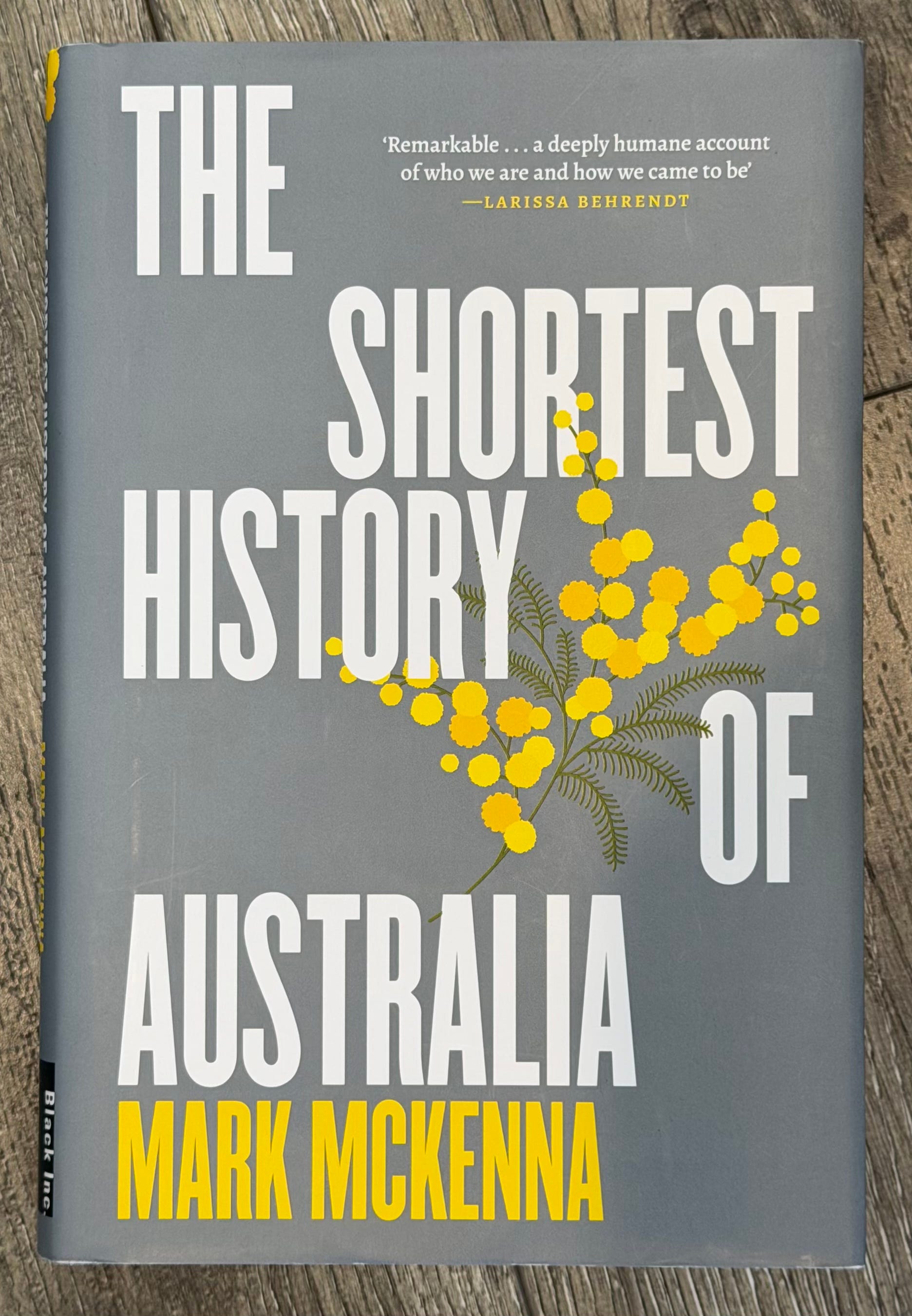
Review: The Shortest History of Australia
Review of The Shortest History of Australia by Mark McKenna
I am not, by nature, a history buff, though as a foresight professional we need to be somewhat familiar with history as well. But nearly seventeen years into calling Australia home, Mark McKenna’s “The Shortest History of Australia” landed on my radar and I’m glad it did.
If you live in Australia, there’s a better than 50% chance that either you or one or both of your parents were born overseas. That’s pretty remarkable. For an immigrant like me, someone who chose this country and has been chosen by it in return, I feel we owe it to ourselves to understand the full picture of the place we’ve made our home, not just the brochure version or the one we engage with in our suburb, social circles, or workplace.
The Shortest History of Australia is the perfect tool for this. It will tell you, honestly, what happened, but more than that, it reframes how you see where you are. For a history book, it’s also mercifully short; noteworthy because they often tend…not to be.
McKenna covers an enormous amount of ground in a compact book, and he does it with an honesty that never tips into either jingoism or self-flagellation. The narrative begins not in Sydney Cove but in the north, with tens of thousands of years of Indigenous history; a corrective to the default European-arrival starting point that still dominates popular understanding.
From there, we get the colonial project with its Christian underpinnings (Cook’s claims were also theological, which was news to me), the shaping of national identity through war and migration, and the slow, painful, still-incomplete reckoning with what was done to First Nations peoples.
There are ugly details to be found not just among the First Nations affairs; Australia is the world’s worst country for mammal extinction. Only Australians could remember the abysmal defeat of Gallipoli as a victory. The learning curve on water and fire management - skills Indigenous Australians had refined over millennia - was, and in some ways still is, embarrassingly slow.
McKenna doesn’t flinch from the uncomfortable facts, and the book is better for it.
Unsurprisingly, the sections on migration and multiculturalism resonated deeply. McKenna captures a striking phenomenon: how migrant views of their home countries tend to fossilise at the point of departure, frozen in time while the country itself moves on. I recognise that pattern; even the language of those who migrated here half a century ago feel like live historical archives. I can only imagine how stupid I’ll sound in Finnish in another decade or two.
He also traces how Australia went from enshrining racial purity at the start of the twentieth century to embracing racial equality by its end, a transformation so dramatic it’s easy to underestimate. Whitlam’s decision to make multiculturalism official government policy in 1973 was pivotal, and the book makes a compelling case that Australia only truly began to feel like an independent country after his election in 1972. The sheer volume of progressive legislation his government passed in just three years is staggering.
Yet McKenna is equally clear-eyed about what remains unresolved. Australia has become one of the world’s most diverse, multicultural liberal democracies, but it is also one of the most property-obsessed nations on Earth, increasingly politically polarised, and, another one of those places where the belief that life will be better for future generations is fading.
One’s postcode remains one of the strongest predictors of opportunity, and levels of sexism, misogyny, and domestic violence remain stubbornly high. The suburbs, McKenna shows, are simultaneously where the miracle of multicultural coexistence is lived out daily and where inequality quietly deepens.
And then there’s the unfinished business. As Australia approaches the 250th anniversary of British arrival, it has yet to recognise First Nations Australians in a just and substantive way. An indifference remains, McKenna writes: a failure to imagine what history looks and feels like for those on the other side. While my broadly multicultural circle of friends I have here is one of the best things in my life, I don’t have many Aboriginal friends; I should. That’s my own small version of the larger pattern he describes.
This was fascinating, authentic, honest and, true to the title, short enough. McKenna manages to compress millennia into a book you can finish in a few sittings without it feeling rushed or superficial.For anyone living in Australia, whether born here or arrived yesterday, this should be required reading. It might help you understand it better, and understanding is where everything worth doing starts.
Rating: 4.5 out of 5
Dog-ear index: 7.3
Who is it for: Anyone living in Australia who wants to begin to understand the place beyond the surface; especially fellow immigrants who, like me, owe it to themselves and their adopted home to know the full story.
[reminder: I highlight important parts of the books I read, and dog-ear the really important pages. The dog-ear index is simply the average number of dog-eared pages per 100 pages]
Product link for reference only; please support your local bookstore where possible: https://www.amazon.com.au/Shortest-History-Australia-Mark-McKenna/dp/1760643599


