

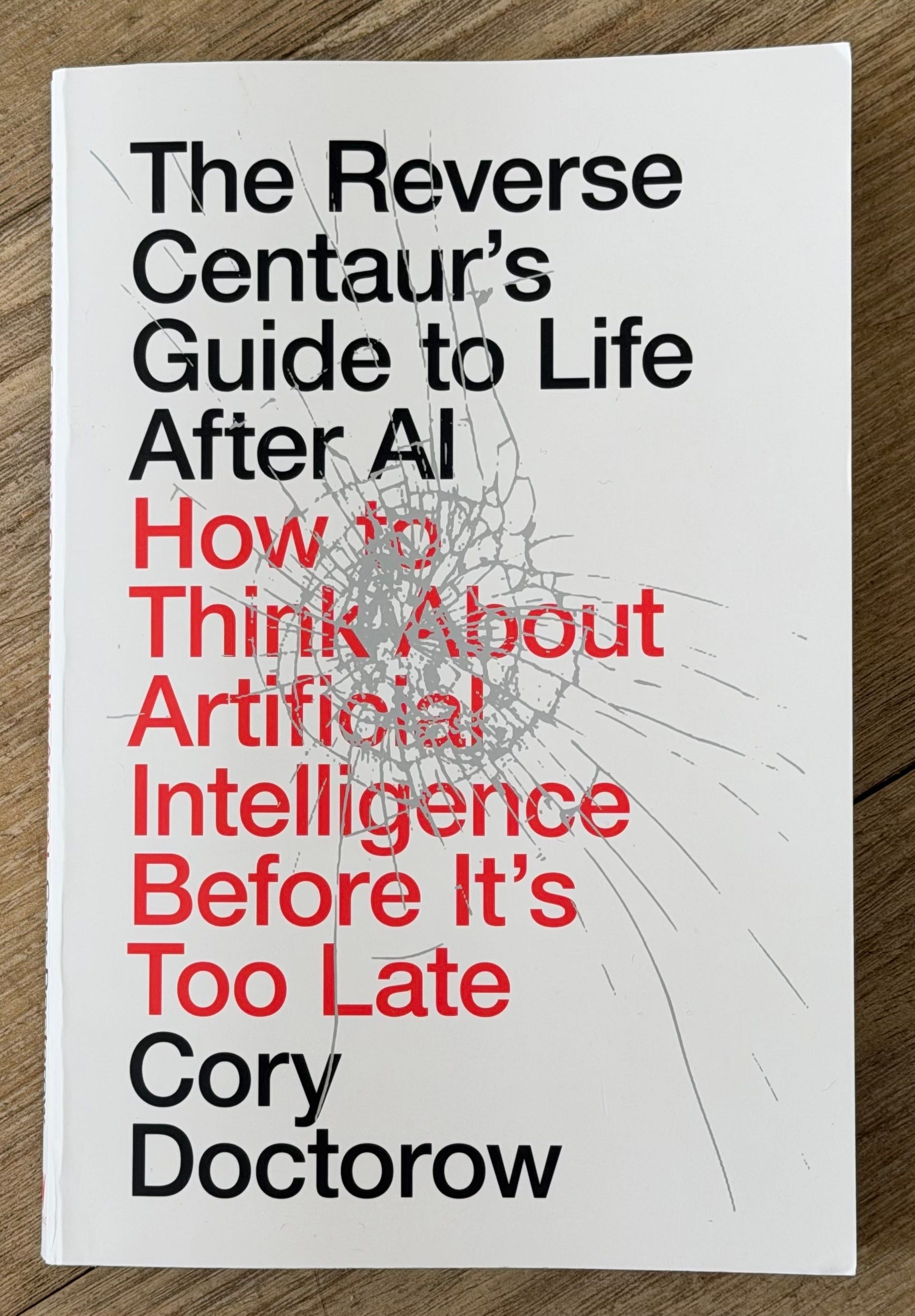
I have several biases to disclose: First, I like Cory Doctorow’s work; many of us reading this do. Second, I like the term centaur, even if Jerry Michalski & I chose the term cyborg for our venture into kind of this domain. Third, I think the answers to how we’re tackling this AI shift we’re all in the middle of are far from settled, and I was looking forward to hearing what Cory had to say about it. Fourth, I sort of work in this space daily, and the human-in-the-loop treatise lands squarely under the agenda of this Children of the Magenta place where we are.
With all that out of the way, I’m not quite sure where to start with the review. Cory Doctorow has written a book about why you should never trust plausible-sounding machine output you can’t verify.
Agreed.
He has then made the strange choice of publishing it without any references, which makes verifying stuff very annoying, and it’s extra-annoying because not all of his claims hold up to scrutiny.
First things first though: what’s a centaur anyway? A centaur is a person assisted by a machine: you, riding a bicycle, or using a spellchecker. A reverse centaur is “a human who is conscripted into acting as an assistant to a machine“.
Think Amazon warehouse worker paced by an algorithm, or the radiologist employed to click OK on machine diagnoses at superhuman speed.
Doctorow’s claim is that the current AI push is fundamentally a fight over which of these you get to be, because “far more important than what the gadget does is who it does it to and who it does it for.“
Ok. I’m on board with that so far.
I found the reverse centaur-concept quite similar to Madeleine Clare Elish’s concept of the moral crumple zone, something I think may be easier to communicate to broader audiences. Curiously, this terminology never appears in the book.
There would also be ample research about automation-induced skill degradation from a number of fields, such as aviation. What all of this research tells us is that viewing a machine that’s usually right and just being careful monitors is basically an impossible job; TSA red teams smuggle fake weapons past screeners almost every time because, as Doctorow puts it, “the human sensory apparatus is just not built to maintain vigilance for something that never happens.”
Doctorow then says the quiet part out loud why companies are implementing AI: “The AI’s primary job is to decrease the wage bill associated with radiography; it is only secondarily charged with spotting tumors on X-rays. Installing a radiologist between the AI and the patient allows the hospital to do the former without taking responsibility for failures in the latter.“
Meet the radiologist as a moral crumple zone, or as the accountability sink to use Dan Davies’ terminology from his brilliant book The Unaccountability Machine.
Now, Doctorow is not a scientist, nor an AI expert. He’s a science fiction-author, first and foremost, and he doesn’t claim to be anything else. “Science fiction is an anti-inevitabilist literature,” Doctorow writes, which serves as a nice corrective for an industry that keeps mistaking cautionary tales for product roadmaps.
The labor framing sits comfortably alongside Brian Merchant’s Blood in the Machine: the issue is never the technology itself, but with who wields it and how the gains get divided.
There’s a lot of good discussion around copyright, and how fighting for more and expanded copyright laws is not likely to be good for creators. Doctorow argues that doing so would be handing the victory to their bosses; “they want us all to fight for more copyright, which they fully intend to extract from us so they can fire half of us and cut the wages of the rest of us.”
Doctorow has some good, pragmatic, practical use cases for AI, but he also has very much macro-level arguments, such as this comparison to how the auto industry managed to pull some sleights of hand on us:
"...the auto industry invented this gimmick when they answered widespread outrage about people being killed by rich idiots in cars (when cars were toys for the wealthy) by inventing the idea of the 'pedestrian,' who shouldn't be in the roadway, where people had walked since roads were invented. The idea of a 'pedestrian' (and that other invention, the 'jaywalker') shifted the blame for product-related fatalities away from the manufacturer and its customers and onto the people who were mangled under the wheels."
The economics side, on the other hand, has aged badly. Doctorow’s bubble analysis implicitly assumes capabilities had plateaued at the time of writing (newsflash: they hadn’t). “Every AI company is losing money“ was shaky when it was written, and is wrong now; Anthropic posted a profitable quarter this year.
There’s more inaccuracies elsewhere; the DeepSeek episode gets oversold, and Agentic AI is dismissed on the logic that because it failed last year it always will, which is nowhere near a solid argument.
Plus there are logical inconsistencies. On page 203 the bubble’s productive residue is said to be the GPUs, but by page 221 the data centres “will go dark.” Which is it? Other GPU-related things could really have benefited from better background research – like the claim that during Meta’s 53-day Llama training run “more than half of its GPUs burned out“. They didn’t. I went to read the original paper, and Meta’s own paper reports 419 unexpected interruptions across a 16,384-GPU cluster, about 59 per cent of failures were GPU-related, meaning one to two per cent of the fleet. Half of the failures were GPU-caused; “half the GPUs burned out“ is a very different sentence.
In a book whose whole argument is that you can’t trust confident, plausible, unverified output, this is quite the own goal. Trust, but verify – and at the very least, let us verify easily, Cory.
Still: a dog-ear index of 14.4 tells you how often this book made me stop, argue, and scribble. It’s thought-provoking with a lot of good thinking, and it’s mercifully short, saying its piece in 230 pages. The Hollywood writers, Doctorow notes, faced bosses who “tried to turn them into reverse centaurs, and they won the right to be centaurs instead.” Even when there’s an argument to be made that that particular case was a Pyrrhic victory, read this book the same way: as a centaur, in charge, checking the machine’s work.
Rating: 4 out of 5
Dog-ear index: 14.4
Who is it for: people generally interested in pro- and anti-AI arguments. Somewhat unexpectedly, you can find both here. Approach the macro-forecasting chapters with your fact-checker switched on.
[reminder: I highlight important parts of the books I read, and dog-ear the really important pages. The dog-ear index is simply the average number of dog-eared pages per 100 pages]
Product link for reference only; please support your local bookstore where possible: https://www.amazon.com.au/Reverse-Centaurs-Guide-Life-After-ebook/dp/B0H1LTFBCT
I like Doctorow, he's very articulate, he keeps a nice quasi-Marxist gaze on the social costs. But one hears different things by the hour about AI. Ironically, maybe, it was on Bloomberg radio today that I heard the best short take: "This technology had better start showing efficiency gains in companies other than companies that make AI, or it's in big trouble." This had the ring of a threat. The revolution will be capitalized, but only for so long. I keep thinking that AI is going to be HUGE, but not as HUGE as the overlords think, and then we'll just be dealing with another useful technology.