Review: The Gift of Not Belonging
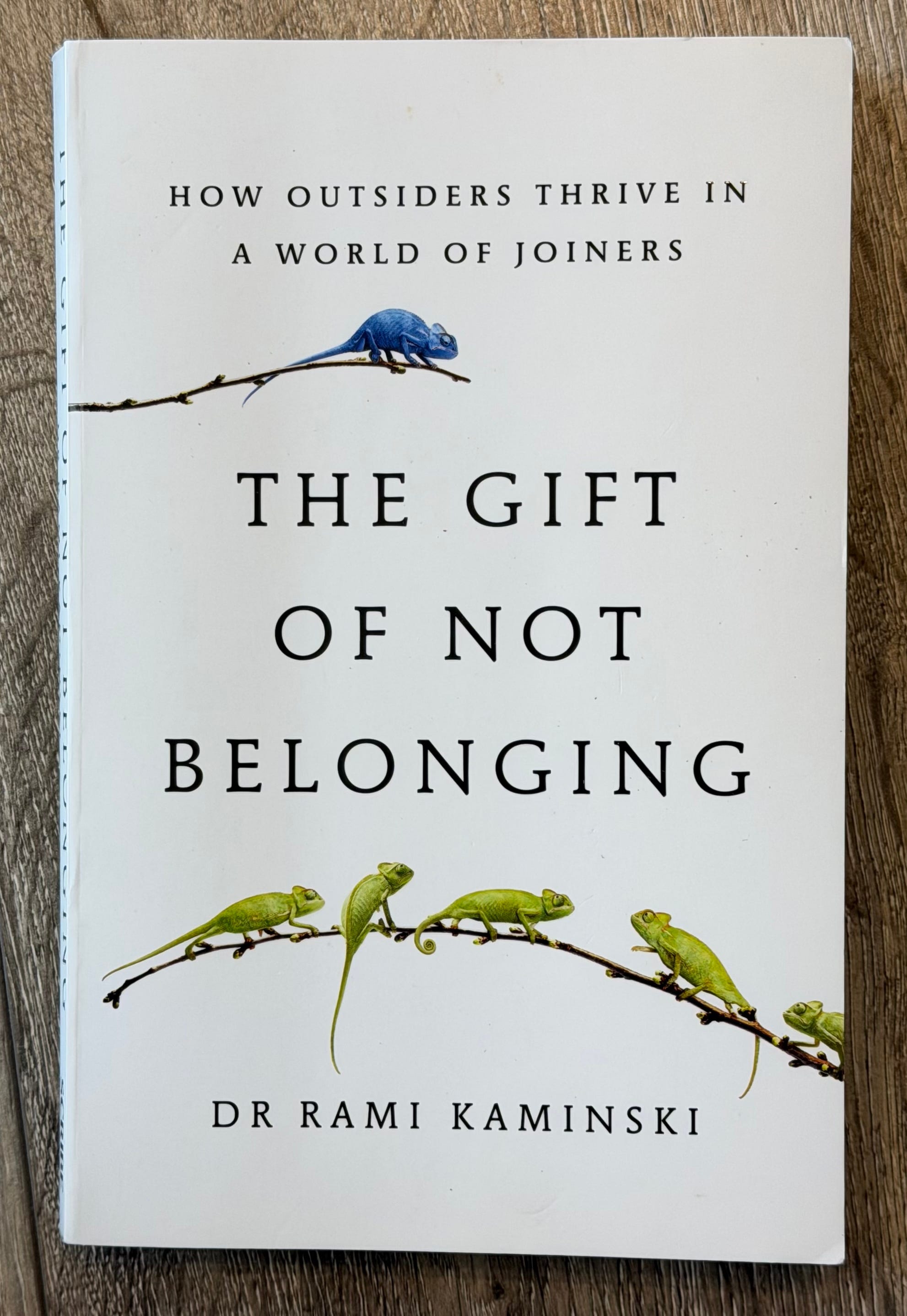
Review of The Gift of Not Belonging: How Outsiders Thrive in a World of Joiners by Dr Rami Kaminski
The The Gift of Not Belonging was one of those random bookstore discoveries – I saw the cover, read the back, and it attracted me enough to get it.
I hadn’t heard of the term “Otrovert” before picking this up, and I was curious as to why. Maybe I had been missing out on something, so I was excited.
As it turns out, there is a good reason I hadn’t heard of it: Dr. Rami Kaminski effectively invented it and did so recently. Having learned that, my excitement reduced somewhat, although remained to positive; however, I went into the book with standard levels of skepticism I have for personality typologies.
Despite what felt like a bit of a homemade taxonomy, I found myself identifying with a lot of it, and subsequently dog-earing page after page.
Kaminski has a pretty simple central thesis - that the world isn’t just introverts and extroverts, or grades of them. There is a third category: the Otrovert. These are people who lack the “communal impulse.” They don’t derive safety or identity from the group and often feel alone and uncomfortable within groups.
As he listed the ‘core qualities’ of Otroverts, I found it deeply validating: preferring one-on-one conversations, standing off to the side at gatherings, finding banal interactions irritating, never feeling true connection to group identity even when connecting individually with people in it. Kaminski’s insight that “normal” simply means “being predictable to others“ rather than any objective state is interesting and liberating.
But let’s not get too excited. The book’s strongest contribution is legitimizing a way of being that society consistently misunderstands or eschews - valuable for sure, but not necessarily a scientific breakthrough discovery. Otroverts aren’t antisocial or damaged - they’re “free to do what they do best: think creatively and expansively, outside the hive.”
The distinction between necessary obligations (things we must do for careers or family) versus unnecessary ones (things we do solely because we feel socially pressured) is useful. So is the quite obvious observation that communal events “were made for communal people“ and feel like torture to otroverts precisely because “they cannot tune out individuals in favor of the group.”
Validation alone, as nice as it is, isn’t enough to make a book great, however - and this book has some flaws I found impossible to ignore, which prevent me from rating it higher.
In an attempt to carve out a unique niche for his theory, Kaminski asserts that “Otroverts are neurotypical.“ Just like that. No room for debate, they just…are? He goes to some lengths to distinguish Otroversion from ADHD or autism, claiming that while behaviors might look similar, the internal mechanism is different.
I have to call bullshit on this.
I identified with almost every trait of the Otrovert, yet I am certainly not neurotypical, so something is off here. The behaviors he describes - sensory overload in groups, the need for autonomy, the “masking” of social behaviors, the “meek rebellion” (who may dutifully attend events while never intellectually respecting the underlying rules) against arbitrary authority - are textbook descriptions of neurodivergence, particularly of high-masking autism.
By insisting Otroverts are neurotypical, I get the feeling that Kaminski engages in a bit of prestige rebranding. He seems to be describing neurodivergent traits but strips away the generally accepted clinical label(s) to make it more palatable for people who don’t want a “diagnosis.”
It feels like he’s saying, “You aren’t autistic, you’re just...spicy independent.” It’s a distinction without a difference, and honestly, it feels a bit irresponsible. More research needed.
Despite these frustrations, “The Gift of Not Belonging“ offers something valuable: recognition. For people who’ve always felt like “popular loners” maintaining a “cool, outgoing facade” while internally never quite connecting, this book provides both validation and a framework. The insight “the otrovert personality is incompatible with many features of corporate life“ is useful self-knowledge, and I suspect many others will also identify with the list of professions that suit otroverts better: consultant, writer, photographer, solopreneur, independent contractor.
The newly-minted terminology, questionable neurological claims, and overgeneralizations prevent this quick read of a book from being a definitive work on this personality style, which may or may not be its own thing in the first place.
Nevertheless, for those of us who’ve spent decades wondering why we feel like observers even when standing on the inside, it’s a start, and it provides a slightly different lens to neurodiverse phenomena, something I believe otroversion would probably be a scale in.
And sometimes, simply knowing you’re not alone in your aloneness is gift enough.
Read this if you have ever felt like a spy in the house of humanity - capable of speaking the language, but never quite believing or sharing the customs. Just don’t treat it as a medical text. Treat it as a field guide for the socially reluctant.
Rating: 3.75 out of 5 (the book is a strange artifact; simultaneously deeply validating and scientifically rustrating)
Dog-ear index: 9
Who is it for: Anyone who’s ever felt like an emotional loner despite being socially embraced; people who find group activities exhausting for no apparent reason; those who’ve been told they’re “too independent” or don’t seem to need anyone. Also a good read for the well-meaning friends and family who keep insisting you just need to “put yourself out there more.”
[reminder: I highlight important parts of the books I read, and dog-ear the really important pages. The dog-ear index is simply the average number of dog-eared pages per 100 pages. Product link for reference only; please support your local bookstore where possible: https://www.amazon.com.au/Gift-Not-Belonging-outsiders-joiners/dp/1761381628/]


