Review: The Daily Laws
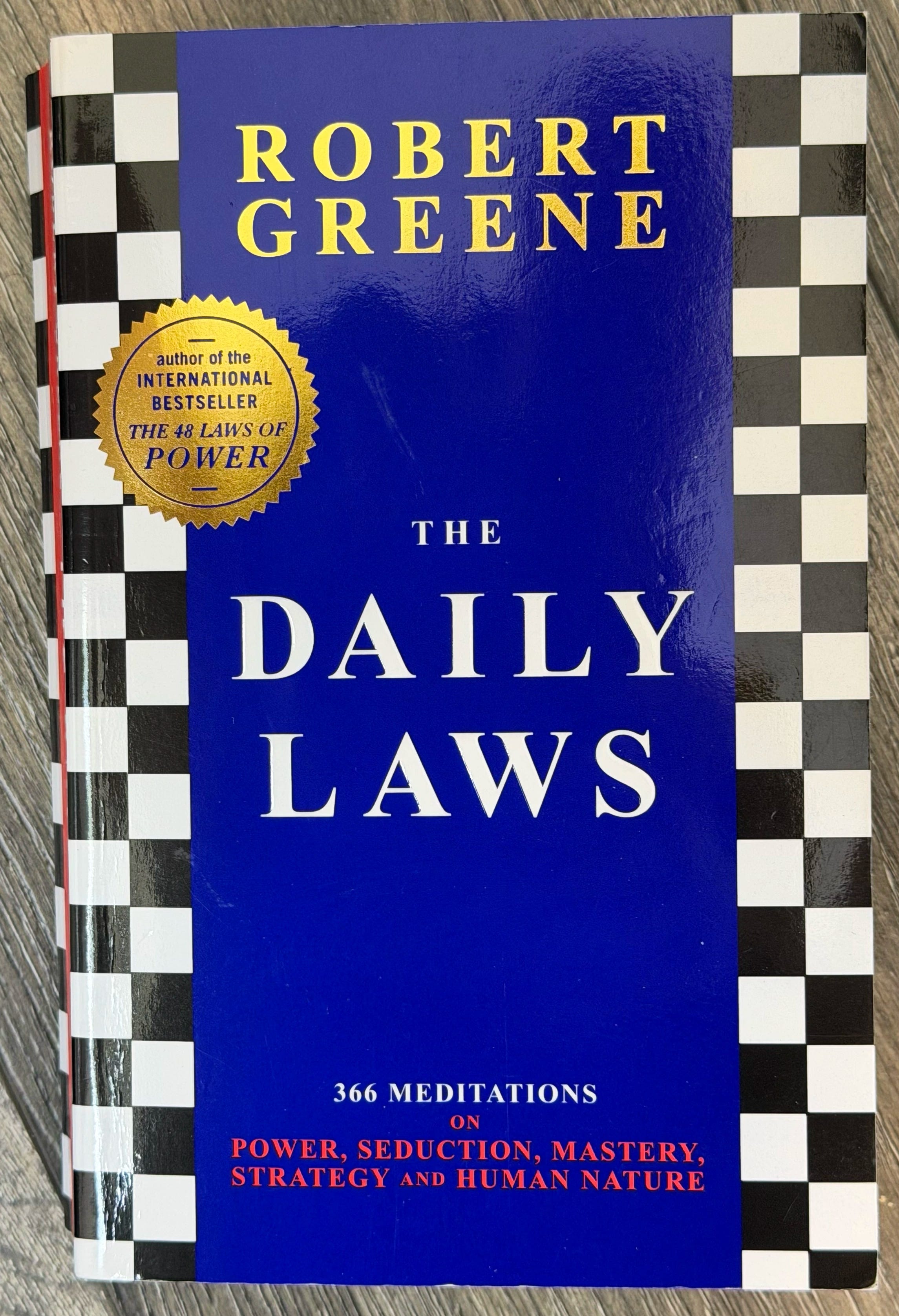
Review of The Daily Laws: 366 Meditations on Power, Seduction, Mastery, Strategy, and Human Nature by Robert Greene
When in Finland recently, I noticed Robert Greene’s books were everywhere. This struck me as odd - none of them are exactly hot off the presses. Curious, I picked up The Daily Laws, hoping for a year’s worth of psychological insight in digestible daily portions.
What I got instead was a villain’s training manual dressed up as self-improvement literature. This isn’t a book about understanding human nature - it’s a handbook for exploiting it.
The renewed popularity makes more sense with the additional context I learned since: Greene’s “48 Laws of Power” has apparently found fresh relevance with observers noting how closely Trump’s conduct mirrors its precepts. The villain’s handbook has found its audience.
The format promises daily wisdom across Greene’s broad body of work: The 48 Laws of Power, The Art of Seduction, The Laws of Human Nature, and others. I, of course, read it ‘wrong’ in that I spent a few days on it, not a year.
Whether read over a Leap Year or in one sitting, the inescapable fact is that the 366 entries treat every human interaction as a battlefield and every relationship as a transaction to be won.
Let me be clear about my core objection: this book doesn’t have an “understand your fellow human“, or even “understand your enemy” energy. It has “here’s how to become the villain“ energy - and it’s pretty much explicit about it.
When Greene discusses “occupying the moral high ground,” he’s not talking about actually being moral; he’s talking about the strategic appearance of morality. When he discusses seduction, it’s conquest, not connection. The underlying philosophy treats manipulation not as something to avoid, or even to recognize and defend against, but as a skill to cultivate and deploy for personal benefit.
That doesn’t mean all of it is bad, or invalid. There are some genuinely useful psychological observations buried in here; the discussion of confirmation bias is accurate; the narcissism spectrum concept reflects legitimate psychology; “Resist Simple Explanations“ is sound cognitive advice.
These insight are like finding vegetables (maybe even quite a few vegetables) in a dumpster - technically nutritious, but the context ruins the appetite.
The predatory mindset Greene shines through loud and clear. On June 1, he advises readers to “Make your face as malleable as the actor’s, work to conceal your intentions from others, practice luring people into traps“. On April 29, he suggests you “Throw in a completely inexplicable move“ to keep people off-balance, cultivating an “air of unpredictability” so that others fear you.
Sound like anyone familiar?
The book’s problems compound from there.
First, the rules contradict each other constantly. One entry counsels authenticity; another teaches concealment. One advocates boldness; another preaches patience and misdirection. You cannot follow all 366 laws because they constantly cancel each other out – you probably couldn’t even follow 50 of them.
Second, there is relentless repetition. The same ideas circle back again and again without deepening. Themes and ‘laws’ appear repeatedly, sometimes nearly verbatim. In a format explicitly designed for daily consumption over a year, this padding feels especially cynical, especially when the repetition can come back-to-back. Could’ve at least tried to put a ‘week’ in between them so maybe it wouldn’t be so jarring - but clearly there wasn’t enough genuine material to fill a year’s worth of pages.
Third, Greene gets many things wrong. His dismissal of academics as “largely indoctrinated“ people who “can never get outside“ their training ignores the entire purpose of the scientific method: systematic challenge of assumptions. His envy typologies are presented as psychological categories but appear to be Greene’s own invention, and certainly not established research. The claims that you have a “Life’s Task” and a “destiny to fulfill” are standard self-help bullshit to make people feel special.
More fundamentally, the book’s entire premise - that human nature is adversarial, relationships are zero-sum, and manipulation reliably works - contradicts extensive research on cooperation, trust, and long-term relationship outcomes. Evolutionary biology shows cooperation as a successful strategy; organizational psychology demonstrates that trust-based cultures outperform fear-based ones.
This is pathological behavior presented as wisdom. Greene actively isolates the reader from genuine connection, warning them on May 17 to “Be extra wary around people who display emphatic traits,” suggesting that empathy is merely a mask for a “dark side“. By framing empathy as a threat, Greene is effectively coaching the reader into a paranoid, lonely existence where trust is a liability.
Significant parts of Greene’s worldview are just demonstrably false, and to base ‘laws’ on such views is dangerous if enough people start believing them.
There’s an audience for this book, I suppose: people who want permission to treat others as obstacles or resources, wrapped in the legitimizing language of “laws” and “strategy.” For anyone else - anyone who believes human connection involves actual connection rather than conquest - The Daily Laws offers little beyond a dispiriting tour of one author’s transactional worldview.
If Greene wanted to be a positive influence in the world, he would position these books as a defense against the dark arts - how to spot immoral behavior and fight it. Instead, he has written a very clear manual on how to be the darkness.
Anyone who wants to follow the rules of this book can fuck right off from my life.
Rating: 2 out of 5 (not 1 only because I suppose it’s useful to know where some people take their guidance from)
Dog-ear index: 3.4
Who is it for: Aspiring Machiavellis and insecure middle managers who think they are on Game of Thrones. Everyone else should look elsewhere for daily wisdom.
[reminder: I highlight important parts of the books I read, and dog-ear the really important pages. The dog-ear index is simply the average number of dog-eared pages per 100 pages]
Product link for reference only; please support your local bookstore where possible: https://www.amazon.com.au/Daily-Laws-Meditations-Seduction-Strategy/dp/1800816286


Word. I picked up 48 Laws of Power and I couldn't get past the first chapter. I wasn't sure how to explain it but it just doesn't feel right. Your post articulated why. 🙏