

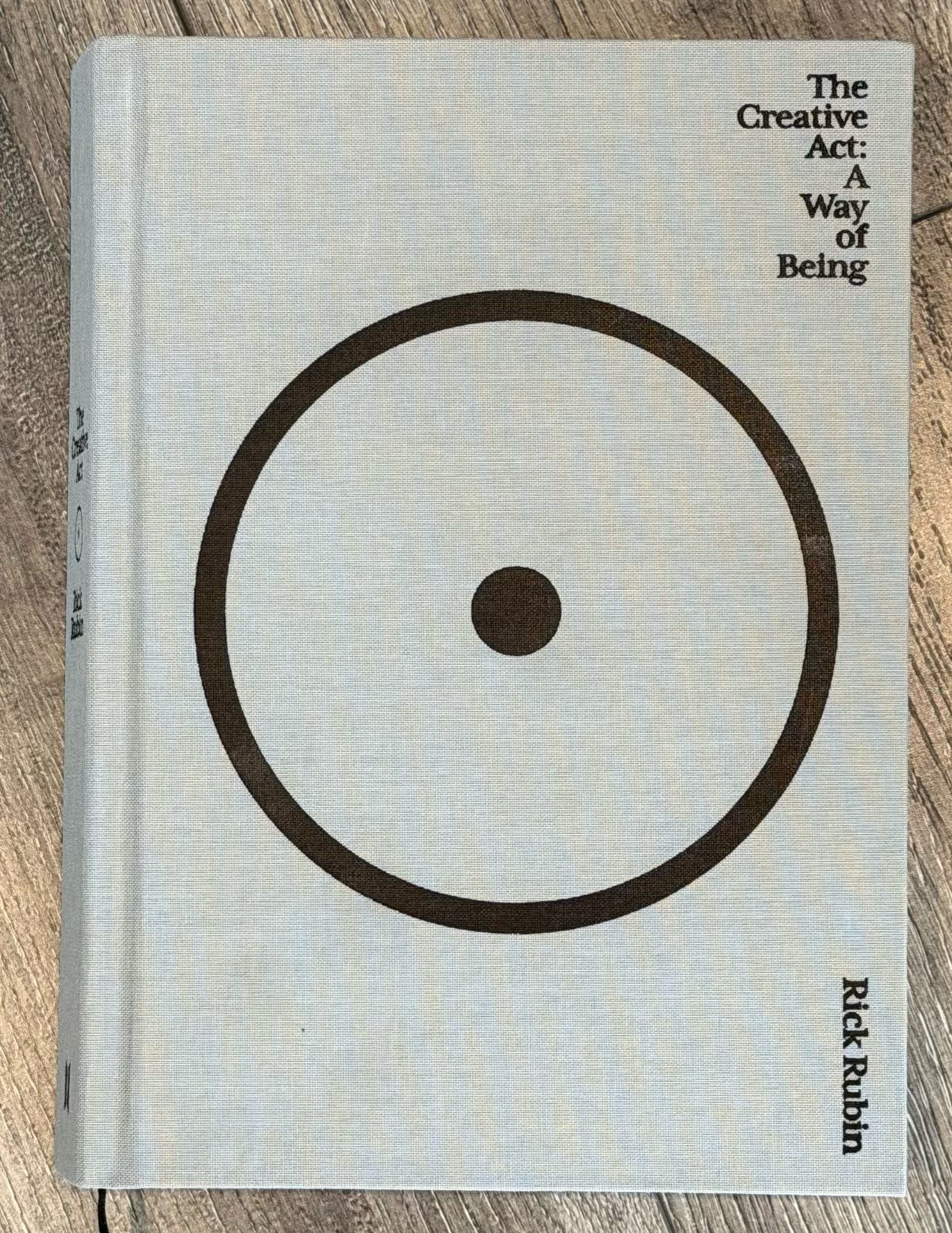
I don’t really know how to review this book. Rick Rubin’s The Creative Act: A Way of Being is a book that, early on, asks you to stop labeling and analyzing, to resist the instinct to categorize. And then here I am, highlighter in hand, kind of trying to do exactly that.
This is a book about creativity by one of the most influential music producers alive, and it contains almost nothing about music. There are no studio war stories, no tales of recording with Johnny Cash or the Beastie Boys.
Instead, Rubin has written something closer to a secular devotional text. There are 78 short chapters he calls “areas of thought,” delivered in very short sentences, with generous white space, structured less like an argument and more like a series of meditations.
There is a very clear core thread: creativity is something you are, not only something you do.
It’s a way of moving through the world.
From page two, Rubin expands the notion of what counts as a creative act to a conversation, taking a new route home, rearranging the furniture in a room. If you perceive, filter, and curate experience, you’re already creating.
In addition to basically all of us being creators, it was liberating for Rubin to spell out that it makes no sense to say you’re “not good at” being creative, any more than you can be “bad at” being a monk.
You’re either practicing or you’re not, and that’s it.
For someone trained to analyze (and I say this as a foresight professional whose job literally contains elements of studying and categorizing emerging patterns) this is a welcome but also slightly uncomfortable invitation.
Have I ever thought I am, or would be, ‘bad at art’?
Absolutely. All the time.
Rubin argues that as soon as you label something, you’re no longer noticing it; you’re studying it. Analysis is a secondary function. The awareness comes first. I know he’s right. I also know that every margin note I made was an act of gentle defiance against the book’s central request.
There’s a spiritual dimension here that some readers will welcome and others will find too untethered. Rubin writes about the Source, about connection, about faith in creative direction without needing to understand it. He’s careful to decouple this from organized religion and uses spirituality as connection rather than doctrine, but the language will be familiar to anyone who’s spent time with Buddhist or contemplative traditions.
There’s a connection to T.M. Luhrmann’s work in How God Becomes Real: both suggest that practice creates the experience, not the other way around.
You don’t create because you’re creative, or practice because you believe.
You become creative because you create, and believe because you practice.
Rubin’s observation that all work is collaboration — with the art that came before, the world you live in, the tools you use, the audience, and who you are today — is one of those insights that seems obvious after (but typically only after) someone says it.
There are unexpectedly sharp moments scattered throughout, almost casually, and in a variety of styles. His chapter on openness, where he notes that we build frameworks that give us reduced options and a false sense of certainty, could have come from a text on cognitive bias or foresight methodology. The passage on curiosity, about how it explores all perspectives, craves constant expansion, and pushes to expose falsely set boundaries, on the other hand reads like a manifesto for anyone whose work involves seeing what others don’t yet see.
Rubin observes that we are interpretation machines, that our explanations are guesses which become fixed as fact; that we are the unreliable narrators of our own experience. On spontaneity, he joins the now-common forces puncturing the myth of effortless genius: the story of spontaneity is misleading, because we don’t see the lifetime of preparation that primes the artist for the “spontaneous” moment.
And then there’s this advice on page 387:
“If you’ve written a book that’s over three hundred pages, try to reduce it to less than a hundred without losing its essence.”
Again, on page 387. Of a book that runs past 400 pages.
Which brings us to one tension that Rubin doesn’t resolve.
The Creative Act would be a more powerful book at maybe half its length. Many of the 78 chapters circle the same ideas in slightly different language. The white space and short sentences create a meditative rhythm that works beautifully for the first hundred pages and starts to feel like padding by the third hundred. The repetition may be intentional; Rubin might, probably correctly, argue that returning to ideas from different angles is itself a creative practice, that the book is meant to be dipped into rather than consumed cover to cover.
Fair enough. But a book that advocates ruthless editing probably shouldn’t need that defense.
I also notice what’s absent. There’s no engagement with the ways creativity is constrained by systems, economics, or power, the very material conditions that determine who gets to really “live as an artist“ to the fullest, and who doesn’t.
The book assumes a degree of freedom and access that is, for many people, more of a real barrier rather than their mindset. I don’t consider this a fatal flaw, but it leaves a gap where something interesting might have been.
This is an overlong, occasionally repetitive book that contains at least a dozen ideas I will continue to carry with me and remind myself of. I’m not sure what rating that deserves.
Rating: 4 out of 5, give or take at least half a point
Dog-ear index: 7.2
Who is it for: Creators of all kinds. With a high likelihood that includes you, even if you don’t think of yourself as one. Especially if you don’t think of yourself as one. Also for anyone who has become so focused on output and analysis that they’ve forgotten creation is a way of being, not just a way of producing. Not for those who need practical creative techniques or step-by-step methodology; this is philosophy, not instruction.
[reminder: I highlight important parts of the books I read, and dog-ear the really important pages. The dog-ear index is simply the average number of dog-eared pages per 100 pages]
Product link for reference only; please support your local bookstore where possible: https://www.amazon.com.au/Creative-Act-Being-Rick-Rubin/dp/1838858636/