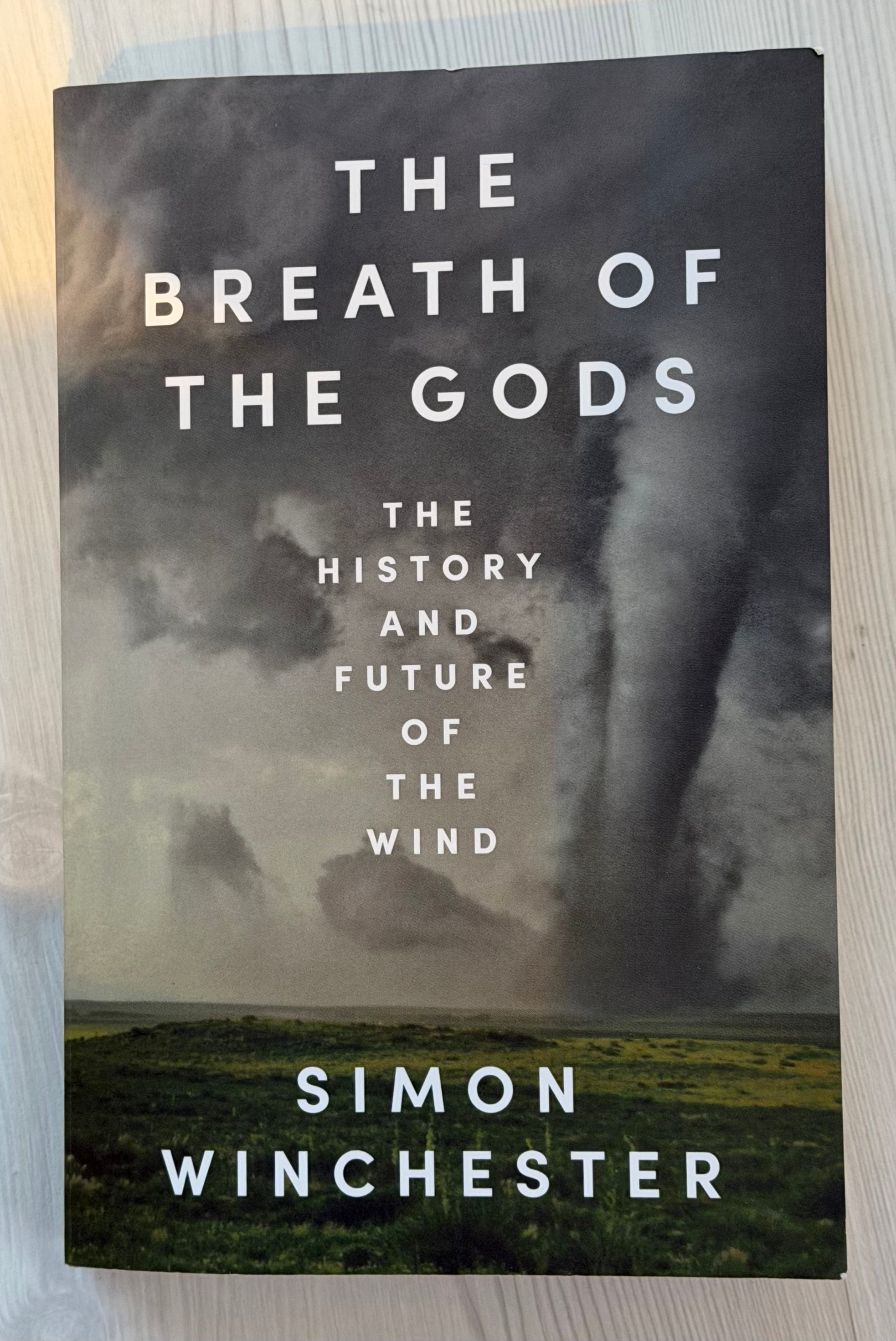
Review: The Breath of the Gods
Review of The Breath of the Gods: The History and Future of the Wind by Simon Winchester
How can there be hundreds of pages about wind?
That was my initial reaction when seeing “The Breath of the Gods: the history and future of the wind” in a bookstore; the initial skepticism went out the window some microseconds later when I saw it was written by Simon Winchester, whose earlier works I have been a big fan of, so I picked it up without a second thought.
Turns out it’s remarkably easy and fascinating to have hundreds of pages about wind. When you think about it, wind does touches nearly everything: it shapes geography, carries disease, betrays secrets, powers civilizations, wreaks havoc, decides battles, and has inspired more vocabulary than you’d ever imagine.
Winchester, with his characteristic erudition and wit, takes us on an encyclopedic journey through the invisible force that surrounds us. The book ranges across an astonishing variety of wind-adjacent topics. We learn, for example, that Hawaiian has over six hundred recorded words for wind, making Finnish’s oft-celebrated thirty words for snow look positively impoverished.
We discover that our cardinal directions (North, South, East, West) are a Greek and Hebrew refinement of Sumerian mythology, where the Four Mesopotamian Winds were invented as sibling gods some two thousand years earlier. There’s the delightfully obscure 1915 Huntington Theory, which held that “the cleverest and most civilized peoples“ lived where weather was endlessly variable, essentially arguing that climatic monotony produced dullards.
There are unexpected stories, such as the engineering challenge of making the American flag appear to fly on the windless moon (solved by NASA engineers just days before Apollo 11 launched); there are wind-adjacent disasters, like covering the history of FDR’s response to the Dust Bowl, planting hundreds of millions of trees in shelterbelts from North Dakota to Texas.
And the way wind betrayed Chernobyl: unseasonal southeasterly winds carried telltale radiation to Swedish detectors when westerlies would have let the USSR deny everything for much longer, with potentially disastrous consequences.
Winchester’s prose shines when describing things we think we know. I was surprised to learn that tumbleweeds, that icon of the American West so beloved by Hollywood, are actually Russian thistle (Salsola tragus), accidentally imported in the 1870s and now reviled as invasive pests. Each iconic rolling sphere carries up to a quarter of a million seeds. Nothing, Winchester notes, is “so large, so obvious, so emblematically Western, and, in a perverse way considering how it is so universally loathed, so romantic” as this prickly Russian import.
The book naturally devotes considerable space to matters like sailing, to the Beaufort scale, to dune formation (complete with Arabic-derived vocabulary: seifs, draas, barchans, serirs), and to how wind wreaks havoc in myriad of ways. The chapter on inclement winds includes harrowing accounts of gliders being sucked into cumulonimbus clouds and shredded by forces “beyond imagination.”
As someone with a particular fondness for aviation, I appreciated the aviation connections throughout; from the accidental discovery of jet streams when B-29s were blown over their targets at 450 mph during WWII bombing runs, to the explanation of why the Nepal Himalayas are the one place on Earth where you can actually see a jet stream.
If there’s a weakness, it’s that the book doesn’t quite cohere into a single argument or narrative arc. At the start, it alludes the Great Stilling, an as-of-yet tentative story of average wind speeds globally declining with climate change and the potentially highly important consequences of that, but doesn’t really dive deeper into this emerging evidence or potential consequences. It’s more of a collection of fascinating stories organised around a theme than a sustained thesis. But for readers who enjoy Winchester’s style — learned, discursive, full of tangents that prove more interesting than the main road — that’s hardly a complaint.
“The Breath of the Gods” won’t necessarily fundamentally shift your worldview, but it will enlighten and deepen it and will certainly leave you noticing wind differently. You’ll think of Sumerian mythology when checking which way the breeze blows. You’ll regard tumbleweeds with newfound complexity. And you’ll appreciate just how much of human history has been shaped by something we mostly take for granted until it knocks a tree onto our roof – which, ironically considering the great stilling, it may do more of in the future.
Rating: 4 out of 5
Dog-ear index: 4.5
Who is it for: Anyone who enjoys well-written popular science writing; readers who appreciated Winchester’s previous works; people who want to understand the invisible force shaping everything from desert dunes to human civilization, and who don’t mind taking the scenic route to get there.
[reminder: I highlight important parts of the books I read, and dog-ear the really important pages. The dog-ear index is simply the average number of dog-eared pages per 100 pages]
Product link for reference only; please support your local bookstore where possible: https://www.amazon.com.au/Breath-Gods-History-Future-Wind/dp/0008679509


