

What if the most reliable thing about your memories is that they’re wrong?
I’ve spent a lot of time in my life thinking about how humans reconstruct events after the fact — in revisionist history of our personal lives, in incident investigations, in organisations trying to learn from failure.
Memory is always at the centre of it. We build narratives. We fill gaps. Even when we acknowledge that memory can be fallible, we are often supremely confident about our memory, and about the veracity of the details we’ve just fabricated wholesale. In interpersonal arguments, we’re quick to doubt the other person’s narrative of the events, while remaining confident about our view.
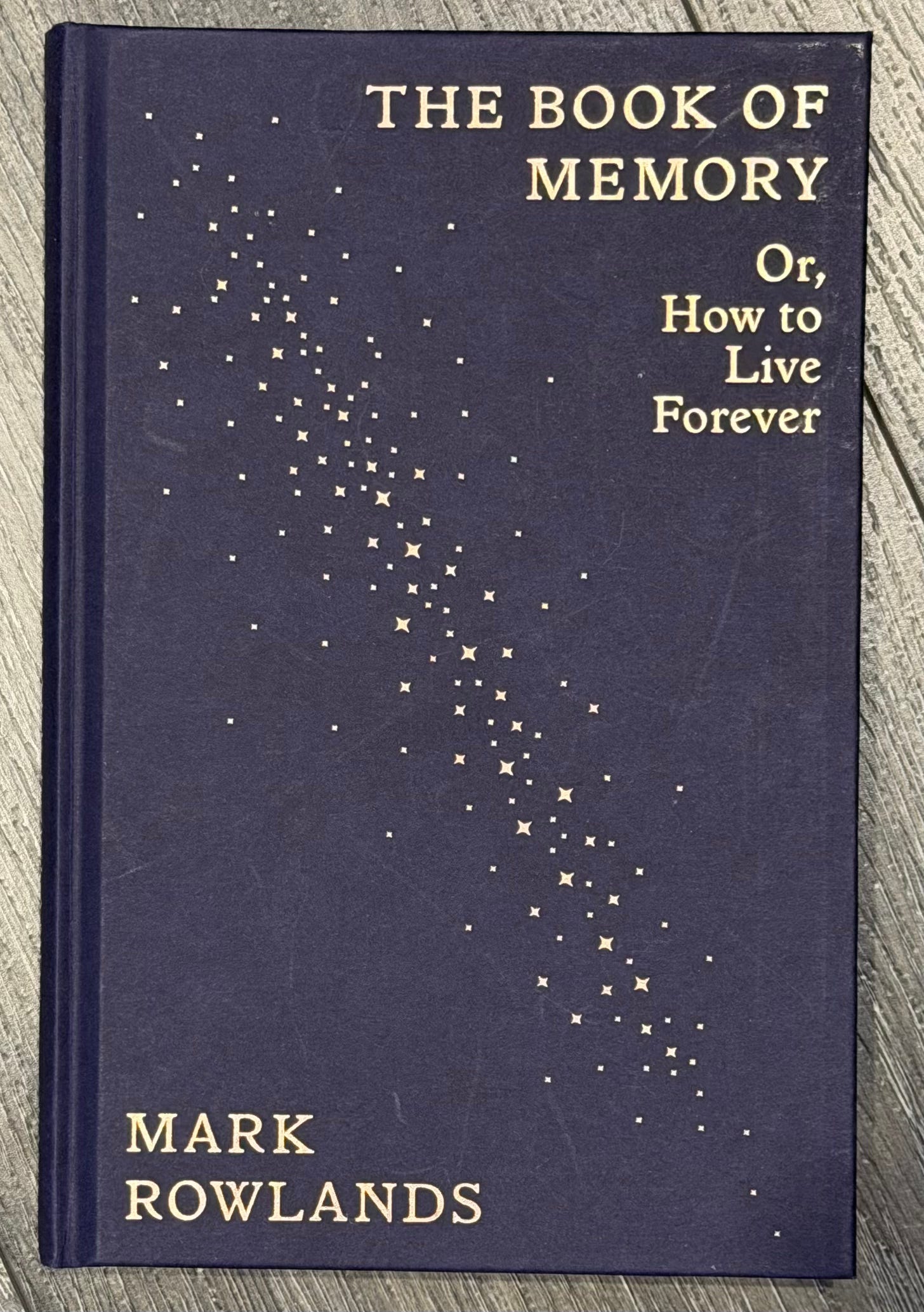
Mark Rowlands’ The Book of Memory takes that discomfort and runs with it, arriving somewhere a little different than your standard book about memory: a philosophical meditation on what it means to be a person at all, written as a love letter to his sons.
Rowlands is a professor of philosophy at the University of Miami, not a neuroscientist. This is a book that uses science — reconsolidation, flashbulb memories, protein synthesis — but in service of philosophical argument rather than as an end in itself.
If you want a more rigorous deep-dive into memory science, Charan Ranganath’s Why We Remember is your book. Rowlands is after something different: what the science means for our understanding of selfhood.
Rowlands introduces the concept of being “ontically fat” versus “ontically thin” — a philosophical distinction I hadn’t encountered before and felt a little weird about at first.
You and I are ontically fat: there are facts about us that exist whether or not anyone knows them. Sherlock Holmes, by contrast, is ontically thin — there is no fact about what he had for breakfast on April 24, 1888 unless Conan Doyle wrote one. What Rowlands argues, provocatively, is that our memories make us partly fictional. Every time a memory is recalled, it must be reconsolidated — rebuilt, essentially — and each rebuilding can introduce distortions.
As such, the memories that make you you are, to a significant degree, works of authorship rather than records of fact.
He builds this argument through different pieces. The chain of events leading to his son’s conception — stretching back through a rebound relationship, a disastrous trip to India, a case of dysentery from a restaurant in Connaught Circus, New Delhi — is a delightful illustration of contingency.
His treatment of metaphor as “an invitation — why don’t you think of things in this way?“ is the kind of simple insight that makes you stop and sit with it for a moment. And the chapter on Stendhal’s syndrome - dizziness, fainting, even hallucinations triggered by exposure to overwhelming quantities of art - was entirely new to me.
The science, when it appears, is mostly solid. The Neisser and Harsch study of Challenger explosion memories is a well-established classic: students’ accounts of where they were when they heard the news changed dramatically between 1986 and 1989, while their confidence in those memories remained stubbornly high. Eleven of forty-four subjects scored zero for accuracy but still expressed high confidence. Karim Nader’s work on reconsolidation — showing that blocking protein synthesis during memory retrieval can effectively erase the memory — is also well-replicated and forms the backbone of Rowlands’ argument that remembering is fundamentally an act of rewriting.
But I said mostly. Where I’m less convinced is the treatment of PKMzeta, a protein Rowlands presents as crucial to both the formation and retrieval of memories. The PKMzeta story has become considerably more complicated since the initial findings. Knockout mice lacking PKMzeta entirely still form and retain memories, and the inhibitor ZIP — once thought to specifically target PKMzeta — turns out to have broader, non-specific effects including suppressing neural activity altogether. The picture has been partially rescued by more recent work showing that a related protein (PKCiota/lambda) compensates for missing PKMzeta, but the neat narrative Rowlands presents is more contested than he lets on. For a book leaning on neuroscience to support philosophical claims, this matters.
Some of the most interesting moments come from Rowlands’ notion of an “existential style” — the idea that even when the content of memories erodes, such as with people with Alzheimer’s, what remains is something like a characteristic way of being.
He illustrates this through his father-in-law Patrick, whose dementia stripped away specific memories but left his essential character — the quiet storytelling, the gentle erudition — perfectly visible. It’s a moving observation which probably, unfortunately, doesn’t neatly generalize, for I have equally heard stories of people who change to something very different in similar circumstances.
Nevertheless, it raises a question Rowlands doesn’t fully explore but that I couldn’t stop thinking about: if so much of our book of memory is dominated by redaction — vast seas of black ink — and our selves are relatively shallow constructs built from sparse islands of recollection, does this explain why our technology, which knows only a thin slice of us, can feel like it knows us so well?
Rowlands also makes a fascinating case that externalising memories — telling people about them, writing them down — can stabilise them against the distortions of reconsolidation. But he immediately complicates this: stability is not the same as accuracy. You can lock in a memory by talking about it, but if your account was inaccurate to begin with, you’ve now fixed the inaccuracy in place.
This sent me down a rabbit hole about journaling. If writing freezes memories in their current (possibly already distorted) state, could the practice of journaling actually be harmful in some cases — cementing false unhelpful narratives about our own lives? (Noting that some false narratives can be helpful). Rowlands doesn’t go there, and I suspect it’s not quite that simple, but the question of the possibility lingers.
The book is ultimately structured as a bequest. Rowlands is writing for his sons, passing on memories that will make his being “no longer my own, but resting on your retrieval and subsequent rewriting.” It’s a philosopher’s version of inheritance, and there’s something tender about it. He compares himself to Sherlock Holmes — a fictional character whose being depends entirely on others — and finds liberation rather than loss in the comparison.
An incompletable being can never die.
The prose throughout is warm and conversational, if occasionally a bit meandering. Rowlands has a habit of circling back to the same ideas from different angles, which serves the philosophical method but occasionally tests patience - though at 139, it’s still pretty short.
Rating: 3.5 out of 5
Dog-ear index: 7.1
Who is it for: Philosophers who want some science, or science enthusiasts who want some philosophy. People grappling with questions of identity, memory, and what remains of us when the facts fall away. Not for readers wanting rigorous neuroscience or a complete treatise of how memory works.
reminder: I highlight important parts of the books I read, and dog-ear the really important pages. The dog-ear index is simply the average number of dog-eared pages per 100 pages
Product link for reference only; please support your local bookstore where possible: https://www.amazon.com.au/Book-Memory-How-Live-Forever/dp/1803512644