

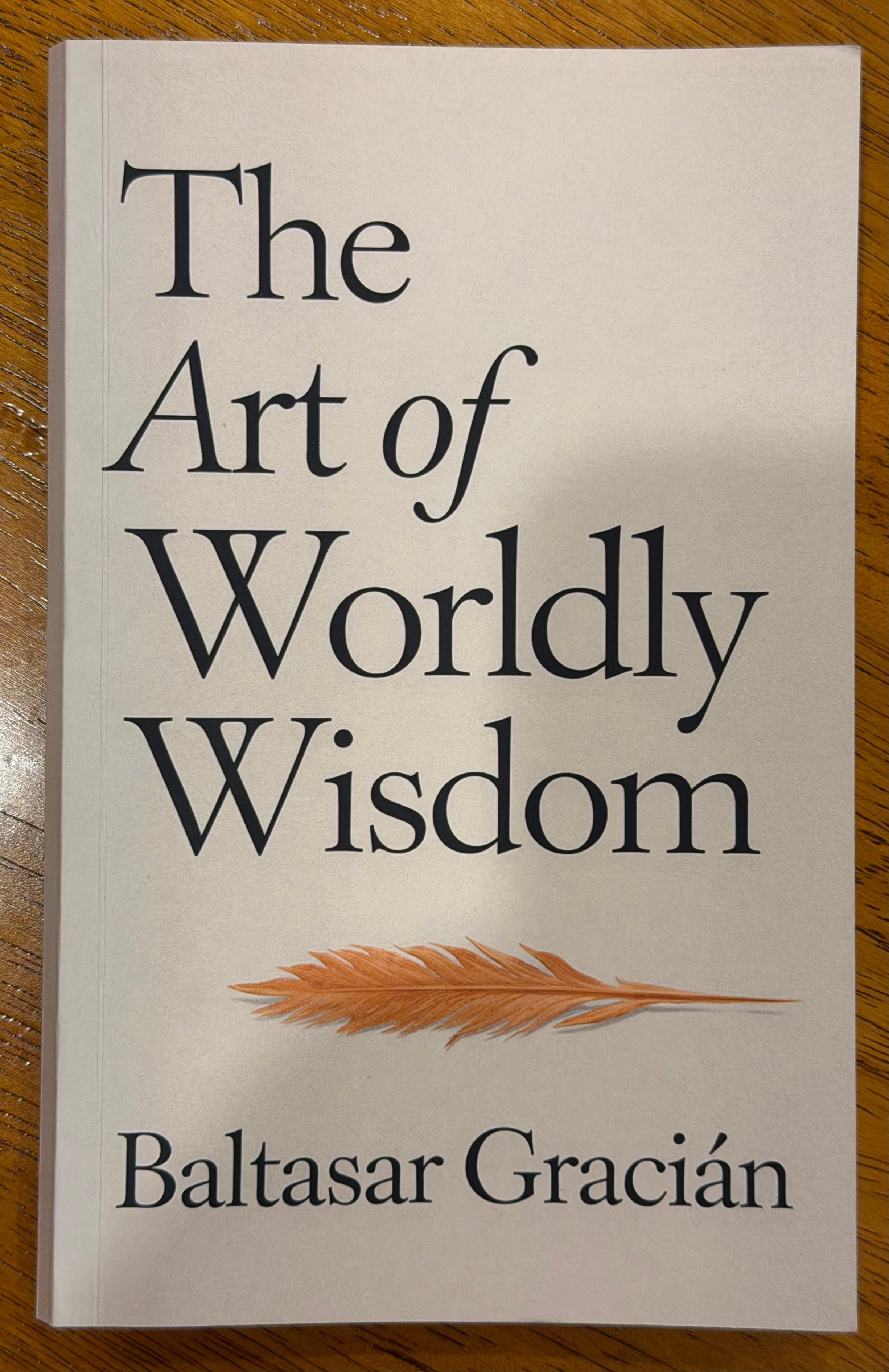
We love to say there’s nothing new under the sun, and then spend most of our lives proving we don’t believe it, overvaluing things mostly because they’re new.
I’m as guilty of this neomania as anyone. So as a small corrective, I reached for the oldest advice book I could stomach: Baltasar Gracián’s The Art of Worldly Wisdom, three hundred maxims a Spanish Jesuit first published in 1647.
A caveat I can’t shake: I’m reading a 17th-century Spaniard in translation, and things are always lost in the crossing. Cultures change, idioms rot, language drifts - I don’t pretend I’m getting Gracián neat.
After a lengthy introduction by Don Vincencio Juan de Lastanosa, the form of the book is relentless: three hundred aphorisms, each a few sentences to a paragraph, on how to move through a treacherous world without being eaten by it. Think of it as the great-great-grandfather of every “rules for life” book on the shelf today; Galloway’s, Peterson’s, the various Laws of Power. Gracián got there first, and more elegantly. Mostly.
Here’s where it got funny. I picked the book up to inoculate myself against novelty-worship, and found that Gracián had not only diagnosed the disease in 1647 but written the manual for exploiting it. “Make use of the Novelty of your Position,” he counsels, “for men are valued while they are new.”
Why? “Novelty pleases all because it is uncommon, taste is refreshed, and a brand new mediocrity is thought more of than accustomed excellence.” He’s telling you to ride neomania while it lasts, because “after four days respect is gone.” I came for an antidote and got a how-to guide.
Sadly, he’s right.
One maxim that sort of hit close to home was the one on transplanting yourself:
Know how to transplant Yourself.
There are nations with whom one must cross their borders to make one’s value felt, especially in great posts. Their native land is always a stepmother to great talents: envy flourishes there on its native soil, and they remember one’s small beginnings rather than the greatness one has reached. A needle is appreciated that comes from one end of the world to the other, and a piece of painted glass might outvie the diamond in value if it comes from afar partly because it is ready made and perfect. We have seen persons once the laughing-stock of their village and now the wonder of the whole world, honoured by their fellow countrymen and by the foreigners [among whom they dwell]; by the latter because they come from afar, by the former because they are seen from afar. The statue on the altar is never reverenced by him who knew it as a trunk in the garden.
Not that I’ve ever had great posts, but there are more modern aphorisms for this phenomenon; “no man is a prophet in his own land”.
Written before the word immigrant carried the freight it carries now, and truer than most things written about it since.
Then there’s the line that could have been written this morning: “Philosophy is nowadays discredited... The art of thinking has lost all its former repute.“ 1647, and already mourning that nobody thinks anymore. Four centuries apart, we have same complaints. Nothing new under the sun indeed.
For all that, a lot of the book is wallpaper. Plenty of these maxims are vague enough to work like horoscopes or scripture: capacious, agreeable, and seemingly true in whatever direction you tilt them. That’s the trap of the whole genre, and I caught myself sometimes falling in. It’s nearly impossible to read advice like this without confirmation bias, nodding along at what you already believe and quietly explaining away the rest.
A book that can’t be wrong isn’t thereby right.
It also argues with itself. For pages Gracián insists you conceal your abilities — keep your tastes hidden (”Do not even let your tastes be known”), your intentions in cypher, your hand face-down. Then, later, a maxim titled “Display yourself” tells you to do the reverse. Which is it? The charitable reading is situational wisdom: the court is a place where the right move depends entirely on the room, and a survival manual has to teach both the veil and the flourish. The less charitable reading is that the three hundred maxims were written to stand alone but were never audited against one another.
And it is, finally, a somewhat amoral book. While it preaches the virtues of good behaviour and reputation, it also talks up appearance, tells you to take advantage of how things look, how luck breaks, how to stay “in vogue.” There’s some great time-honored social engineering here. If you’ve read Will Storr’s The Status Game, you’ll recognise the whole thing as a 17th-century field manual for status play.
Which leaves me with a strange split. My dog-ear index here is 13, so quite high. I marked this book up heavily, because individual maxims kept landing, and there can be four per page. But the whole is worth less than its best parts.
Nothing new under the sun, then — including the suspicion that nothing is new under the sun. Gracián knew we’d keep chasing the shiny thing, and knew we’d keep needing to be told not to. I’ve dog-eared that, and, like most wisdom, will promptly fail to apply it.
Rating: 3 out of 5
Dog-ear index: 13
Who is it for: Readers who like their self-help old, dense, and unsentimental, and who treat aphorism books as quarries to mine rather than arguments to follow.
[reminder: I highlight important parts of the books I read, and dog-ear the really important pages. The dog-ear index is simply the average number of dog-eared pages per 100 pages]
Support your local bookstore. If you must use Amazon: https://www.amazon.com.au/Art-Worldly-Wisdom-Original-Navigating/dp/1917598289
There's something in the idea that a person who has passed away has more wisdom that one still with us. The Tuesdays with Morrie effect. I wonder if we recognise that they have no stake in the game any more, so give it a boost.