

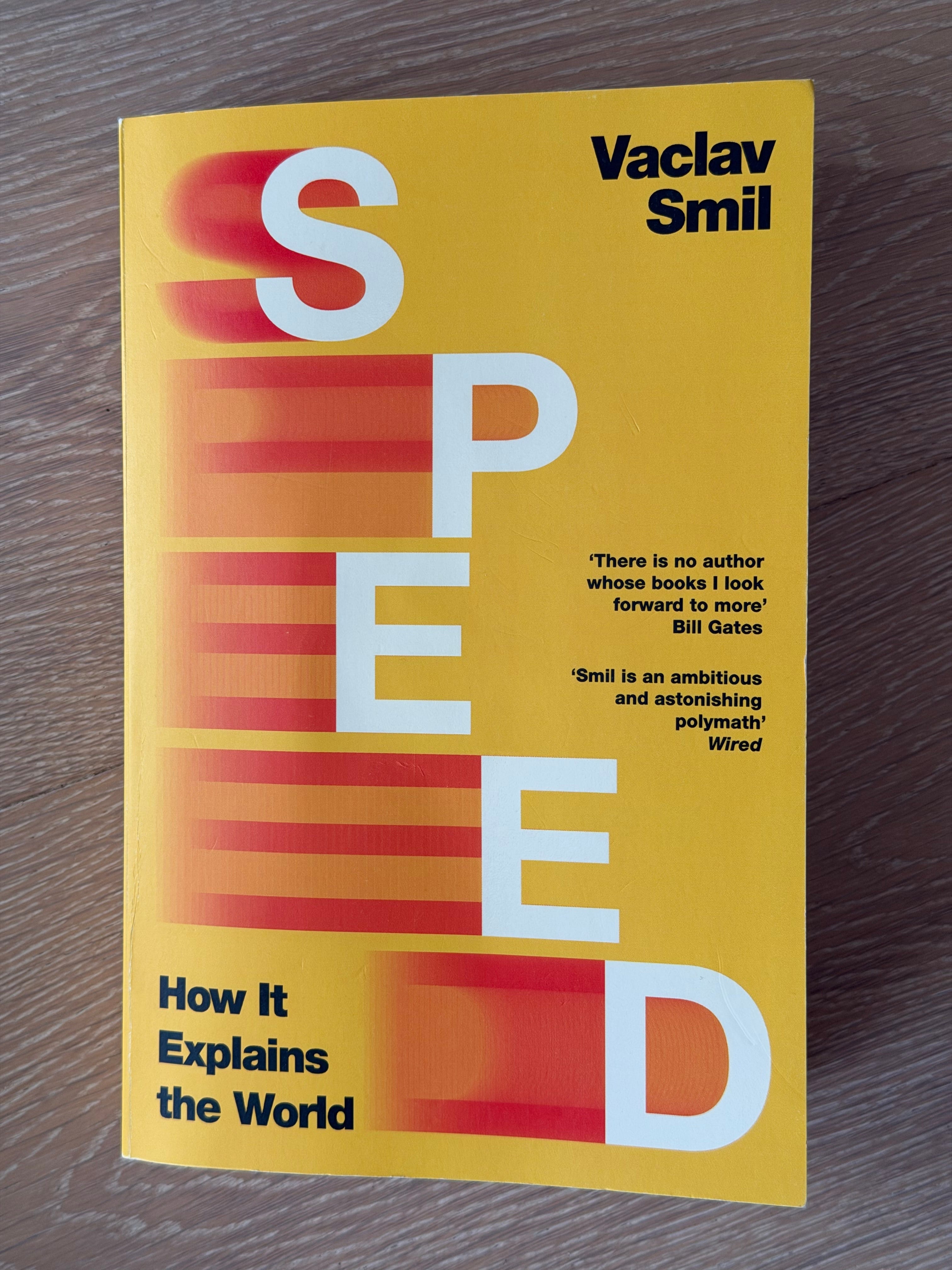
In the preface, before the book has properly started, Smil offers some reading advice: “slow, methodical reading will bring greater rewards than zooming through the book at page-turning speed.”
A book about speed, asking you to slow down. I kind of liked that, and I took it as a promise of good things to come.
The good things didn’t come.
This is my third book by Smil. How the World Really Works got 4.5 from me. Invention and Innovation got 4. I’ve defended him to people who find him dry, because if that dryness means accuracy, it’s a virtue, and there frankly aren’t many writers left who will tell you what a number actually means in actual real detail.
I’m sorry to report that this book…just doesn’t work. Not for me anyway.
But let’s take a step back.
Even though humanity has been worried about things speeding up for generations, there is a visceral sense of things really accelerating in our modern times. Alvin Toffler’s Future Shock really feels like it’s here for many people.
So with that backdrop, I welcomed a methodological look into all things speed.
And my god, if you come to the book hoping for random numbers about all things speed, you will get them.
Raindrop terminal velocity. Denudation rates for the Brahmaputra basin. The rupture speed of the 2018 Palu earthquake. Roman cursus publicus load limits, itemised by cart type. How much water a Texas swimming pool loses to evaporation in July.
I actually skim-skipped parts of the book (which I almost never do) because I did not need a refresher on tectonic plate movement, and I couldn’t figure out what it was doing in the book.
The weird thing is, I normally love this stuff. Fascinating tangents are half the pleasure of a good non-fiction read, but I guess there’s a difference between a tangent and what feels like a million tiny rabbit-holes that don’t really coalesce into a coherent whole.
Which is not to say that some of the numbers in the book aren’t fascinating, or interesting, or just depressing.
Like the broiler chicken. A free-running bird takes four to five months to reach one kilogram; a modern broiler takes under fifty days to reach three kilograms. Smil accurately calls these “mini monsters”, but I have a feeling these facts may not be news to most people.
Then there’s a pedestrian fatality curve – spoiler: fatality rises dramatically as the speed of collision increases.
Interesting, yes, but news to most people? Again, probably not. Most people probably learned this in school.
And this is the problem with a bunch of these numbers: many of them are things we kind of all know. Probably. At least directionally; we will probably have forgotten the actual numbers, but we know how these things work – we know aircraft are faster than cars and trains, and we know that if you take into account all the ancillary things you have to do (get to the airport; go through security; boarding; check-in; etc.), the average speed of a flight often becomes much less impressive.
It’s both been drilled to us and it’s intuitively clear that speed kills.
It’s not just pedestrians that too much speed is lethal for. We rarely think of meatpackers, where:
“The line is so fast there is no time to sharpen the knife. The knife gets dull and you have to cut harder. That’s when it really starts to hurt.”
In 2019 the US removed the standing hourly limit of 1,106 pigs and set no upper value at all. As a result, some plants now run 1,300 an hour. The annual injury rate in animal slaughtering is nearly three times that of logging - a job famous for being dangerous.
So much of the book feels like this – numbers, so many numbers, all paraded with academic rigor, but numbers that seem kind of…irrelevant? Pointless? Or making obvious points? Not core to the story? All of that.
But then the coda arrives at the very end of the book, which is the only stretch where Smil stops measuring and starts arguing, and then immediately proceeds to demonstrate the problem with the rest of the book.
He takes aim at a 2018 RAND paper on speed and security, quoting it accurately but reading it badly. RAND opens by stating that acceleration is “neither uniform nor deterministic“ and that their aim “is not to provide a concrete take on the future.”
Their four 2040 scenarios are workshop provocations written to get people in a room talking. Smil treats a paragraph defining the paper’s scope as a list of predictions, then demolishes it with questions RAND never invited: are we getting ten-day wheat? Two-week steak? Bits moving faster than light? The answers are all obviously no, and none of them are answers to anything RAND said. He also missed that RAND’s own conclusion — design for problems, not for speed, and stop building Hyperloops that solve the wrong thing — is roughly his own.
He’s better on Musk, where the target actually deserves it: the Mars rocket, and the “endlessly gullible mass media“ that keeps repeating the pitch.
Smil also refuses to romanticise slowness in return, noting that Slow Food is “tinged with elitism and wishful thinking“ while McDonald’s quadrupled its profits.
Finally, he lands here:
“The pursuit of speed should not be a quest for further indiscriminate speed iterations, but rather a carefully considered combination of further gains, thoughtful limits, and justifiable retreats.”
Yes.
Exactly.
Thank you.
2.5 out of 5 stars.
Wait, what?! WHY?
Because I had to read hundreds of sometimes frankly pretty tedious pages to get there, and I can’t remember almost any of them. Too many numbers to hold, and too little telling me why I was even trying to hold them. I will forget – nah, have already forgotten – 99% of them.
But there’s one thing I learned that I will probably remember: canola.
I did not know that canola is a contraction of “Canadian oil, low acid“; a 1970s rebranding of low-erucic-acid rapeseed out of the University of Manitoba.
Fascinating.
But also something not particularly useful, not really contributing anything important to the narrative, and also potentially known to most people (just not me).
Slow, methodical reading, he promised, would bring greater rewards.
I read it slowly, and all I got was canola.
Rating: 2.5 out of 5
Dog-ear index: 2.8
Who is it for: Smil completists and reference-hunters who want a single volume of rate-of-change data and are happy to browse rather than read. If you do buy it, very much atypically start from the end and read the Coda first; then decide whether you want the other 250 pages.
[reminder: I highlight important parts of the books I read, and dog-ear the really important pages. The dog-ear index is simply the average number of dog-eared pages per 100 pages]
Product link for reference only; please support your local bookstore where possible: https://www.amazon.com.au/Speed-Explains-World-Vaclav-Smil/dp/0593834542/