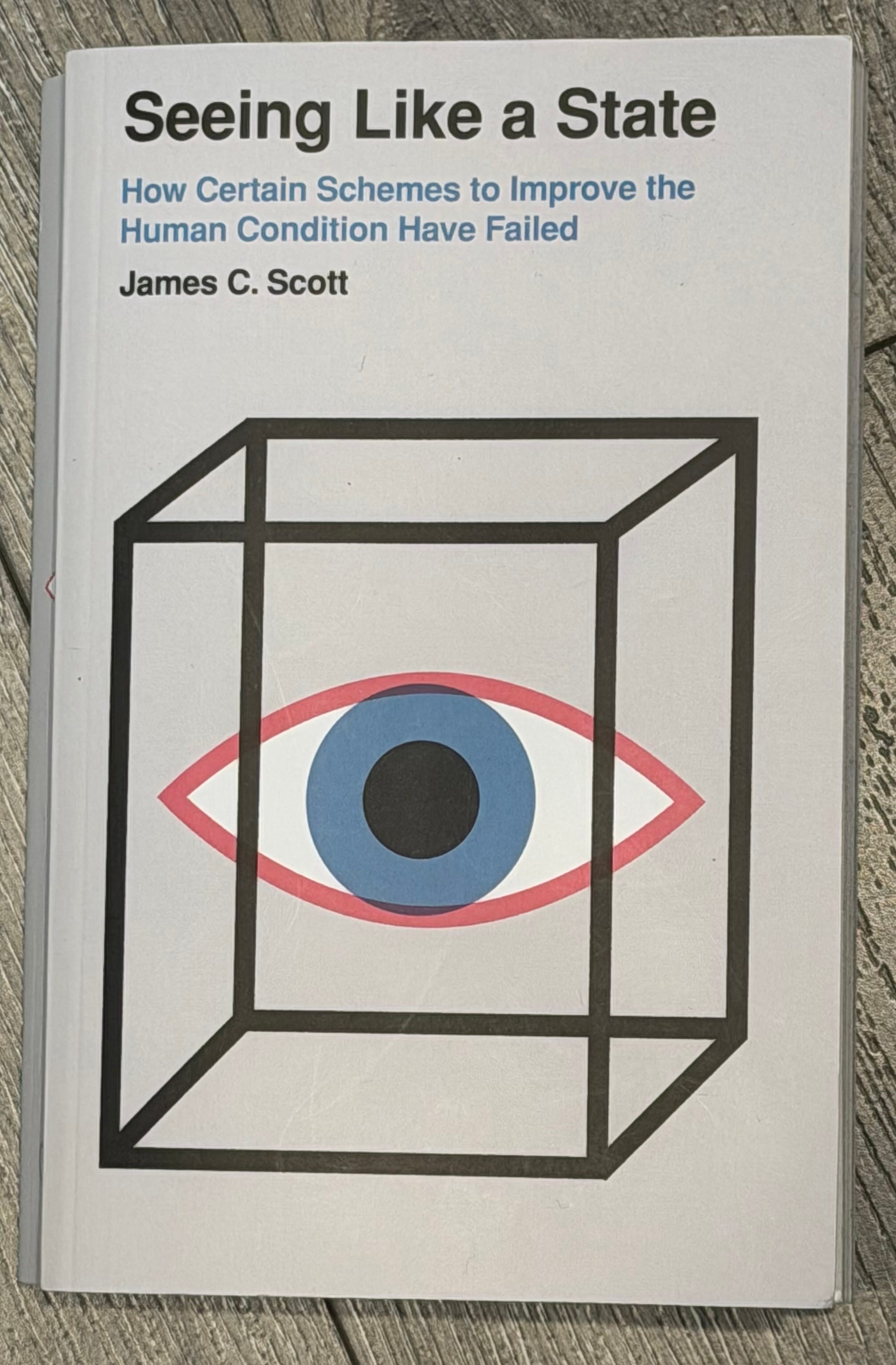
Review: Seeing Like a State
Review of Seeing Like a State: How Certain Schemes to Improve the Human Condition Have Failed by James C. Scott
Every organisation you’ve ever worked for has tried to simplify you: your performance has been reduced to a number; your skills to a list of keywords that HR has built company-wide profiles on (usually failing to accomplish anything meaningful in the process); your potential to a box on a nine-grid; and so on.
If you’ve ever felt that the version of you that exists in a system bears only a passing resemblance to the actual you, if that, James C. Scott has 445 pages explaining why — and what happens when that impulse to simplify is backed by the full coercive power of a state.
“Seeing Like a State: How Certain Schemes to Improve the Human Condition Have Failed“ is an ambitious, dense, and frequently brilliant examination of what happens when states try to make the messy complexity of real life legible - reducible to categories they can then measure, manage, and control. First published in 1998, it remains remarkably relevant, even as some of its examples have aged a bit.
Scott opens with an example that seems deceptively simple: forestry. When eighteenth-century German states looked at a forest, they didn’t see an ecosystem. They saw - surprise! - revenue. Specifically, they saw how much timber could be extracted annually.
Everything else about the forest - the berries, the fungi, the medicinal plants, the grazing, the habitat, the spiritual significance - was invisible to the fiscal lens. The forest-as-habitat disappeared and was replaced by the forest-as-economic-resource.
This, Scott argues, is what states do to everything they touch: they strip away the particular, the local, and the contextual in favour of standardised categories that can be counted, taxed, and administered.
From forests, Scott expands to measurements (did you know that in pre-modern Malaysia, the answer to “how far is the next village?” might be “three rice-cookings”? - a unit that conveys what the traveller actually needs to know far better than any number of kilometres), to surnames (which are a surprisingly recent invention, imposed by states for the purpose of making populations legible), to language standardisation, to the redesign of cities, and eventually to the grand disasters of high modernism: Soviet collectivisation, compulsory villagisation in Tanzania, and the architectural hubris of Le Corbusier’s planned cities.
The book’s argument rests on four elements that, Scott contends, must combine to produce truly tragic state-initiated social engineering: administrative ordering of nature and society; a high-modernist ideology with uncritical confidence in science and technology; an authoritarian state willing to use coercive power; and a prostrate civil society that lacks the capacity to resist.
It’s hard to read this list in 2026 without a chill of recognition, except that today’s high modernists have replaced uncritical faith in science with uncritical faith in a blinkered, biased, and demonstrably false worldview.
I found the book to be at its best when discussing cities, drawing heavily on the work of Jane Jacobs. The contrast between Le Corbusier’s sterile modernist vision and Jacobs’ celebration of messy, organic urban life is one of the book’s most compelling sections, but YMMV of course.
The concept of being on “sidewalk terms” with people in your neighbourhood — not friends, but acquaintances who recognise one another and who collectively form an intricate web of informal social order — resonated deeply with me, and also ties into points made in many other books, such as Joe Keohane’s The Power of Strangers. Jacobs saw that the busiest room in a house is the kitchen, and the busiest street in a neighbourhood functions for the same reason: it is the most versatile setting, a place of socialisation and exchange. Understanding this, Scott argues, is no more difficult than understanding why the kitchen draws people; and yet urban planners have spent a century trying to engineer it away.
The analogy Scott draws between city development and language development is particularly elegant. Both are the unplanned creation of millions of people over time. Both resist central planning; Esperanto and Brasília share the same fundamental problem.
And both, when allowed to develop organically, tend towards a rich, multivalent complexity that planned alternatives simply cannot match.
The book’s final chapters, on what Scott calls métis (a Greek term denoting practical knowledge that can only come from experience) are where I found the deepest current value.
Métis is the firefighter who reads a situation; the sea captain who senses a change in weather through the roll of the ship; the farmer whose knowledge of this particular piece of land cannot be reduced to generic agricultural principles. It is knowledge that resists codification precisely because the environments in which it operates are too complex and variable for formal procedures.
You can master every principle and still fail at the craft, because knowing how and when to apply rules in a concrete situation is métis - and it is precisely what our current AI models lack. They can ingest every principle ever written down; what they cannot do is develop the practitioner’s feel for when the principles don’t apply.
The concept has stayed with me. In fact, it became one of the triggers for a recent essay I wrote on what I call “the grace margin“ - the space between what a system prescribes and what a person actually does, where someone can look at the rules, look at the situation, and choose judgment over procedure.
The grace margin lives in métis; in the practical, informal knowledge that no system can fully capture and no algorithm can replicate. Scott showed me where that concept has its roots, and why its erosion matters far more than most people realise.
The observation that formal order is always and to some considerable degree parasitic on informal processes is one of those insights that, once seen, cannot be unseen. Scott illustrates this brilliantly with the work-to-rule strike, aka malicious compliance: when workers follow every rule and procedure to the letter, production grinds to a halt, because actual work depends on a host of informal practices and improvisations that could never be codified.
The formal scheme cannot create or maintain these processes; it can only exist because of them.
I do have some reservations. The book is not a quick read. The concepts are heavy, the language is heavy, and Scott’s academic thoroughness sometimes comes at the expense of pace. Some readers will find the extended case studies, particularly the chapters on Soviet collectivisation and Tanzanian villagisation, more exhaustive and potentially exhausting than illuminating, though I appreciated having a case study I’d never encountered before in the Tanzania material.
More significantly, there is a datedness issue that becomes harder to ignore as the book progresses. Scott’s framework is built almost entirely from twentieth-century examples, and some of the most significant mechanisms of legibility and control in our current era — social media, the internet, algorithmic governance, platform economies — simply don’t register.
In many ways, what has been done in agriculture alone in the past twenty-five years represents another layer of extraordinary change, much of it not for the better, but some also for the better (e.g. permaculture, regenerative agriculture).
The core arguments remain powerful, but the book would benefit from a contemporary companion that extends Scott’s framework into the digital age, where legibility is no longer imposed by census-takers and cartographers, but extracted by algorithms processing our every click, purchase, and movement.
The state still sees; but so, now, does everyone else with sufficient data and computing power, and potentially in much higher detail than the state does.
Despite this, “Seeing Like a State“ is a book whose central insights have only become more urgent. The impulse to simplify, to make legible, to eliminate the variance where human judgment lives — this impulse hasn’t weakened since 1998. If anything, it has been turbocharged, because we can now have so many data points it feels like we could finally quantify everything and make everything legible. I’m highly skeptical of that view.
Scott’s warning that high-modernist designs tend to diminish the skills, agility, initiative, and morale of their intended beneficiaries feels less like historical analysis and more like a forecast of what algorithmic management is doing to workers right now.
And his closing plea for métis-friendly institutions — organisations that are multifunctional, plastic, diverse, and adaptable — feels almost radical in an era that worships efficiency and consistency above all else.
We need more flexibility and we are, as Scott feared, designing it away.
Rating: 4 out of 5
Dog-ear index: 6.6
Who is it for: Anyone who has felt ground down by bureaucracy and wanted to understand why; people interested in urban planning, governance, or the tension between efficiency and humanity; and anyone building or deploying systems — algorithmic or otherwise — who wants to understand what gets lost when you optimise for legibility.
[reminder: I highlight important parts of the books I read, and dog-ear the really important pages. The dog-ear index is simply the average number of dog-eared pages per 100 pages]
Product link for reference only; please support your local bookstore where possible: https://www.amazon.com.au/Seeing-Like-State-Certain-Condition/dp/0300246757


A brilliant review of a brilliant book that is simultaneously both very dated and never more relevant.
As Sami points out, work-to-rule is a profound illustration of why organisational complexity and messy reality will make AI adoption much harder and longer than is currently supposed.
Thomas Heatherwick’s brilliant “Humanize” provides an equally superb, perhaps more accessible, deconstruction (pun intended) of Le Corbusier’s aesthetic and the subtle social damage caused by much modern architecture.
Full of wisdom and insights worth reading and reflecting upon!