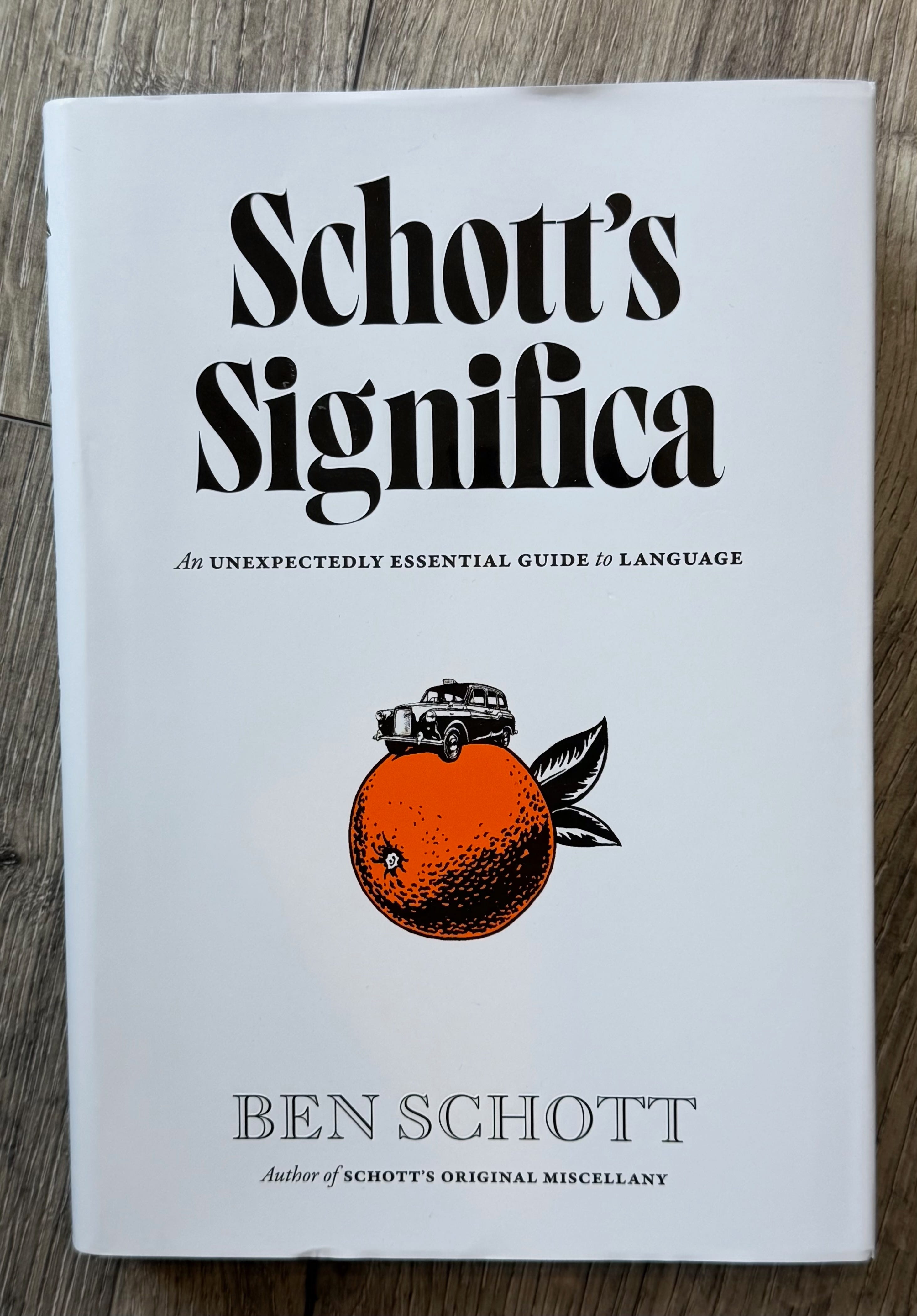
Review: Schott's Significa
Review of Schott’s Significa: An Unexpectedly Essential Guide for Language by Ben Schott
There are worlds within worlds hiding in plain sight. Every profession, subculture, and community has developed its own lexicon - a private language that marks insiders and bewilders outsiders; in some domains, it’s explicitly used to mark that border, while in others the jargon is simply adopted for reasons of efficiency in communication. In many cases, it’s a bit of both.
You are no doubt a member of one or more such group. It could be your profession, your hobby, your religion, or a special area of interest – but while all of us are involved in one or a few, the subcultures run so deep it’s impossible to be deeply embedded into more than a handful.
Which is where Ben Schott’s “Schott’s Significa“ comes in – it gives us outsiders an absolutely riveting view into some of those hidden worlds; a skeleton key to dozens of these hidden vocabularies, and reading it feels like being handed a decoder ring for parts of modern life that were either hidden from us or that we just ignored, not understanding them.
You may not have heard of the word ‘significa’. That’s because the English word was, to the best of my knowledge, invented by Ben.
It’s the first of many, many, words you will learn from this book. The very first page of the book mercifully offers a definition for significa, which feels tongue-in-cheek, but turns out to be dead-on accurate:
Schott’s Significa, while there are brief sections that resemble a dictionary, is not a dictionary, or linguistic analysis. It’s more like a guided tour through the secret handshakes of human tribalism. From Venetian gondoliers (did you know their trade is seasonal?) to Taylor Swift fans, from espionage tradecraft to graffiti writers, from London black cab drivers to the manosphere’s toxic taxonomy - Schott has assembled a veritable compendium of specialist vocabularies that reveals just how little we understand about the worlds we brush past daily.
It’s utterly fascinating.
The range is staggering; a glance at the contents page offers everything from “Open Outcry Trading” to “Pride Flags,” from “Competitive Eating” to “Italian Gesticulations”, the last of which gets multiple pages of hand gestures, naturally – an example how the book is not just words, but also other forms of language.
Want to understand what Swifties mean when they deploy their particular lexicon? It’s here.
Curious about the surprisingly elaborate terminology of movie poster billing blocks? That too.
The alphabet’s role in protest movements and Russian disinformation tactics? Present and accounted for.
I would be willing to bet you will learn more words from this book than any other book ever, save a dictionary – and if you’re anything like me, then promptly forget most of them. But you will learn so much more than just the words; it illuminates the depth that exists in seemingly mundane domains.
Take graffiti: what is usually casually dismissed as vandalism turns out to have an intricate hierarchy (TOY to KING to LEGEND to ANGEL), elaborate rules of etiquette (don’t hit graveyards, memorials, or small businesses), and a vocabulary that would make academics envious.
“Genuine graffiti may best be understood as a private conversation on which passersby eavesdrop without understanding.“ That point, along with the below quote from TOOMER of the TKO crew reframe the entire art form:
Some people come up to me when I’m doing a mural, and be like, ‘Wow this is beautifu! I like the colours, and I like these animals you put on there, and incorporate it in this whole thing, I just hate that damn tagging shit, though?’ And I tell ‘em: It’s the same thing! I mean, it starts with a little tag and from the little tag it gets a little throw up, and the little throw up gets a little burn, a little burn turns into a piece, and the piece turns into a mural — and if I didn’t do that tag, I wouldn’t be able to do your building.
There’s just layers and layers of discovery here. The bartender slang section reveals how lingo can be wildly diverse even within a single profession - terminology varies not just by country but by individual establishment, from Weather Up in Manhattan to the Mirror Bar in Bratislava.
I should note: my daughter, who exists in certain fandoms I merely orbit, was quick to point out that not everything in those sections was exactly 100% accurate.
I’m assuming similar minor imperfections exist elsewhere – that seems inevitable when covering this much ground at this pace. Each subculture gets only a dozen pages at most, so depth is necessarily sacrificed to breadth.
But even these glimpses increase understanding by miles, and more importantly, they reveal how much we don’t know about things we encounter every day.
Some sections will quite naturally resonate more than others depending on your existing interests - there’s something here for everyone, and probably several somethings you didn’t know you needed. This also isn’t the kind of book you would necessarily read cover-to-cover in sequential order, although I did. You can jump in at a random section to learn something and come back to somewhere else in the book with no issues whatsoever.
Every community, no matter how niche, over time seems to develop rich linguistic traditions. Since people don’t have time to be deep members of more than a couple of communities, learning about the others through a work like this offers not mastery, but appreciation.
A recognition that the seemingly simple surfaces of modern life conceal elaborate codes, hierarchies, and traditions goes a long way, even if it doesn’t make you a member of the ‘in’-group.
I was slightly disappointed that some communities I’m a member of weren’t represented (all aspects of aviation? Notably absent. IT and computer side of things? Same.) and surprised to learn that others I’m superficially part of, like gyms, run far deeper than I’d realized.
The book also captures some things we’re losing - like the hand signals of trading floors, now increasingly replaced by algorithms. Whether that loss is bad for us is debatable; that it represents a kind of a loss of human complexity is not.
Schott’s Significa is amazing deep dive into the diversity of humanity itself. Every subculture’s vocabulary reflects its values, hierarchies, and obsessions. The manosphere’s elaborate taxonomy of male types tells you everything you need to know about its worldview. The restaurant industry’s euphemisms for difficult situations reveal its psychological survival strategies. The graffiti community’s rules about what you can and cannot paint over encode an entire ethical system for a community that many people probably consider completely devoid of ethics.
The production quality deserves a special mention: pages are packed with information, but have a light and airy feel to them nevertheless; it’s lavishly illustrated with photographs that actually illuminate the concepts and aren’t just there for looking nice; it’s beautifully typeset; and organized in a way that rewards browsing and reading.
Rating: 5 out of 5
Dog-ear index: N/A (not really the kind of book where this applies)
Who is it for: The subtitle is actually perfect; this really was unexpectedly essential, and I’m confident any curious person will find many interesting things from this.
[reminder: I highlight important parts of the books I read, and dog-ear the really important pages. The dog-ear index is simply the average number of dog-eared pages per 100 pages]
Product link for reference only; please support your local bookstore where possible: https://www.amazon.com.au/Schotts-Significa-Unexpectedly-Essential-Language/dp/0241736609/


Sami, I'm delighted you like "Significa" … thank you for this generous and thoughtful review! – Ben Schott
We've long had Schott’s Original Miscellany next to the toilet, as an indispensable browseable book. Glad to know he's created something huger.