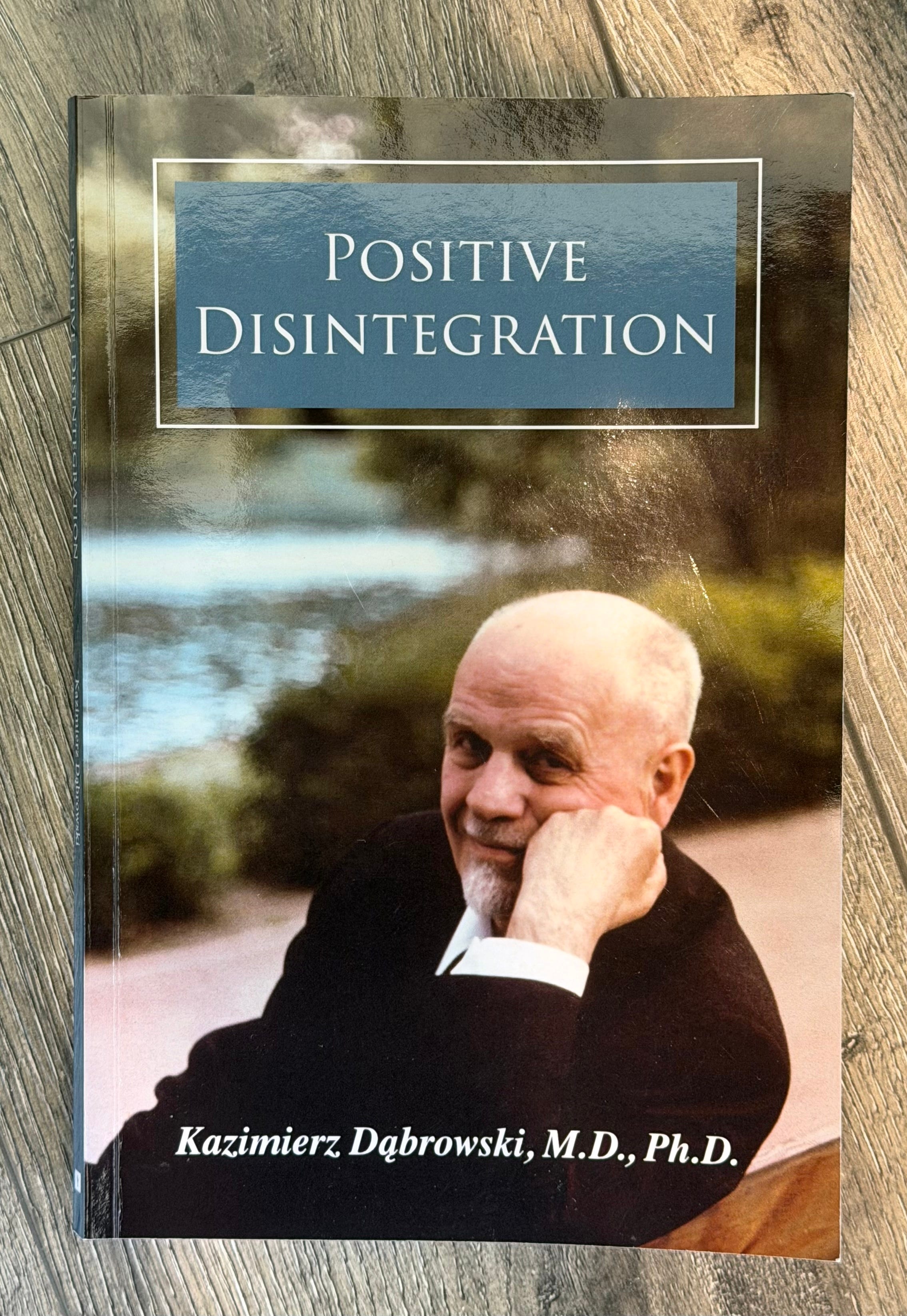
Review: Positive Disintegration
Review of "Positive Disintegration" by Kazimierz Dabrowski, and a nano-introduction to the theory while we're at it.
I came to learn of Kazimierz Dabrowski’s theory of positive disintegration from a psychology professional, which started an intellectual breadcrumb trail that I’ve really only begun: I listened to a few podcast episodes, saw references in discussions about gifted education and trauma, and then decided to trace the concept back to its source. The first book-length presentation in English is Dabrowski’s book Positive Disintegration from 1964, which is both a foundational outline of the theory and a bit of a problematic artefact of its time.
I was somewhat surprised to learn that despite having been in existence for over half a century, the theory of positive disintegration remains largely unrecognized in mainstream psychology. Despite having been called “one of the most influential theories in gifted education“, Dabrowski’s framework hasn’t been integrated into standard curricula or clinical practice in the same way e.g. Erikson’s stages have.
The theory seems to have found its audience primarily among educators working with gifted children, individuals seeking alternative frameworks for understanding psychological crisis, and a small cadre of scholars interested in personality development and existential psychology.
What is positive disintegration?
Dabrowski inverts conventional mental health discourse: what if the markers we typically associate with psychological disturbance like anxiety, internal conflict, depression, and even neurosis aren’t actually pathologies requiring elimination or treatment, but rather signals of positive developmental potential? He argues that disintegration of socially-conditioned personality structures constitutes – at least sometimes – not breakdown but breakthrough. The capacity for psychoneurotic crisis becomes, paradoxically or at least counter-intuitively, an indicator of potential mental health.
From Dabrowski’s war experiences, including witnessing the aftermath of battle, emerged a theory positing that “it is not internal conflict, nervousness, or even neurosis which signifies mental disease“ but rather the absence of such conflicts in individuals capable of development. True mental disturbance, in this framework, manifests not as anxiety but as its opposite – a kind of sociopathic calm of someone incapable of moral doubt, and the rigid certainty of primary integration.
The theory distinguishes between two fundamentally different types of personality integration. Primary integration represents the socially-adjusted individual who has internalized their culture’s values wholesale, experiencing minimal internal conflict because they’ve never questioned the environment that shaped them. This is conformity mistaken for stability that Dabrowski calls “normality” in scare quotes, noting that “normal” traits commonly include “group thinking and behavior” accompanied by “minor, ‘safe’ dishonesty.”
Secondary integration, by contrast, emerges only through active disintegration; an often painful breaking apart of socially-conditioned responses to consciously construct autonomous values. This requires what Dabrowski terms the “third factor,” an internal drive toward self-improvement (or, to be more precise, “dynamism of conscious valuation and selection”) that enables individuals to evaluate and transform themselves according to consciously chosen ideals rather than social conditioning.
Dabrowski articulates his challenge to conventional psychiatric thinking as follows:
In many psychiatric textbooks the ability to adapt to changing conditions of life is given as one of the characteristics of mental health. What is meant by this concept of adaptation? Does it mean clearly understanding various types of environmental reality and various human personality patterns, including their level of development, and on this knowledge basing appropriate behavior in accordance with one’s principles? Or does it mean greater or lesser resignation of one’s own point of view, principles, and modes of behavior for the sake of resolution of conflict?
The first formulation is in accordance with the demands of mental health; the second is not. The developing individual should understand reality as completely as possible. He should not react too emotionally to the difficulties emerging from it. He may even wisely involve himself in resistances, conflicts, and the consequent life difficulties where an unavoidable situation demands nonadaptation if he is to be consistent with his moral and social points of view. Such an attitude practiced consistently contributes to the formation of moral individuality.
The insight that conformity might impede development, that “normal” functioning can represent arrested growth, that creative transformation requires breaking things, remains, to the best that I can tell, a somewhat radical proposition. In an era obsessed with optimization and the pathologization of discomfort, Dabrowski’s insistence that psychological tension can be developmental rather than merely symptomatic offers a welcome counterpoint.
Where the book and the theory start feeling a little off comes from its age. There are passages like Dabrowski’s discussion of sexuality, where mid-century moral conventions parade as universal developmental principles. Then the distinction between “primitive animal impulses“ and “purified human“ expressions comes across as less psychology and more normative smuggling of repackaged Cartesian dualism.
The lengthy contemporary foreword by William Tillier from 2016 is important for navigating some of this, offering context that helps separate valuable theoretical insights from dated social conventions. It’s important to remember not to take Dabrowski’s cultural prejudices as psychological truths. As it is, the text requires constant critical engagement - appreciating insights about developmental dynamics while recognizing when mid-century morality is being dressed up as universal law.
In addition to the cognitive load of filtering everything through contextual lenses, the language itself requires a bit of effort. It’s dense, philosophically ambitious, sometimes opaque – while it’s just ~100 pages, the pages are slow. Concepts like “multilevel disintegration,” “developmental dynamisms,” and the various integration types demand intellectual work.
The “third factor” itself veers toward the unfalsifiable, a quasi-mystical internal drive that supposedly enables autonomous development but resists clear empirical definition. It’d be tempting to just write some of it off as woo-woo, and maybe some of it should be.
I am, however, convinced all of it should not be written off. Underneath all this historical baggage and conceptual density, there are valuable concepts, such as the recognition that many conflicts arise from clashes with external environments rather than internal pathology; the observation that “the developing individual cannot submit to narrow specialization except at the cost of a loss in creativity.”; the insight that conformity might represent its own form of developmental failure; the possibility that what we call mental illness might sometimes be mental growth in clothing we’re uncomfortable with.
Reading this original text offers something no contemporary summary can provide: an encounter with how groundbreaking ideas emerge embedded in their moment. Every state-of-the-art theory eventually becomes a historical artefact. The frameworks we treat as universal reveal themselves as culturally specific.
That made the reading a strange combination of annoying, humbling and oddly liberating. If Dabrowski could be so insightful about developmental dynamics while being obviously wrong about some things and clearly outdated in his neurobiology, what are we getting wrong right now while convinced we’re right?
Would I recommend beginning to understand positive disintegration with this text? Not really. Not unless you’re committed to engaging with original sources and fascinated by intellectual history, and willing to work through historical views that will rub you the wrong way.
Frustratingly, given I’m in relatively early stages of understanding all this myself, I don’t have a great alternative to offer either – but a couple of useful starting points are the introduction in this book, and the Positive Disintegration podcast.
• Rating: 3.5 out of 5
• Dog-ear index: 9
• Who is it for: Those who have already been introduced to the theory and want to go back to the original source, and psychology historians who are interested in how groundbreaking ideas age.
[reminder: I highlight important parts of the books I read, and dog-ear the really important pages. The dog-ear index is simply the average number of dog-eared pages per 100 pages]
Product link for reference only; please support your local bookstore where possible: https://www.amazon.com.au/Positive-Disintegration-Kazimierz-Dabrowski/dp/1600250955/


Loved this, Sami. Thank you for your thoughts, it is useful and has given me some additional areas to explore. The discussion on Positive Disintegration captures why inner conflict can sometimes be a sign of growth, not decline. The caution about mid-century baggage is spot on. I’m exploring similar ideas as a peripheral lens in aviation training, using a Crew Cognitive Resilience Index (CCRI™) to separate productive challenge from harmful overload. Curious what you think would count as good, modern evidence for the “third factor” in practice. As ever thank you for your insights.