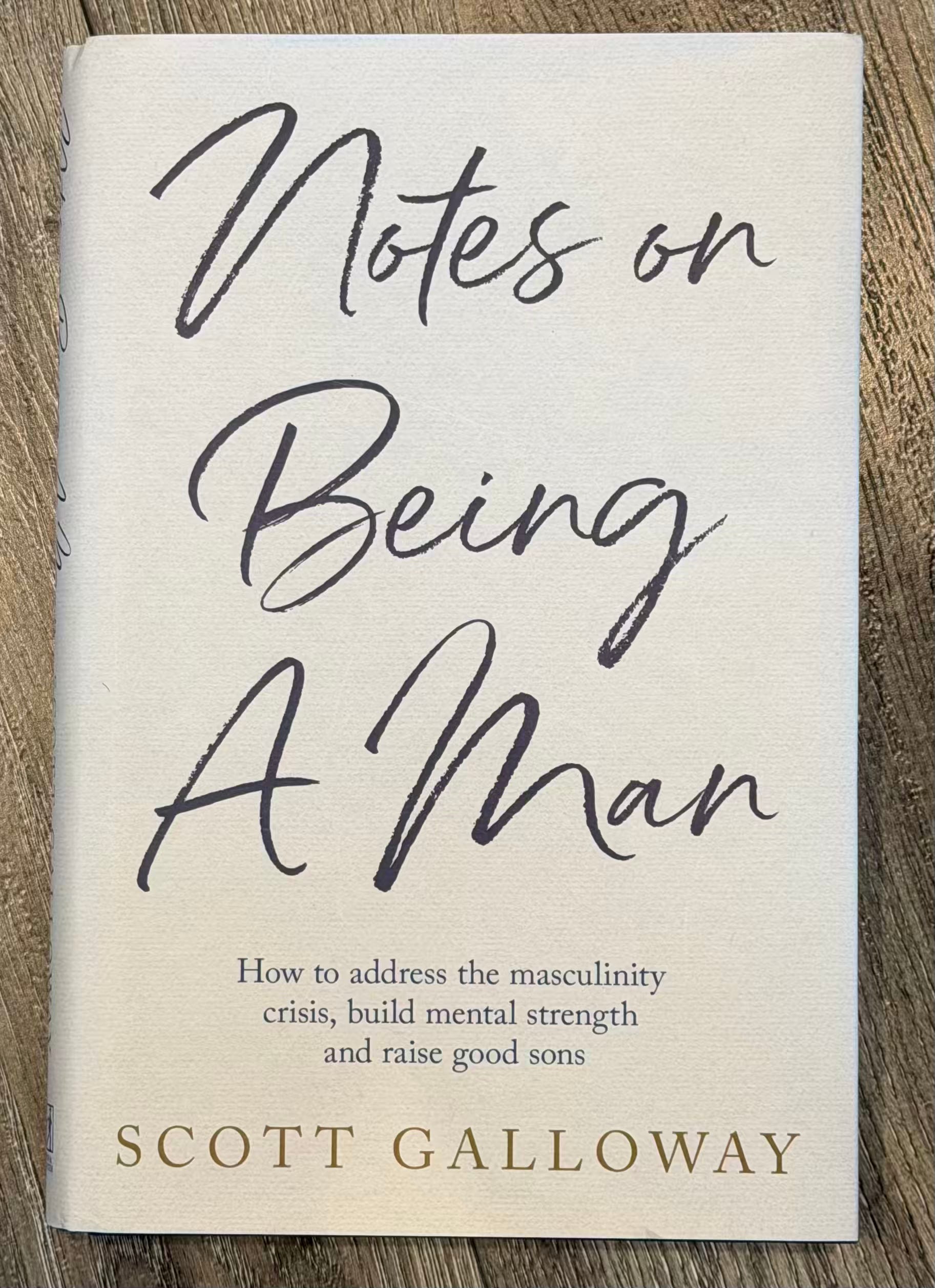
Review: Notes on Being a Man
Review of Notes on Being a Man: How to Address the Masculinity Crisis, Build Mental Strength and Raise Good Sons by Scott Galloway
Let’s get a bias disclosure out of the way first: I’m a fan of Pivot, the podcast Scott Galloway co-hosts with Kara Swisher. Their dynamic of at times disagreeing fiercely while remaining genuine friends is exactly what our discourse desperately needs more of. I’m sure Scott would appreciate this mentioning of Kara in a review of a book that’s 100% his.
Anyway, the point is I might have come into this book predisposed to appreciate Scott’s perspective, though I’ve tried to read it fairly.
“Notes on Being a Man“ arrives at a moment when discussing masculinity has become a minefield. Say the wrong thing and you’re either a crypto-misogynist or a woke scold; there’s precious little room for nuance. Even the word seems cursed. Scott acknowledges this directly: it’s very easy to get labeled ugly things if you point out that men are struggling.
Yet struggle they are, and into that vacuum have rushed voices ranging from the merely unhelpful to the genuinely toxic, like the idiot who fled to Romania to escape sex trafficking charges while building a fanbase of young men who mistake cruelty for strength.
Against this backdrop, Scott offers something refreshingly different: practical, often brutally honest advice grounded in his own failures as much as his successes. His framework couldn’t be much simpler: protect, provide, procreate. This might sound reductive but functions as a reasonable starting point.
One of the book’s strengths is its unflinching self-assessment, in typical Scott Galloway parlance:
“As a young man, I thought my success was solely a function of my being awesome. My character, my tenacity, my talent. What a fucking child.”
This willingness to call out his own past delusions extends throughout: he acknowledges that “a lot of success isn’t your fault,” that he was “born on third base,” partly a function of being “a white, heterosexual male who was born and came of age in the right place and the right time.”
There’s some very basic-sounding practical wisdom scattered throughout: get the easy stuff right (show up early, have good manners, answer the damn email); leave your house because “the amount of time you spend at home is inversely correlated to your success, professionally and romantically“; develop a code because “without a code, humans, men especially, can become feral and disorganized.”.
Notes on Being a Man is appropriately peppered with short notes, some of which are in the category of hard truths that are obvious but often need to be spelled out:
“Note: Talent isn’t enough. Being in the 1 percent means joining 75 million others.”
These are in no way revolutionary insights, but young men need to hear them from somewhere, and they’re increasingly not hearing them from traditional sources. Now, if you’re an older man (or a woman) reading this and thinking the advice is too simplistic, congratulations - you’ve either internalized it already or should have read this book decades ago.
You’re not the target audience. If you have sons or young men in your life, and they’re not going to hear equivalent guidance from you, have them read this book, but with a couple of caveats.
First caveat: understandably, it’s very US-centric; the concerns about healthcare costs, the specific cultural dynamics, the particular flavor of hustle culture all read as distinctly American, even if the broader patterns rhyme elsewhere.
More fundamentally, Scott operates from a worldview where financial success is a major metric. “Working for a corporation is a great way to get rich slowly“ is solid advice if getting rich is your goal, but not everyone defines success that way. Galloway is a child of capitalism and while he strongly advocates for better and more redistributionary policies than we have now (which is great), he’s not one to question the core.
Still, in a landscape where young men are being fed poison by grifters and ideologues, Notes on Being a Man is useful: honest, experience-tested guidance from someone willing to admit his own failures. Precious little guidance out there comes from such a transparently honest place, so full credit for that.
It’s not perfect, and it won’t resonate equally with everyone, but as a counterweight to the Andrew Tates and Jordan Petersons of the world, it’s a welcome contribution. Scott’s takedown of the ‘never give up‘ mythology captures the book’s spirit: ‘Jesus, what bullshit.’ There’s something quietly radical about a success book that insists quitting is also a virtue.
Rating: 4 out of 5
Dog-ear index: 6.8
Who is it for: Young men looking for practical life guidance that isn’t toxic; parents of sons wanting a framework for conversations about masculinity; anyone frustrated by the current discourse around men and looking for something sensible.


