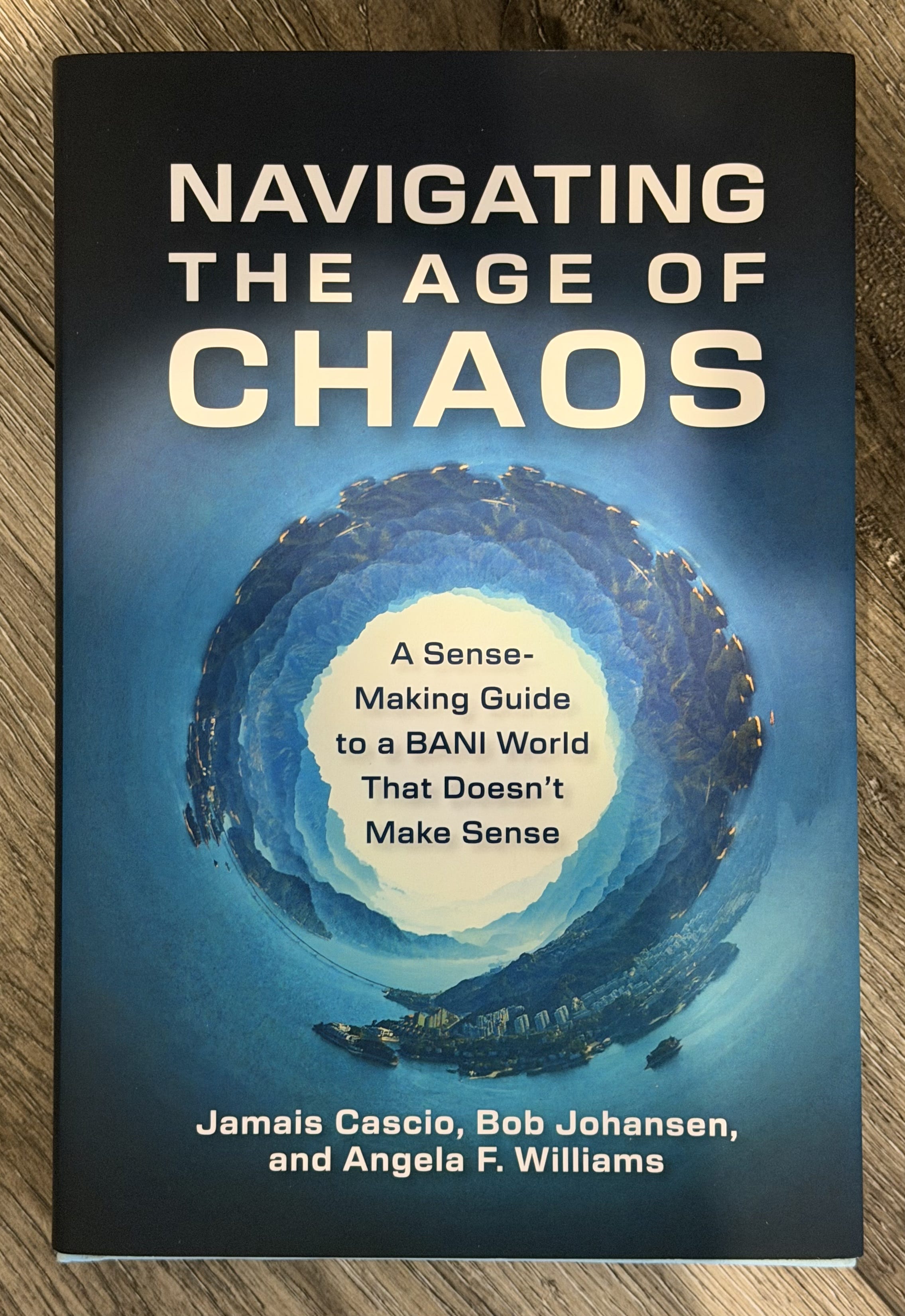
Review: Navigating the Age of Chaos
Review of Navigating the Age of Chaos: A Sense-Making Guide to a BANI World That Doesn't Make Sense by Jamais Cascio, Bob Johansen, and Angela F. Williams
Full disclosure: I was in the room at the Institute for the Future conference in 2018 when Jamais Cascio first introduced BANI. I know Jamais and Bob. I have written about the BANI concept multiple times over the years (here, here, here, and here for starters), and I genuinely love the concept. BANI captures our current moment in more visceral way that the older VUCA framing doesn’t quite reach.
For those unfamiliar with the term, BANI stands for Brittle, Anxious, Nonlinear, and Incomprehensible. It’s a framework for describing how the modern world feels to those living in it. Brittle systems appear robust until they shatter catastrophically. Anxiety pervades our collective psyche as we await the next crisis. Nonlinear means cause and effect are disconnected - that small actions can trigger outsized consequences, and vice versa. And incomprehensible captures the reality that we now depend on systems so complex that no one fully understands them.
Where the older VUCA framework (Volatile, Uncertain, Complex, Ambiguous) describes the environment we operate in, BANI is, to me anyway, more about the human, emotional experience of navigating that environment. That’s what made it resonate when Jamais first introduced it, and why I’ve found it useful ever since.
As a fan of BANI, I really wanted to like this book.
I mean I really, really wanted to like this book.
I don’t. Not really.
The core problem could be that BANI worked brilliantly as an article, or a series of articles, but stretching it to book length has led more unnatural-feeling padding than useful substance – but since it’s a short book, the additions feel like they haven’t been given due attention either, and start at weird places.
Several complex topics like AI, climate change, pandemics, and social media receive treatment so superficial it borders on counterproductive. Climate change is introduced as if readers might not have heard of it. The AI section contains simplifications that veer into inaccuracy. And some claims are simply wrong: global suicide rates, for instance, are not increasing as stated.
Some of the framing choices grated on me. The book suggests we should “farewell” VUCA in favor of BANI, which is nonsensical - they describe different things; VUCA is about the environment, BANI about how we experience it. They’re complementary, not competing – or at least that’s how I’ve always treated them. I challenge anyone who thinks the VUCA elements of Volatile, Uncertain, Complex, and Ambiguous don’t still apply today.
But this whole thing made me think of BANI in more fundamental ways, too, and I realized we shouldn’t let the authors - or BANI aficionados like myself - off the hook here. We need to question the very base premise of the framework: the idea that we are living through a somehow unique inflection point of maximum chaos.
Are we? As much as the book talks about the importance of history, there is a case to be made that the book suffers from historical amnesia, and that we’re just suffering from illusory exceptionalism. Wouldn’t be the first time.
Over 100 years ago in 1919, watching the collapse of physics, empires, and logic simultaneously, Paul Valéry captured an eerily similar sentiment in his essay Disillusionment, noting:
“The storm has died away, and still we are restless, uneasy, as if the storm were about to break. Almost all the affairs of men remain in a terrible uncertainty... We think of what has disappeared, and we are almost destroyed by what has been destroyed... We civilizations now know that we are mortal.”
As much as I want to believe that ‘this time is different’, and agree there is some data to support that notion, I would also have to concede that in many ways the “anxiety” and “brittleness” are just the baseline condition of modernity. Possibly to some extent humanity. By framing them as novel, we risk confusing a recency bias for a paradigm shift.
Setting aside these larger questions, there are also execution issues. The forced alliteration of “positive BANI” counterparts (Anxious-Attentive, and so on) feels exactly that - forced. Worse, “nonlinear” gets redefined from its actual mathematical meaning to “a more metaphorical concept,” which strips the term of some of the power that made it useful.
There are internal contradictions that editing should really have caught. The book accurately acknowledges the nonlinearity and hysteresis of climate change - that we’re locked into worsening conditions regardless of what we do now - and then on page 79 assures us that “we know how to keep it from getting worse than it is now.”
Which is it?
Similarly, pages 169-170 argue, within paragraphs of each other, that leaders who have experienced mental health challenges like bipolar disorder are better suited for BANI chaos - and then that leaders need to be “extremely mentally and physically healthy to perform at the highest levels of leadership.“
Which is it?
The confusion is compounded by a fundamental misunderstanding: though a very minor point overall, bipolar disorder isn’t something you “experience” and move past. It’s a chronic, lifelong condition - manageable, yes, but not curable. People have bipolar disorder; they don’t “go through” it. Someone with well-managed bipolar disorder can absolutely be an excellent leader but framing it as a past event they’ve overcome undermines whatever point the authors were trying to make.
The practical advice sections, which I appreciate as a concept because too often authors of high-concept books try to shy away from anything practical, prompted me to scrawl “HOW??!” in the margins more than once.
To give you a taste of the language: under “Nonlinear” leadership qualities, we’re told that:
“Bio-engaging: Leaders must harness the inherent wisdom of nature to mobilize responses to the climate-disruption urgencies we face as a planet.”
Under “Incomprehensible,” leaders are advised to foster “gameful emotionally laden attention to deliver first-person growing experiences.”
What do these even mean? The charitable interpretation here is that the authors have been too embedded in this terminology to realize it sounds weird, and you can make some sense of them, but why make it sound so difficult?
We’re told leaders must “lower tensions and bridge polarities“ – and then it’s pretty much left at that. There is no meaningful level of ‘how’ to that guidance. Granted, such an answer would probably have taken five more books, but the sheer complexity of doing this is not acknowledged properly.
Retrofitting famous examples like Viktor Frankl’s survival story into paragraphs on “Viktor Frankl’s Anxious Turnaround / Brittle Turnaround“ frameworks feels reductive and, frankly, a bit icky (technical term). And reframing Netflix’s strategy as demonstrating “neuroflexibility and improvisation“ is business book 101 in a negative way: taking old stories and slapping new terminology on them.
Too much of that part reads like what it probably is: material rewarmed from Bob’s previous books, combined with concepts that haven’t developed much beyond their original articulation. Or maybe they have developed, but not in ways that I found compelling or very useful.
The result feels like a principles-based AI ethics framework - appealing words and concepts, things few people will on the face of it disagree with, but that are extremely hard to implement, with little guidance offered for that crucial part and as such, not very helpful.
To be fair, I am not the target audience. As a foresight professional who knew about BANI from day one, little to nothing here was new to me, and that inevitably colors my reading experience; readers encountering these ideas for the first time are likely to find the book a more useful introduction. The point that BANI operates at a more human, emotional level than VUCA remains valid and important. There are scattered insights worth preserving.
Rating: 3 out of 5
Dog-ear index: 4
Who is it for: Those entirely new to the BANI framework who want an accessible introduction. Foresight professionals and those already familiar with the concept will likely find little new ground covered.
[reminder: I highlight important parts of the books I read, and dog-ear the really important pages. The dog-ear index is simply the average number of dog-eared pages per 100 pages]
Product link for reference only; please support your local bookstore where possible: https://www.amazon.com.au/Navigating-Age-Chaos-Sense-Making-Doesnt/dp/B0DVBG9FYR/


Sounds like a must-read! Navigating chaos is something we all need guidance on these days 📚💡