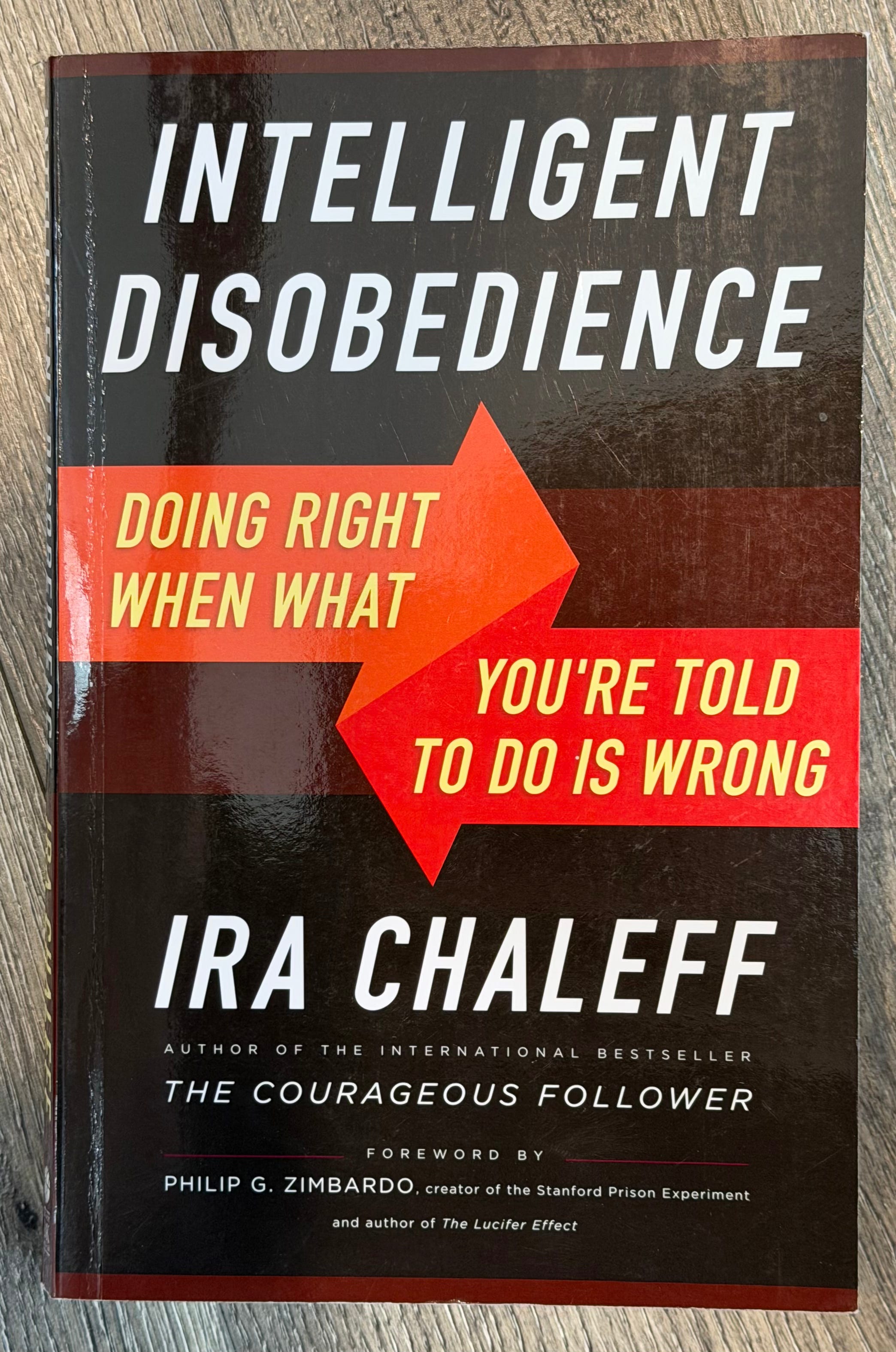
Review: Intelligent Disobedience
Review of Intelligent Disobedience: Doing Right When What You're Told to Do Is Wrong by Ira Chaleff
We teach obedience extraordinarily well. We teach it in homes, in schools, in workplaces, in militaries. The vast majority of the time we reward compliance and punish deviation.
And then, when someone follows orders into a catastrophe — financial fraud, medical harm, atrocities — we act surprised. We ask, “How could they do that? Why did they just go along with it?“
Ira Chaleff’s Intelligent Disobedience wants to address that gap. The title concept is borrowed from guide dog training: a guide dog must learn when to disobey a command that would put the team in danger. When a handler says “forward” at an intersection, but a car is coming, the dog must refuse. Learning not to obey, the trainers say, is a higher order of skill.
Chaleff argues we need to develop the same capacity in humans, and he’s right. But is this book, published over a decade ago, still an applicable guide for getting there?
I should disclose my angle here: I’ve spent a significant chunks of time around the aviation industry, where the problem Chaleff describes was identified, and substantially addressed, decades ago. Crew Resource Management (CRM) emerged in the 1970s and 80s precisely because junior officers were failing to challenge captains making deadly errors.
CRM was the aviation industry’s answer to exactly this problem: structured, trained, practiced authority-challenging within hierarchies. So when Chaleff arrives at this territory, I’m reading with the eyes of someone who has seen the solution work at scale, and who notices where the book falls short of it.
To be fair, the book covers a lot of ground well. The “algorithm of obedience” framework, quoted below, which lays out the conditions under which compliance is appropriate, and the parallel conditions that should trigger resistance is genuinely useful as a teaching tool. There is also a useful training list, with an emphasis on practicing disobedience with a strong voice and commending it when it occurs.
I am receiving a rule or order from a legitimate source, not from a random direction.
I understand the rule or order, what its goal is and what is expected of me in achieving that goal.
The order is good, or at least neutral in terms of the impact it will have.
Because no serious harm will result from implementing the order and no core value is being violated, I will obey the order.
The Milgram experiments, which form some of the backbone of much of the book, can get tiresome for anyone who’s read anything about this topic. Yes, we know: people obey authority figures even when told to administer electric shocks. If you’ve read any popular psychology in the last forty years, this is well-worn territory, and Chaleff’s extended treatment of the original experiments feels like it’s padding for the familiar.
However, then Chaleff covers some of the lesser-known variations of Milgram’s experiments. The finding that compliance dropped from 65% to 40% when the subject could see the victim, and to just 30% when forced into physical contact with them, tells us something important: distance enables obedience. It works both ways: when the authority figure left the room and gave orders by phone, compliance plummeted to 20%.
This matters enormously right now.
The most frightening variation of Milgram’s experiment isn’t about distance at all, it’s about role. When subjects weren’t the ones administering shocks but were assigned ancillary tasks like reading questions or documenting answers, compliance shot to 90%. They weren’t pulling the lever; they were just doing their bit within a system that happened to cause harm downstream.
They were comfortably distant from the harm.
As Chaleff observes, most of us today occupy the equivalent of the analyst’s role — we’re not directly causing harm, we’re processing data in a contracting office, cleaning up statistical noise in a drug trial, providing affordable school lunches that happen to contribute to juvenile diabetes.
We’re upgrading our phones to the newest user-friendly technology without dwelling on the factory conditions that produced them. The mechanism that neutralises our moral resistance is removal from direct causation. And in an age of drone warfare, algorithmic decision-making, and bureaucratic chains so long that no individual feels the consequences of their actions, the conditions for that kind of compliance have never been better.
That insight alone is worth the read. But it sits alongside material that hasn’t aged well. The case studies of teachers pressuring to cheat on standardised tests, police underreporting crime statistics, football players urged to deliver concussion-causing hits all probably felt illustrative in 2015 when this book was written.
In 2026, after everything we’ve collectively witnessed, they feel quaint and almost inconsequential. The book’s examples operate in a world that seems smaller and simpler than the one we’re navigating now.
There’s also a scope limitation that nagged me throughout. Chaleff is explicit that intelligent disobedience “works within a system rather than challenging the system itself.” He clearly distinguishes it from civil disobedience; intelligent disobedience accepts the legitimacy of the hierarchy while pushing back on specific orders.
I understand the distinction, and it’s useful as far as it goes. But the harder question goes largely unaddressed: what do you do when the system itself is corrupt, when the mission isn’t positive, when resistance within the system will just get you fired, or worse?
The book assumes a fundamentally sound structure with occasionally flawed commands. Today, that’s a highly optimistic frame, and in many of the situations where disobedience matters most, it’s an inadequate one.
The strongest chapters deal with education and development. Chaleff’s argument that we train obedience into children without simultaneously developing the judgment to know when disobedience is warranted is compelling and undersold. The observation that critical thinking programs teach the thinking but not the acting — not the competence to express dissent in the face of positional authority — is sharp.
We teach children to analyse; we don’t teach them to resist.
We should.
If you’re drawn to this topic — and you should be — I’d actually first point you toward Sunita Sah’s Defy: The Power of No in a World that Demands Yes, which I reviewed last year and rated significantly higher. Sah covers fundamentally similar ground but with sharper tools, more contemporary framing, and a five-stage model of defiance that better captures the psychological reality of why we stay silent when we shouldn’t.
That said, Intelligent Disobedience was ahead of its time in 2015, and the core message remains both important and urgent. We need people who can distinguish between legitimate authority and illegitimate orders. We need to teach resistance as deliberately as we teach compliance. And we need to reckon with the fact that in an increasingly automated, bureaucratised, algorithmically mediated world, we are more removed from the consequences of our decisions than ever, which means the conditions for blind obedience have never been better.
The guide dog metaphor is a good one.
But a decade on, we need more than metaphors. We need the training program.
Rating: 3.5 out of 5
Dog-ear index: 7.4
Who is it for: People new to the obedience/authority literature who want an accessible introduction; educators thinking about how to balance discipline with independent judgment; leaders who say they want to hear dissent but haven’t built the structures to support it. If you’ve already read books like Sah’s Defy or have a background in CRM, human factors, or organisational psychology, much of this will be familiar ground.
reminder: I highlight important parts of the books I read, and dog-ear the really important pages. The dog-ear index is simply the average number of dog-eared pages per 100 pages
Product link for reference only; please support your local bookstore where possible: https://www.amazon.com.au/Intelligent-Disobedience-Ira-Chaleff/dp/1626564272


