

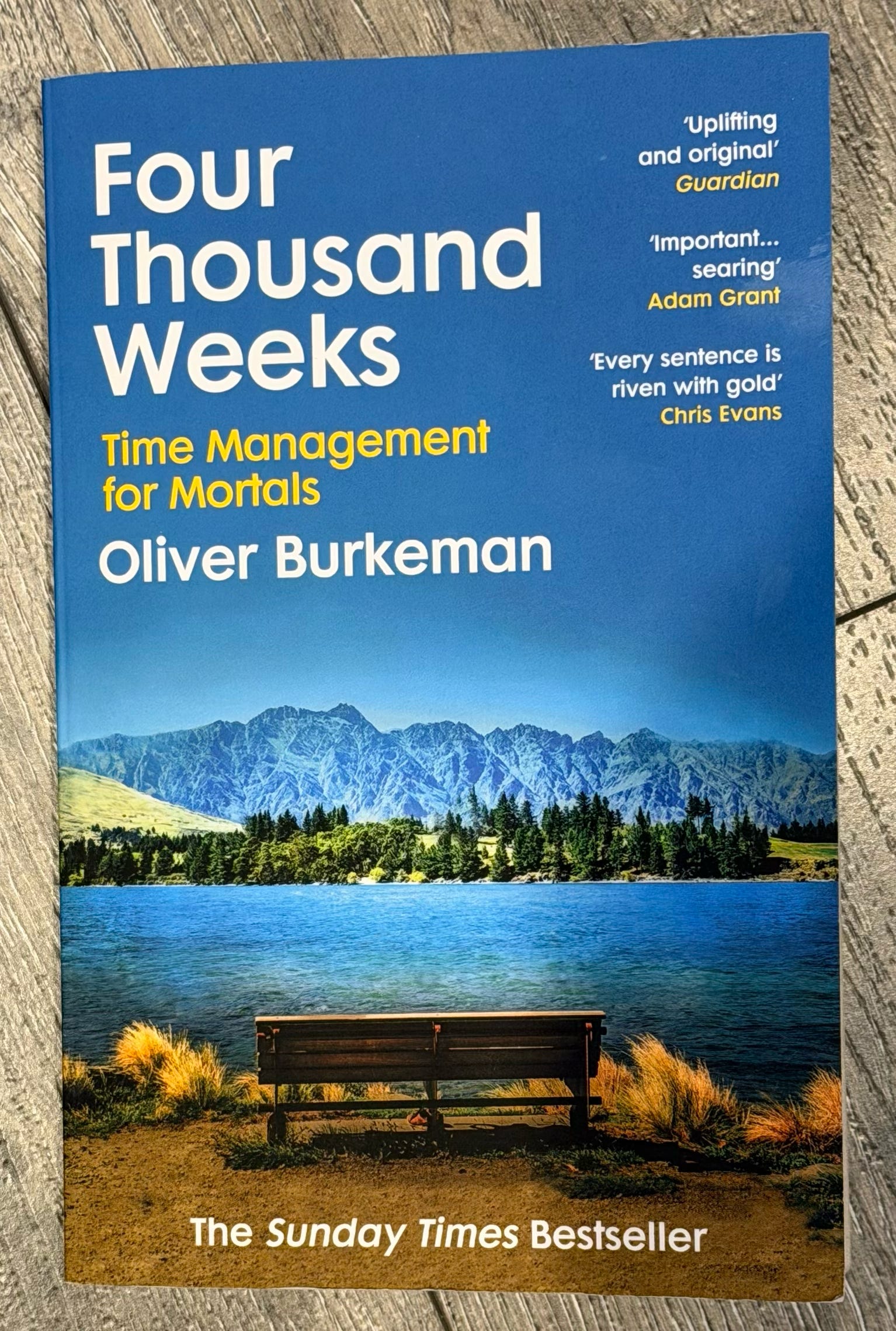
Four thousand weeks. That’s the approximate length of an average human life, and the calculation is designed to make you flinch. Oliver Burkeman opens with this arithmetic as a kind of ambush: you can make infinitely ambitious plans, but you get almost no time to execute them.
It’s cruel in its precision; a small number you can hold up against your age and feel the remainder shrinking.
I had several moments of confirmation bias activation with this book - as well as moments of personal discomfort.
I spend a lot of my professional life arguing that optimisation can go too far, that smoothness is overrated, that the friction and mess of practical knowledge is where real competence lives. Burkeman is making a structurally similar argument from a completely different angle: that our obsession with mastering time is itself the problem, that the tools we build to control our schedules are just sophisticated ways of avoiding the terrifying fact that we’re finite.
The first part of that? Confirmation bias. Great! The second part? Looking at my Morgen- and AI-optimised calendars and workflows to save time — umm. A bit of discomfort there. No disagreement though.
The core point of the book is that the modern discipline of time management is a depressingly narrow-minded affair, focused on cramming more into a container that will never be big enough.
Burkeman, a recovering productivity journalist who once chased Inbox Zero and Getting Things Done with genuine devotion, argues that every efficiency gain simply generates more demand. Clear your inbox faster and you get more email. Get better at saying yes and you attract more requests. The belt speeds up. This is Edward T. Hall’s conveyor-belt metaphor made personal — and anyone who has ever “optimised” their morning routine only to feel busier by lunchtime will recognise it immediately. Maybe you ‘accomplished’ a lot? But did that really make everything better?
He also draws on Martin Hägglund’s This Life, and Burkeman reframes finitude from tragedy to precondition. If you had infinite time, nothing would matter - there’d be no stakes to any choice, no urgency to any love, no weight to any commitment.
The guarantee that you will run out of time is what makes your choices meaningful. Missing out on almost everything is an unavoidable fact of life; it’s what gives the few things you do choose their gravity. Claiming you can have it all, or do it all? It’s a lie, plain and simple. You will never have time to do everything you’d want. This is the intellectual spine of the book, and it’s genuinely powerful.
He’s also sharp on the psychology of avoidance. Productivity obsession, he confesses, served a hidden emotional agenda: as long as he was racing through his to-do list, he never had to sit with the scary questions about whether his life needed to fundamentally change. Boredom, he argues, is the discomfort of confronting your limited control. We flee to infinite-scroll feeds not because they’re fun (they often aren’t), but because they dull the pain of finitude by making us feel unconstrained. The distraction isn’t the problem; it’s the symptom.
The three principles of patience he introduces — developing a taste for having problems, embracing radical incrementalism, resisting middling priorities — are practical enough to be useful without collapsing into lifehack-territory. And the Afterword’s call to abandon hope is the book’s most counter-intuitive and memorable move: hope, Burkeman argues via Derrick Jensen and Pema Chödrön, is just another way of placing your faith outside the present moment.
Give it up, and you’re free to actually do the work in front of you.
So why four stars and not five? There’s a faint rehearsed quality to parts of the book — a smoothness, ironically, in how the arguments unfold. Burkeman is a skilled writer, maybe too skilled here: some passages feel like they’ve been polished to the point where the rough edges that would make them truly confronting have been sanded away.
The ending with its ten tools for embracing finitude tilts toward the self-help format the rest of the book has been arguing against; I’m not sure how I feel about them, because the points are useful, too.
I reviewed Tricia Hersey’s Rest is Resistance last year - same broad territory, but where Hersey preaches rest as political liberation (with all the US-centric blind spots that entails), Burkeman makes the case philosophically and personally. He’s more honest about his own complicity in the productivity machine, and crucially, he doesn’t pretend the answer is simple. The answer, if there is one, involves grief: you have to mourn the lives you’ll never live, the options you’ll never take, the versions of yourself that will never exist. That’s harder to put on a poster than “nap more,” but it’s truer.
If you’ve ever finished a productivity book feeling both inspired and somehow emptier, this is the antidote. Burkeman has written the rare time-management book that takes seriously the fact that time will, eventually, manage you [out].
Rating: 4 out of 5
Dog-ear index: 11.7
Who is it for: Recovering productivity addicts; anyone who suspects that the problem with their relationship to time goes deeper than not having the right app. Not for readers seeking actual productivity tips. Burkeman would consider that missing the point entirely.
[reminder: I highlight important parts of the books I read, and dog-ear the really important pages. The dog-ear index is simply the average number of dog-eared pages per 100 pages]
Product link for reference only; please support your local bookstore where possible: https://www.amazon.com.au/Four-Thousand-Weeks-Embrace-limits/dp/1784704008