

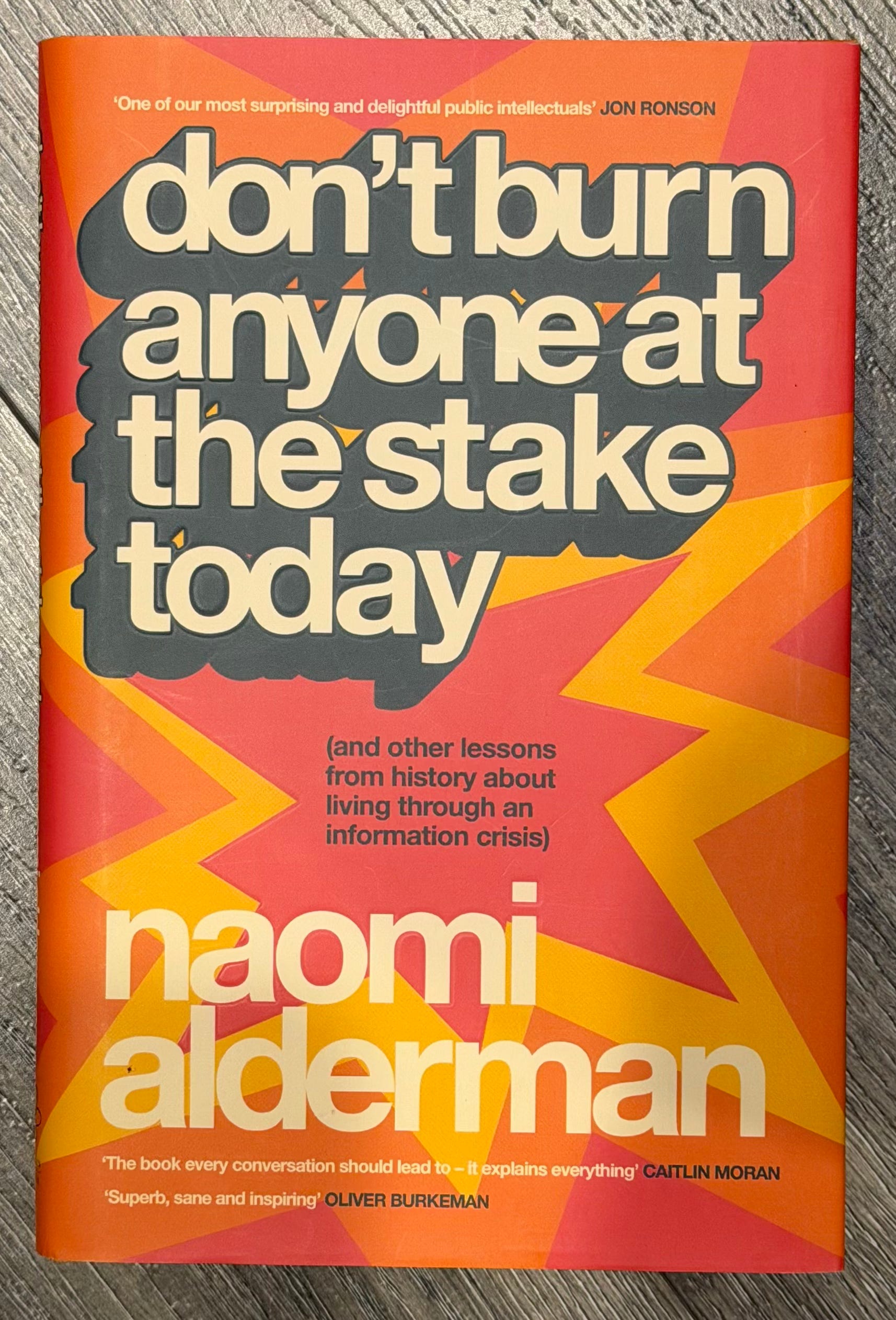
I need to be honest with you upfront: this book is confirmation bias on steroids. I love writing. I love words. I spent decades working in and around communication technology. I now work in AI & strategic foresight. Naomi Alderman has written a book that sits squarely at the intersection of all those things. As a result, my highlighter barely survived the experience, and the book looks a little ridiculous; just look at the up-there dog-ear index.
Throughout my reading experience, I tried my best to check my biases. Even so, take what follows with a bigger-than-usual pinch of salt, given I was unlikely to succeed in setting all of them aside.
Anyway, Alderman’s thesis is cleanly: we are living through the third great information crisis in human history.
The first was the invention of writing. The second was the Gutenberg printing press. The third is digital communications technology.
Each crisis brought enormous leaps in knowledge and understanding — and also prolonged periods of intense instability, violence, and social upheaval. If you’d known the name of your era, she argues, it would have given you a clue about what to prepare for.
The framework is compelling, and Alderman builds it well. She draws on Walter Ong’s work on orality and literacy, tracing how writing made us value older people less (they were no longer the sole repositories of knowledge), how it enabled independent thinking by freeing people from constantly rehearsing traditional knowledge, and how each new communication technology introduces what she calls a “war of interpretation” — conflict over the meaning of written words with people you’ve never actually met.
There are a lot of observations in the book that come across as fundamentally important. The idea that when people worked with sheep all day, they imagined God as a shepherd; now that we work with computers, we describe ourselves as “hard-wired” or “programmed.” The Borges parallel — The Book of Sand, an infinite, unfinishable book that becomes a prison, as a metaphor that’s too close for comfort for the infinite scroll of social media. The Elizabeth Eisenstein insight that when technology went to press, occult lore flooded out alongside scientific knowledge, and few readers could discriminate between the two.
Well, bugger. Here we are again.
Alderman brings out interesting points about forgetting. She distinguishes between the right to be forgotten — which data protection laws especially in the EU attempt to address — and the right to forget. The imperfect way our memory works, she argues, actually mitigates lasting conflict. When people say “time heals,” what they partly mean is that memories fade, becoming less sharp and less wounding.
Digital technology has stolen that from us. Memories in digital form never fade - on the contrary, they might end up being amplified.
Twenty years turns a shitposting fifteen-year-old into a responsible thirty-five-year-old, but the internet remembers every post. We need, she says, to find ways to say “I am not that person any more“ and to actually mean it, and to let others mean it too. I agree wholeheartedly.
Growing up in a small Finnish town in the early days of the Internet, I recognise what she describes about the pre-digital world: before the Internet, there were so many things people simply never talked about, because there was no space for it.
The internet made it possible to talk about them; to find your tribe globally. I found that exhilirating and liberating in the 1990’s, where IRC allowed me to connect with like-minded people globally. That ability, Alderman acknowledges, is both a liberation and a source of enormous friction. The discovery of how many radically different lives are being lived in parallel to our own is disorienting. It can push us toward empathy or toward our own enclosed private pews, shutting out everything that challenges us. Alderman calls this the “box-pew effect”: individualism paradoxically leading to more rigid think-alike communities.
There’s much practical wisdom scattered throughout, such as pausing before reposting when you feel a strong emotion and starting hard conversations with what you agree on. Her personal rule — never talk about a culture-war topic with anyone who only wants to talk to you about that topic — is the kind of heuristic worth adopting immediately. And her call to protect institutions like Wikipedia, public libraries, and the Archive as information services that aren’t trying to sell you something feels both urgent and underappreciated.
When reading, I agreed with so much of the book that my gut reaction was to give it 5/5 just for that. But there are limitations, and I want to be fair about them.
The book is light on hard evidence and meticulous referencing. Alderman is working as an essayist, not a researcher, and the Reformation parallels don’t necessarily always hold up under scrutiny. The analogy between Luther’s disintermediation and Uber’s is suggestive but not what I’d call rigorous. And Alderman herself acknowledges, in her afterword, that the AI dimension is underdeveloped: “we’re not in the midst of it yet,” she writes.
On that point, I disagree strongly. We are, and we were squarely “in the midst of it” in 2025 when this book was published.
As a more general point, here’s what I find somewhat unnerving about books that resonate strongly with me. Often — not always, but often — when they touch on a topic I know quite a bit about, I find them wanting. Alderman’s treatment of AI is a case in point. She’s used Claude, finds it useful, acknowledges its limitations. But she treats the default sycophantic behaviour as inherent rather than configurable. She frames AI companionship as a supernormal-stimulus risk — which is a fair concern — but doesn’t engage with how the technology is actually developing.
What’s my point? Where the book doesn’t touch my areas of expertise, it feels like brilliant 5/5 work. Where the book does touch on topics of my expertise, it’s not. It’s not terrible either by any means, but it’s not 5/5.
The point is that I suspect it would be a very strange coincidence if the analysis were less than rigorous only in the areas I happen to know deeply.
I’m choosing not to penalise the book for those assumed flaws, but it’s a pattern worth noticing, and it tempers what might otherwise be a higher rating.
What Alderman does well — and this is no small thing — is name what an information crisis feels like. The anxiety, the anger, the sense that we’re surrounded by cretinous vicious imbeciles (her words) when actually most people around us are careful, thoughtful people who may disagree with us for good reasons. The loss of shared consensus reality. The feeling that the ground is shifting under our feet.
Naming the era you’re living through doesn’t solve it, but it helps you stop blaming yourself for feeling destabilised by it.
The book also echoes something Melvin Kranzberg captured more concisely: technology is neither good nor bad — nor is it neutral. Writing enabled both the Axial Age’s moral philosophy and centuries of religious war. The printing press gave us the Enlightenment and the Holocaust’s foundational texts.
The internet gives us Wikipedia and QAnon. Alderman’s contribution is to trace this pattern across three crises and invite us to learn from the previous two. The invitation is worth accepting.
She ends with hope, but not naive hope. Brains evolved for small groups of a few thousand are trying to build moral consensus among billions. She argues that even as we write ourselves into all sorts of trouble — moral, spiritual, physical, psychological, intellectual — we can also use these same technologies to work ourselves out of them again.
It’s a warm, humane ending.
I’d like to share her optimism fully. I’m not sure I do.
Rating: 4 out of 5 (so, still very good)
Dog-ear index: 14.7 (i.e., ridiculously high)
Who is it for: People who sense that something has gone deeply wrong with how we communicate and want historical context for the feeling. Writers and communication professionals will find the most to chew on.
reminder: I highlight important parts of the books I read, and dog-ear the really important pages. The dog-ear index is simply the average number of dog-eared pages per 100 pages
Product link for reference only; please support your local bookstore where possible: https://www.amazon.com.au/Dont-Burn-Anyone-Stake-Today/dp/1405981393