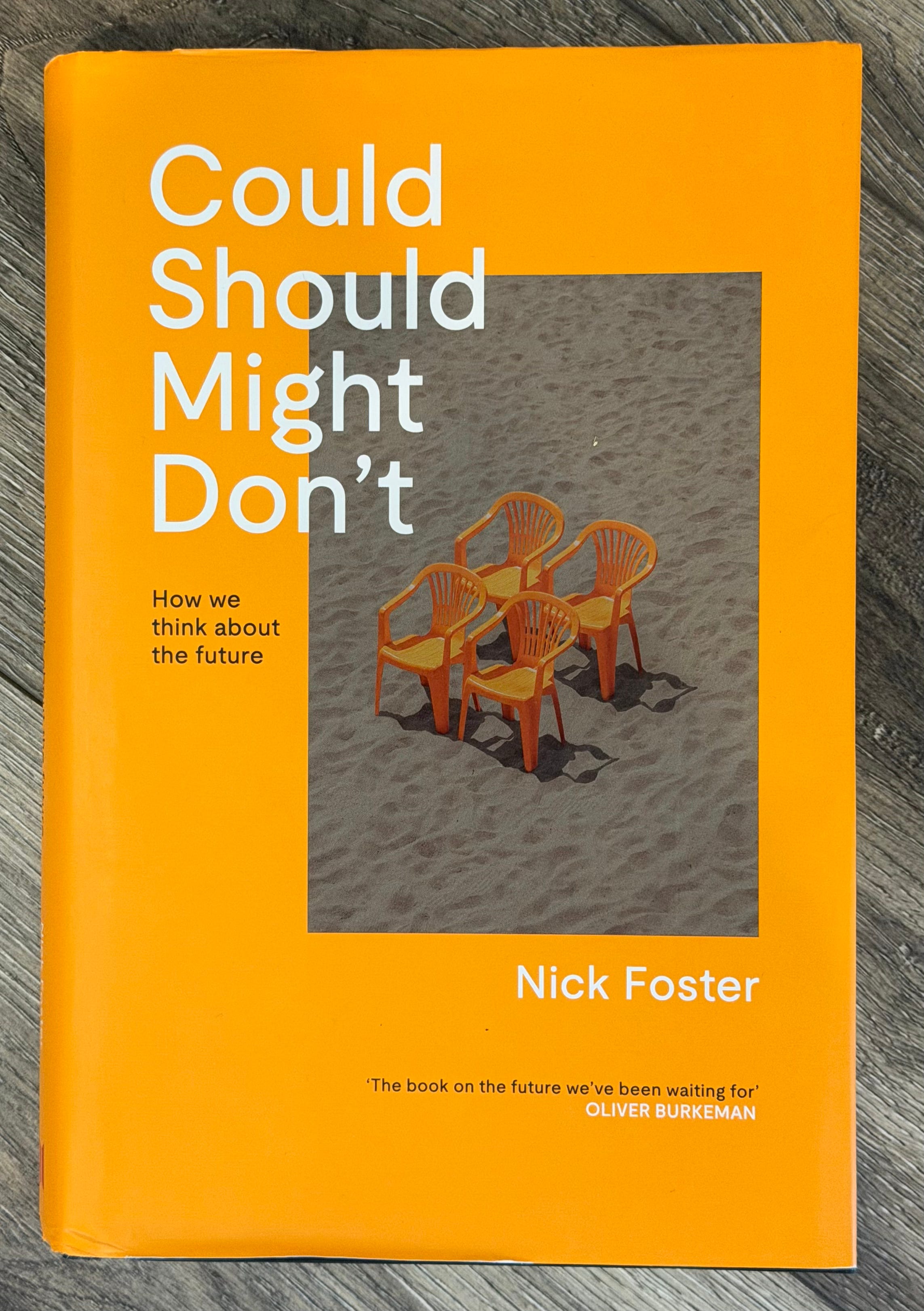
Review: Could Should Might Don't
Review of Could Should Might Don’t: How We Think About the Future by Nick Foster
This review comes with a disclosure: foresight is a significant chunk of my professional identity. Reading a book that critiques how we think about the future was simultaneously validating and uncomfortable - like having someone narrate your therapy session while occasionally getting the details wrong, prompting the occasional “Hey wait that’s not how it went down!”
Nick Foster’s Could Should Might Don’t gives us, in its title, a simple taxonomy for understanding the different flavors of futures work.
“Could“ futurism is the shiny, techno-optimistic variety that dominates TED stages, conferences, and often corporate innovation labs. “Should“ futurism brings in values and ideology. “Might“ is a more rigorous strategic foresight territory of scenarios and probabilities, but with its own problems. And “Don’t“ - the hardest and usually, at least from an action-point of view the most neglected, branch - forces us to confront futures we must actively prevent.
The framework is, to my moderate surprise, genuinely useful, and Foster wields it effectively against the futures-industrial complex. Many of his views align with mine, which means arguably provocative descriptions like trade shows as “cacophonous orgies of energetic capitalism“ made me chuckle at the accuracy rather than take offense. Foster’s takedown of commercial Could futurism - all gleaming surfaces and conveniently absent consequences – also clearly articulates a lot of the frustrations I’ve felt for years.
The observation that “nothing on earth works the way they pretend“ in these polished visions cuts to the heart of why so much futures work fail to connect with reality – and, frankly, why so many products arising out of that style of futures work fails miserably when it comes to contact with reality.
Foster makes several important points. A few examples include that newness as an inherently positive attribute is a modernist mindset shift we rarely question; that we have an insatiable and largely unwarranted desire for predictions; that identifying trends is far more questionable than trend-spotters would have you believe; and that the most transformative technologies eventually become mundane, embedded invisibly into everyday life. The concept of “Endineering” - thinking about endings and full lifecycles rather than just shiny beginnings - deserves wider adoption.
The book’s call for “mundane futures” also resonates deeply. Most of us will live in the statistically swollen middle, not in gleaming smart cities or dystopian wastelands. So much of futures work either fundamentally misunderstands or willfully ignores such basics as how cities come into being in the first place. The characters in our future, as Foster notes, “will not necessarily need to save the world at every turn - most of them will simply live in it, quietly getting through each day.”
This is where futures work should spend more time, yet rarely does.
And yet.
Reading as an insider of sorts, I found myself in a recurring “yes, but...“ pattern. The critique Foster lays out sometimes feels like it hasn’t fully engaged with the better work being done in the field - the rigorous scenario work at places like IFTF, for instance – curiously, IFTF is not so much as mentioned even though RAND Corporation, its parent organization, is (full disclosure: I am a Senior Research Affiliate at IFTF).
While Nick to his credit fully acknowledges his own biases and blind spots, occasionally they raise their heads in a somewhat ironic manner: his anecdote about finding time for reflection on long flights immediately after discussing how futures thinking skews toward the privileged is a perfect, probably unintentional, demonstration.
More frustratingly, I finished the book asking “now what?“ The diagnosis is comprehensive and often brilliant, but the prescription feels thin.
We need to do better, demand better, be more critical consumers of futures work - yes, agreed, violently so. But for practitioners seeking concrete guidance on how… There’s not all that much there.
Which, to be honest, is not what the title or subtitle promised either. Offering a prescription was never part of the plan, probably. I get that. It’s still something I as a practitioner would want effective ideas or options for.
My perspective is skewed by proximity. For readers who are not foresight professionals - which is most people - this book offers something very valuable. Executives, policymakers, and people who consume futures work (this is pretty much everyone, if you pay attention to marketing) would benefit enormously from Foster’s framework for identifying when they’re being sold seductive nonsense.
The billions wasted on manifestly bonkers projects like The Line - that mirage monument to Could futurism that treats the desert as a blank slate for techno-utopian fantasy and, let’s face it, is never going to get built - suggest we desperately need more critical consumers of futures visions. This book helps create them.
For those of us already living in Might and Don’t territories, “Could Should Might Don’t” offers the bittersweet comfort of having our professional frustrations eloquently articulated - along with the sobering reminder that this more rigorous approach is harder to sell. It’s validation, but not transformation.
Rating: 4 out of 5 (closer to 4.5 for non-foresight readers)
Dog-ear index: 11.8
Who is it for: Anyone who consumes futures work and wants to become a more critical reader of it; executives and policymakers who’ve been dazzled by shiny visions; foresight professionals seeking articulate validation of their frustrations (though perhaps not new tools to address them).
Oh, and the Could-futurists who need a good hard look in the mirror!
[reminder: I highlight important parts of the books I read, and dog-ear the really important pages. The dog-ear index is simply the average number of dog-eared pages per 100 pages]
Product link for reference only; please support your local bookstore where possible: https://www.amazon.com.au/Could-Should-Might-Dont-Future/dp/1837263833


