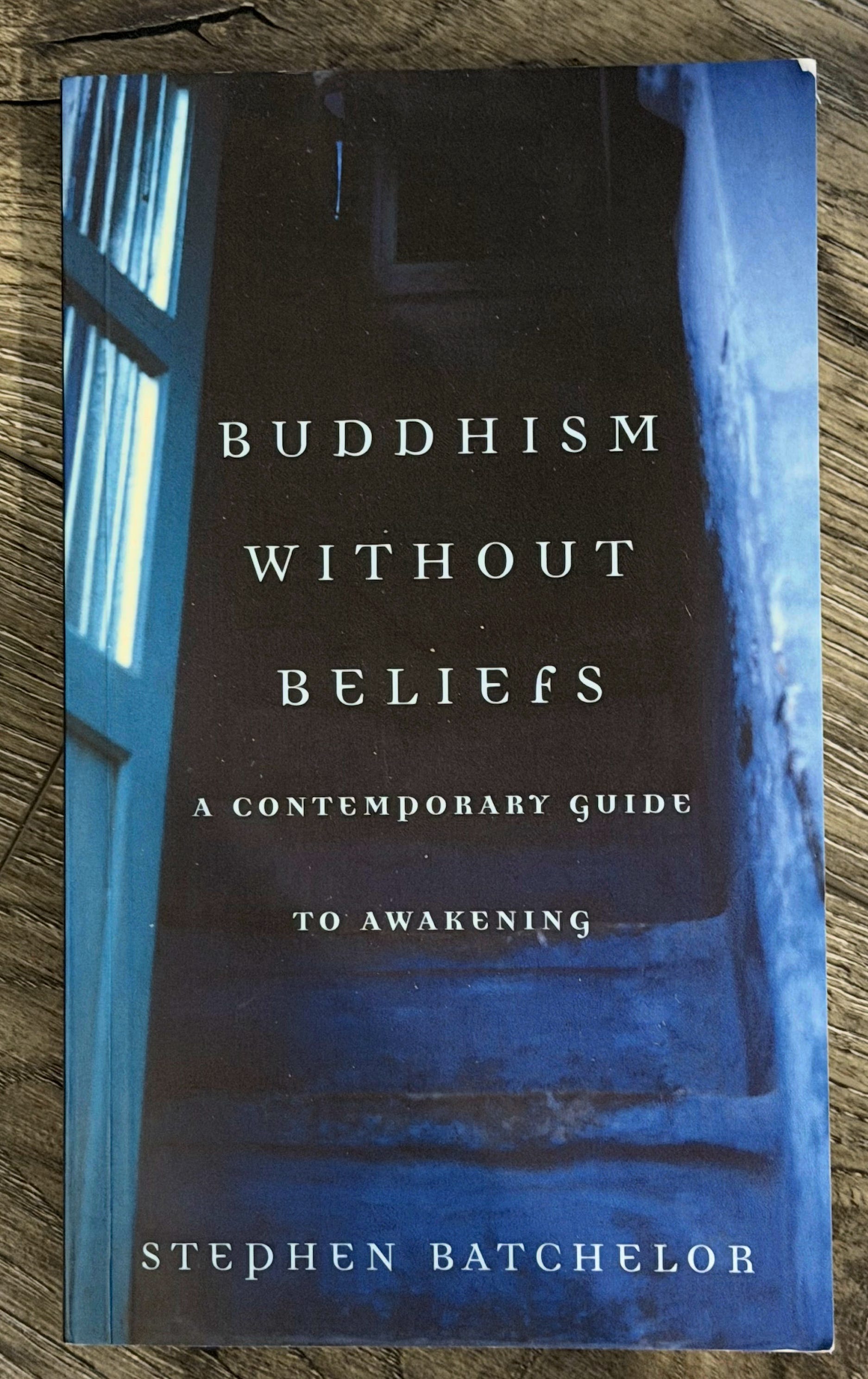
Review: Buddhism Without Beliefs
Review of Buddhism Without Beliefs: A Contemporary Guide to Awakening by Stephen Batchelor
There’s a certain irony in how Buddhism has been morphed first into a more traditional religion with dogmas, which inevitably then splinter into multiple factions all professing to be the right one, and then later into Western culture.
As the West does, it brought in commercialization of things as well, and while Buddhism may have escaped the worst of it, it didn’t escape all of it: strip away the incense and meditation apps, and you’ll find that much of what passes for Buddhist practice has simply swapped one set of dogmas for another - trading salvation for enlightenment while keeping the same rigid belief structures intact.
Stephen Batchelor’s “Buddhism Without Beliefs” is a corrective to this, and a quietly radical one at that.
Batchelor, a former monk in both Tibetan and Zen traditions, is a sort of calling back to the roots of Buddhism, reminding us that the core insights don’t require believing in rebirth, nor karma as cosmic accounting, nor make any metaphysical claims at all.
The Buddha was offering a method rather than a doctrine - a way of engaging with existence rather than a set of truth claims about it. To me, that suddenly makes it a whole lot more appealing.
Batchelor grounds his approach in what he calls agnostic Buddhism - and in doing so also rescues agnosticism from its reputation as mere intellectual fence-sitting. Agnosticism, properly understood, isn’t about not knowing; it’s about recognizing the limits of what can be known and refusing to pretend otherwise.
It’s “the confrontation with the rending awe and wonder of the world.”
One of the most interesting aspects of Buddhism Without Beliefs was Batchelor’s treatment of awakening itself as relative rather than absolute. Even the Buddha, he notes, “was still constrained by the worldview of his time“ - his language, geography, the limits of available knowledge.
This is refreshingly honest. Awakening isn’t some binary state you achieve and then you’re done; it’s an ongoing process of freeing yourself from whatever particular constraints happen to be gripping you, and Batchelor is very much cognizant that even as a gradual process awakening isn’t a linear one – it ebbs and flows, progresses and recedes, sometimes coming in fleeting moments.
Fittingly, the person oriented this way increasingly values ‘lightness of touch, flexibility and adaptability, a sense of humor and adventure, appreciation of other viewpoints, a celebration of difference.‘ Arrogantly, I would like to think I can identify with that description; more honestly, we can just say it’s an aspirational vision I’m still striving to strive toward.
The wave analogy early in the book captures this beautifully - we are both distinct from and inseparable from the sea of existence, “traceless and mysterious.”
The practical implications are significant. If dharma practice is seen as “the cultivation of a way of life in which such moments are not just left to chance,” then the emphasis shifts from correct belief to skillful engagement.
The four truths aren’t propositions to accept but actions to perform: anguish to be understood, its origins to be let go, cessation to be realized, the path to be cultivated. This reframing extends to emotions themselves. As Batchelor writes:
A compassionate heart still feels anger, greed, jealousy, and other such emotions. But it accepts them for what they are with equanimity, and cultivates the strength of mind to let them arise and pass without identifying with or acting upon them.
This is such a welcome corrective to the “enlightened beings don’t feel negative emotions” nonsense.
I found myself particularly drawn to his vision of what a contemporary culture of awakening might look like:
How to create an authentic community, which provides a sound basis for the emergence of a culture while optimizing individual freedom, may be the single most important question facing those practicing the dharma today.
[..]
The democratic and agnostic imperatives of the secular world demand not another Buddhist Church, but an individuated community, where creative imagination and social engagement are valued as highly as philosophic reflection and meditative attainment.
The agnostic Buddhist vision that “it will emphasize the freedom and responsibility to create a more awakened and compassionate society on this earth” I strongly resonate with, and it also ties in with ideas I’ve encountered elsewhere about communities of thinking and the importance of genuine inquiry over tribal belonging.
It’s a vision I can actually imagine participating in, which is more than I can say for most religious or spiritual frameworks.
Batchelor doesn’t shy away from the harder edges either. His observation that in liberal democracies “freedom may be held in high regard; in practice it is experienced as a dizzying loss of meaning and direction“ is very relevant in our current moment. We have unprecedented freedoms and are using them to doom-scroll ourselves into alienation.
This was a short book; at just over 100 pages, some ideas necessarily remain sketched rather than fully developed. But perhaps that’s appropriate for a book arguing against the calcification of living practice into dead orthodoxy.
Rating: 4.5 out of 5
Dog-ear index: 12
Who is it for: Anyone who’s been drawn to Buddhist ideas but is allergic to the metaphysical baggage; skeptics who suspect there might be something valuable underneath the lightweight mindfulness meditation courses; anyone who read my review of ‘Buddhist Boot Camp’ (see here) and wanted something with more intellectual heft. It also pairs interestingly with Tanya Luhrmann’s brilliant ‘How God Becomes Real’ (see review here); they’re complementary lenses on the relationship between doing and believing.


“The agnostic Buddhist vision that “it will emphasize the freedom and responsibility to create a more awakened and compassionate society on this earth” I strongly resonate with, and it also ties in with ideas I’ve encountered elsewhere about communities of thinking and the importance of genuine inquiry over tribal belonging.”
There’s a lot in this section of your review for me, Sami. I can sense the core liberal belief in the primacy and sovereignty of the individual and how those individuals make wise, thoughtful decisions in social life. At the same time I detect a dismissiveness around “tribes”. How do we reject tribalism without jettisoning containers of civic relationships that form belonging? What do we belong to? Are communities of thought strong enough to inspire loyalty and durable belonging?
I ask these questions as someone from the liberal left who’s spend most of his adult life pushing back against the identity politics of the left and the weird appropriation of ‘eastern metaphysics’ that’s par for course in my contexts. How do we do civic belonging without any metaphysics about what it means to be human?