

With regular intervals, there are journalists who fly to Finland, visit schools where everyone takes their shoes off and do all kinds of allegedly wonderful things, and then fly home with The Secret to Great Schools.
As a product of said school system, I’ve learned to brace myself.
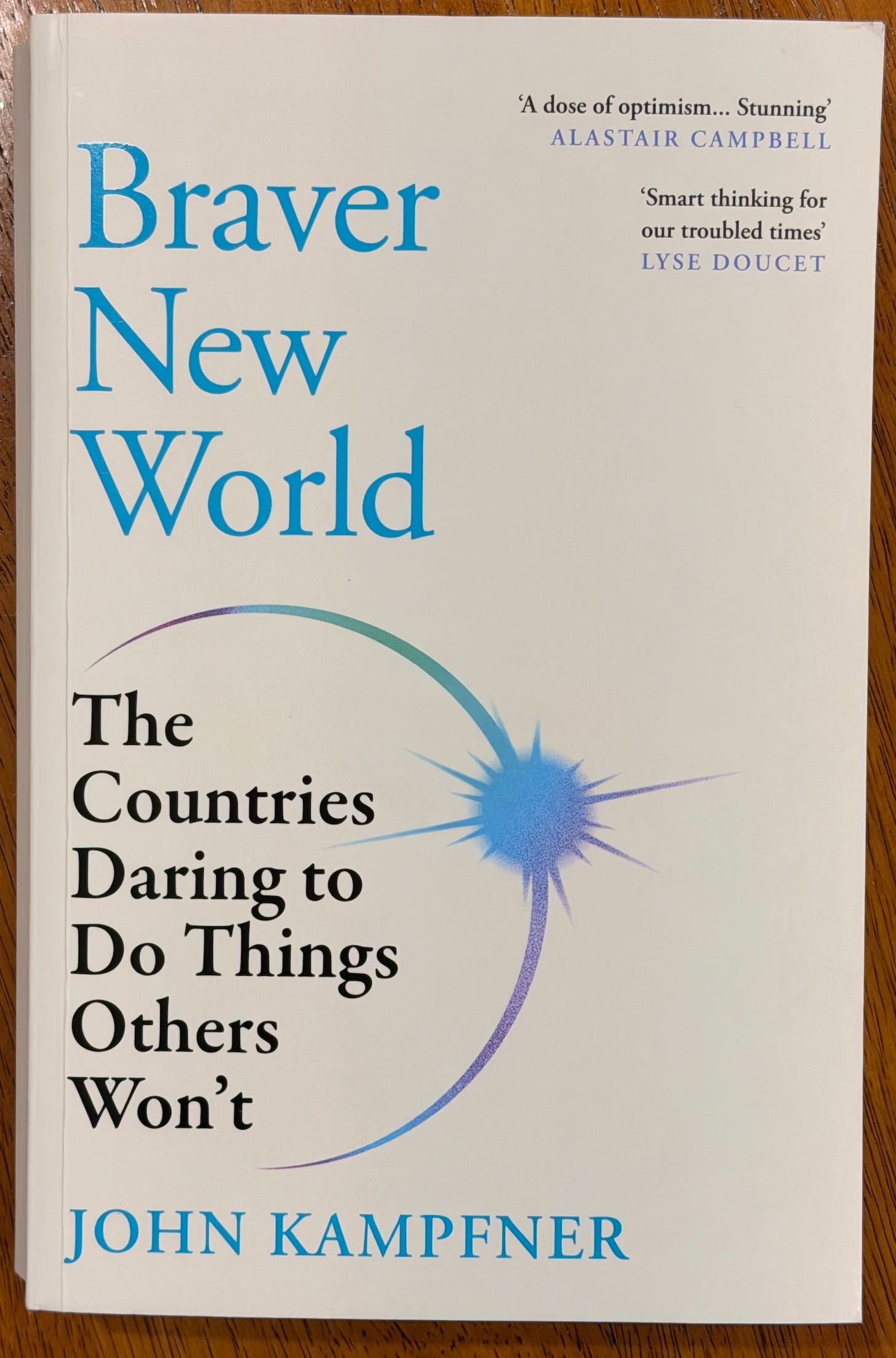
John Kampfner has written a book about amazing things done elsewhere in the world that we can learn from, no matter where we are. I very much support the notion, and it has an appeal rhyming with William Gibson’s phrase “The future is already here, it’s just unevenly distributed.” I very much support learning from other places.
Unsurprisingly, the place that Kampfner visits on education is Finland. So when he announced that, after a slide in the PISA rankings, “reforms have since been introduced that are once more paying dividends“ and Finland’s schools “are ahead of the game“, I bristled a little bit. All this fawning over Finland’s schooling system reduces my trust for all the other claims made in the book.
What draw me to this book in the first place was one sentence in the last book I read, Eric Ries’ Incorruptible: “Anything can be different if we want it to be.“ I already had Braver New World sitting in my to-read shelf, so it seemed like the perfect next book to read.
Kampfner, a former editor of the New Statesman, spent three years in ten places doing things differently. This ranged from care homes in Tokyo to social housing in Vienna to Taiwan’s health system, Morocco’s solar plants, and Estonia’s digital state.
The implied target of all these learnings is Britain; the United States largely serves as “the ‘how not to‘ example”, a role they should be getting used to by now.
A signal book
In foresight work we collect signals of change: small, concrete examples of a possible future turning up early, somewhere. Read that way, this is a signal catalogue for whole societies, and it’s a good one at that. Every chapter is proof of it being possible to do something differently. Sort of.
The catch is that a signal is not a trend, and an anecdote is not a dataset. Kampfner is a journalist and builds his chapters out of people and stories: an Afghan teacher who lost a son at the Pakistani border, or a Karnataka farmer with a new chaff cutter. Stories can be effective, sure. But for a book asking governments to change policy, I kept wanting the numbers alongside the anecdotes, and they weren’t always there.
The good…
The Vienna chapter is great. The city’s housing agency manages more than 220,000 flats, rents are regulated “so that no resident spends more than 40 per cent of their income on housing“, and one co-op, Gleis 21, has 700m2 of shared space, including a sauna. As a Finn, I approve. Meanwhile the 15-minute city, which Vienna has more or less run for a century, is “regarded by some right-wing conspiracy theorists as a ploy to hem people in.“
I still find it mind-boggling that for some people liveable neighbourhoods have become a conspiracy theory. Seriously?
“Around 60 per cent of Vienna’s 2 million inhabitants live in public housing“ is the city’s own figure, and it counts nearly everything built with a housing subsidy. Strictly, about 41 per cent of Viennese homes are social rentals, roughly half of them council flats.
Seen from Melbourne, where social housing is around 4 per cent of the stock and comes with a heavy social stigma, that is staggering. Housing could, and should, be done so much better in many places, perhaps most places.
There are other things that 100% should be broadly adopted, too, like Tokyo carers in power-assisted suits that have “cut down on the number of sick-leave days considerably“? Yes please.
There I met Essmart, a for-profit rural distributor that doesn’t “make much because they keep prices low”, having chosen that route because a charity allegedly wouldn’t have raised as much seed capital.
Fresh off Incorruptible, that structure made me nervous, so I checked into them: thirteen years in, Essmart is still going, still small, apparently still loss-making, and increasingly selling market research: a textbook case of the financial gravity Ries warns about.
… and the bad, or at least wobbly
My trust problem didn’t stay in Finland, but let’s start there. PISA 2025 came out last month: Finland fell again, by 16 points in reading and 15 in maths, and now ranks 17th in reading, a subject it topped in 2000. To be fair, it still sits above the OECD average.
Kampfner cites the migration scholar Hein de Haas: around 97 per cent of the world’s people stay put. A page later: “According to some scenarios, 1.2 billion people could be displaced by 2050“. That figure comes from a 2020 report that counted people living in fragile countries, conceding that not all of them would move, and de Haas himself holds up the “1.2bn” headline as an example of climate-migration forecasts that “lack any empirical basis“.
Which is it?
Taiwan’s health system is held up as a model of affordability, with personal payments covering “the remaining 10 per cent“ of costs. Taiwan’s own figures put out-of-pocket spending at close to 40 per cent of health expenditure, roughly double the rich-country average. Cheap for the state, then; less so for the patient. Not sold.
As a sign of our times perhaps, some of the book has simply aged very quickly.
The Australia paragraph credits Anthony Albanese’s May 2025 landslide to voters who “did not fall for the confrontational rhetoric of his right-wing opponent“.
One Nation took 6.4 per cent at that election; fast-forward to June this year, when Newspoll had it at 31 per cent, ahead of Labor.
Morocco’s renewables are about 40 per cent of capacity but only a quarter of its electricity, and it still imports around 90 per cent of its energy. Kampfner says he could have opted for Australia’s health system. Maybe, but I’d have nominated our roofs: renewables supplied 43 per cent of our electricity last year, and over half a million home batteries went in under the federal rebate in barely more than a year. The roll-out scale of both distributed solar PV and storage are world-leading by a fair margin, and the grid is being transformed at incredible pace.
Lessons for Australia?
What should we, in Australia, learn from this? Well for one, Australian super funds should be more active in housing. They aren’t entirely absent; by the industry’s own figures, funds put well over A$30 billion into residential housing between 2018 and 2024.
That’s about 1 per cent of their assets. Could be a fair bit more!
Vienna’s housing model doesn’t run on pension money, however. It relies on a payroll levy earmarked for housing, combined with cheap long-term public loans and limited-profit landlords. If super is to play a bigger role (and I argue they should), the performance test, which has no residential benchmark, needs to stop penalising funds that invest in housing; Treasury’s May proposal for an “emerging assets“ class is a start. We also need more kinds of tenure, not just more units. Models like Finland’s asumisoikeus (right-of-occupancy), paying roughly 15 per cent of the price upfront, then a monthly charge and the kind of security renting here rarely offers, deserves a look.
In summary
Braver New World has lots of great examples, but is perhaps purposefully very light on the translation work. Fair enough: translation is each country’s job. Kampfner himself asks why Britain can’t “focus on the boring bits, getting the system to work“. His book is the inspiring bit; the boring bits are left to the reader, or the society of the reader.
Check his numbers before repeating them in any arguments you make locally, and expect a few showcases to have wobbled since April. Signals tend to do that – not everything points to a new world order.
He closes with seven principles, from “Be candid with citizens, don’t hide problems from them“ to “Most of all: demonstrate courage.”
Is this simplistic? Yes. Is it correct? Also yes. Take the lessons to your representatives – asking them to read the book would probably be asking too much, unfortunately.
Rating: 3.5 out of 5
Dog-ear index: 6.9
Who is it for: Policymakers, public servants and anyone tired of hearing “that could never work “: this is a catalogue of places where it did. Now that it’s written for a British audience; Australians can skim the Westminster asides but should read the Vienna chapter twice.
Reminder: I highlight important parts of the books I read, and dog-ear the really important pages. The dog-ear index is simply the average number of dog-eared pages per 100 pages] Product link for reference only; please support your local bookstore where possible: https://www.amazon.com.au/Braver-New-World-Countries-Daring/dp/1805462512/