

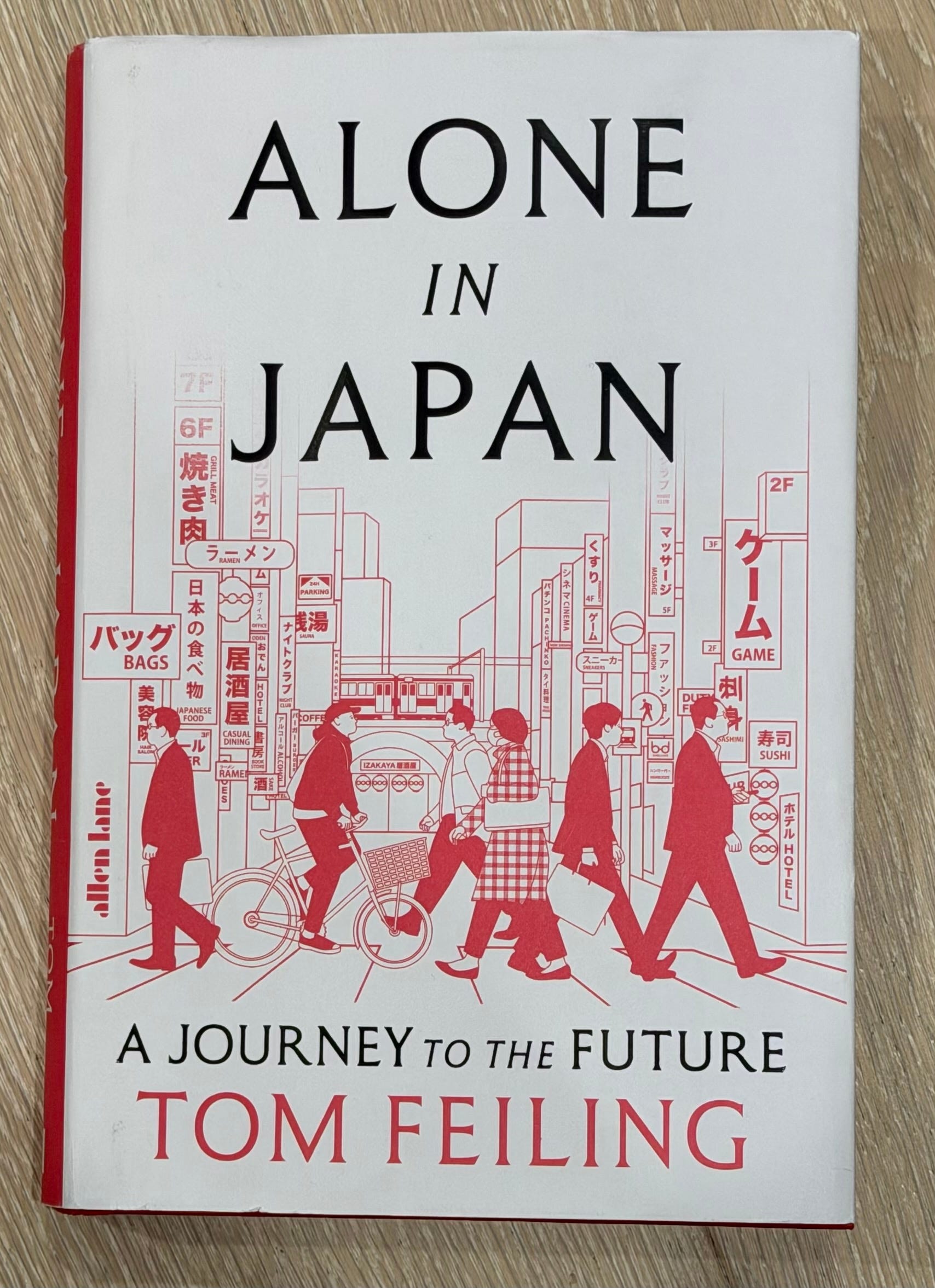
I’ve always been fascinated by Japan, and I love the country. I am not alone in this, with the country logging over a million Australian visitors last year – nearly triple from 10 years ago.
Something that many people know about Japan is that it’s one of the fastest-ageing countries in the world, with an economy that has barely grown for decades. Neither of those things sounds particularly exciting.
Yet something that all visitors also know about Japan is that on the ground, it often feels like a very well-functioning society; certainly the big cities feel vibrant, and everything works well.
But we tourists never see the full picture, so a book that promises to be a Journey to the Future, implying the reader will learn something not only about Japan but the future of the rest of the world obviously caught my attention.
The journey gets delivered in full.
It’s the future part…not so much.
Let’s take a step back.
Tom Feiling first moved to Tokyo in the early nineties, back when Japan was what the future looked like in an exciting, positive way — and returned about a quarter of a century later to find, in his words, that “it was no longer a beacon. It was a warning.“
What follows is a tour of a depopulating country: overnight ferries to Shikoku, dying fishing villages, mango farmers in Miyazaki, love hotel economics, carebot showrooms, shrines where young women’s written wishes are addressed to boy-band idols rather than actual men.
As a travelogue, it works well. In Mugi, a near-dead village on Shikoku, Feiling finds shuttered shops with signs in the windows reading “junbichū“ - “getting ready”.
“Nobody was getting ready to do anything, apart from die.”
Ouch.
Let’s take another step back, because there are a couple of problems.
First, this is one person speaking on behalf of an entire country, and this made me think of this whole genre in a way that isn’t limited to this book. How long does someone need to live somewhere before they can do that?
In some ways, I suspect it’s longer than this. But then Japan is famous for always considering foreigners foreign, so maybe it’s impossible for an outsider to ever truly get 'in' a country like Japan.
Much of Feiling’s cast is his own English students, his housemates, strangers at language-exchange Meetups, and the itinerary of a Foreign Press Centre trip. I kept wondering how much this (inevitable, I might add) selection bias colours the picture. He’s observant, well-read, and honest about his limits, but this is one view.
A multifaceted, well-informed view, yes. Still one view, and an outsider’s view at that. It can’t be the full picture. No single book could be.
Another problem is the future.
Japan is presented as the place the rest of us are heading, and then immediately followed by tons of things that are so specifically Japanese that they can’t travel without significant translation and change in the process.
A childcare employer that “set up ‘shifts’ for when the female staff were permitted to conceive and chided her for ‘selfishly breaking the rules’“. Marriages that still mostly depend on the consent of both families. Two per cent of children born to unmarried parents, against about 40 in the US. A work culture arguably second worst only to South Korea’s in its demands. Love hotels collapsing from 38,000 to 7,000 in a decade.
If all the mechanisms are this local, the destination, or the lessons, can’t be that universal. Yes, the ageing population part is real, and it’s happening everywhere. I’m just very skeptical that Japan is the future for the rest of us.
To be fair, Feiling knows this. A good chunk of the book isn’t about Japan at all but about falling birth rates everywhere, and the closing chapters argue Britain is converging on the same loneliness.
On loneliness specifically, he may well be right in saying that “the world is not ready for the scale of the loneliness and isolation that lie ahead“. This is one of the warnings that probably does travel, and the one I’d least like to bet against.
Which brings me to the thing I did not expect to learn.
Japan may already be past the worst of it. Its working-age population went from 50 million in 1950 to a peak of 87 million in 1995, and is heading back to roughly 50 million by 2050 — “a perfect bell curve over the course of a century“. Feiling notes that Japan “may already be over the worst of its shrinking pains“. The future may inevitably be a smaller population, but I had not considered the fact that the dependency ratio may have a ceiling that’s still somehow manageable.
For regular readers of Children of the Magenta, there’s also a whole thread on automation worth the detour: in Japan, “technology is the mantra invoked to solve all manner of social problems“, carebots are “stand-ins for the country’s absent humans“, and ageing militaries are one more driver for automating war.
So here’s my dilemma: I dog-eared a tenth of this book (the dog-ear index is very high), and I still can’t tell you what its argument is.
I learned that Japan has over 14,000 islands. I didn’t know that. I learned that the average Japanese farmer is 69, the oldest in the world. I didn’t know that either, and that is bonkers. That the country has enough empty houses “to accommodate the entire population of Australia at three people per dwelling“; a sentence to read twice if, like me, you live amid Australia’s housing shortage, and one whose empty-countryside half could have been written about Finland.
But these are anecdotes and interesting facts, and they don’t accumulate into a cohesive argument. It felt like reading a well-researched travel journal with thoughts about the world along the trip. As a portrait of a depopulating country, quietly excellent and at times viscerally sad.
As a map of the future we’re all supposedly heading to: not proven.
Rating: 3.5 out of 5
Dog-ear index: 10.7
Who is it for: Armchair travellers and demography-watchers who want the human texture of Japan’s decline rather than a data-driven argument; people following the loneliness beat.
Children of the Magenta is a reader-supported publication. To support my work, please consider becoming a free or paid subscriber.
Product link for reference only; please support your local bookstore where possible: https://www.amazon.com.au/Alone-Japan-Journey-Tom-Feiling-ebook/dp/B0D54CVT6L
[for comments: reminder: I highlight important parts of the books I read, and dog-ear the really important pages. The dog-ear index is simply the average number of dog-eared pages per 100 pages]