

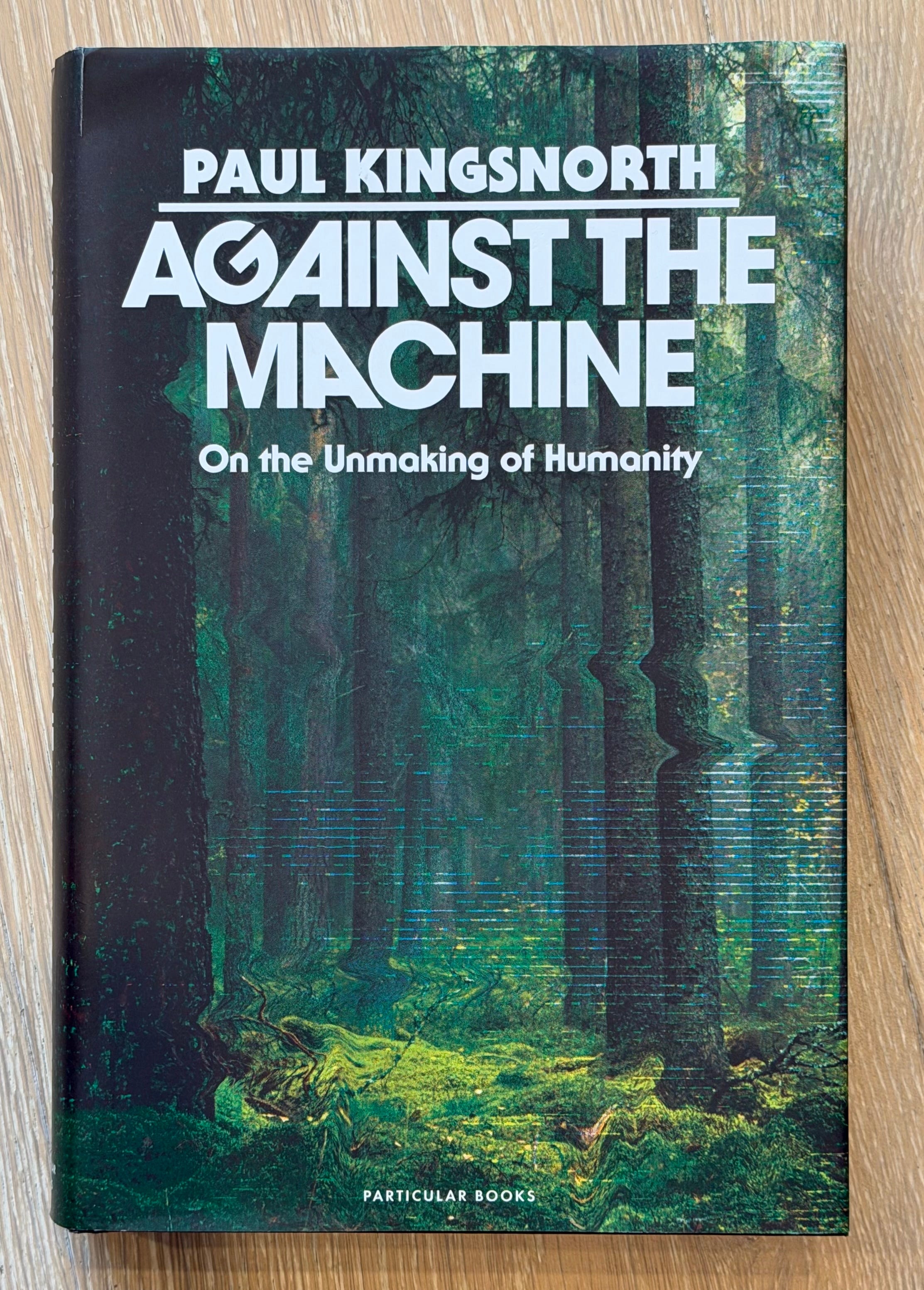
On page 285 of Against the Machine, Paul Kingsnorth explains how he processes information:
“the minute I am told that an ‘expert’, a state-sanctioned authority, a scientific body or a mainstream media organisation has ‘fact checked’ what I’ve just heard, I instinctively dismiss it.”
Okay then.
To his credit, he adds that he’s not defending this as a healthy response, but he should have led with it! It would have saved me 284 pages of wondering why, in a book so well-read and so beautifully written, the data keeps losing to some very predetermined vibes.
This is going to take a bit to unpack, so bear with me for this atypically long review.
Let me start with the sympathy, because it’s real and because I really wanted to like this book. Kingsnorth — a former environmental activist, co-founder of the Dark Mountain Project (I am a fan of the Dark Mountain manifesto), novelist, and since 2021 an Orthodox Christian living in rural Ireland — is trying to name something that many of us feel: that modernity has a texture, a momentum, a hunger, and that it eats roots, limits, silence, and meaning.
He calls it the Machine: “an intersection of money power, state power and increasingly coercive and manipulative technologies.“ When he stays descriptive, he can be great. His supermarket epiphany about marketing language — “The deepest human emotions are engaged to flog us cornflakes, shampoo and dog food. We are drowning in strategically commercialised passion“ — is exactly right, and I’ve made the same observation standing in the same aisles.
His formula for modernity’s engine, “Want. Want is the acid,” deserves its place on the page. And there is real erudition here: Spengler, Mumford, Ellul, Illich, Weil, Guénon, McGilchrist. The man has done his reading.
His core argument, distilled: the West was Christendom; Christendom died; a culture that kills its sacred order does not get a vacancy, it gets a replacement; and what rushed into the vacuum was the Machine, whose values – which Kingsnorth lists as science, the self, sex, and the screen – are now dissolving everything from nations to genders to reality itself.
By the final chapters, the book has escalated from cultural criticism to eschatology: the Machine has a theology, AI may be literally demonic, and we are possibly living in the time of Antichrist.
You can feel the book’s origin as a series of Substack essays: the same points return in slightly different robes, and the register drifts from argument toward sermon. That’s a forgivable sin. What is unforgivable is motivated reasoning shining through the pages which are also riddled with factual errors.
Take, for example, data centre power usage. Bemoaning Ireland’s campaign against turf fires, Kingsnorth writes of “the massive increase in internet server farms, which by 2030 could be using up an astonishing 70 percent of this country’s electricity.” I went looking for the source for this evidently ludicrous figure, and it traces back to a 2021 Irish parliamentary committee hearing, where an academic testified that data centres could reach 70% of grid capacity if every single proposed facility were approved and built.
They obviously weren’t. Dublin has had a de facto connection moratorium since 2022. The actual number: Irish data centres consumed 22% of the country’s electricity in 2024, with official projections around 30% by decade’s end.
The real number is already the most extraordinary in the world. Globally, data centres use about 1.7% of electricity; Ireland is the planet’s data-centre outlier by an order of magnitude, and 22% is a perfectly astonishing fact. Kingsnorth had the world’s best example sitting in his own country and still reached for the stupidly inflated version.
That’s what motivated reasoning does: it can’t even recognize when the truth is on its side.
This pattern repeats in the book.
“Religion in the West is effectively dead,” he declares — writing from a country whose census records roughly seven in ten residents as Catholic, while about 70% of Americans report a religious affiliation, US religious decline has visibly plateaued since 2020, France just recorded its largest cohort of adult baptisms in decades, and church attendance among young Britons has apparently risen sharply enough that his own side of the argument now celebrates a “quiet revival.”
The revival narrative may yet prove thin, but “effectively dead” was already wrong when the book went to print. And when he suggests that Christendom’s “secular replacement has, if anything, fared worse,” I can only note — as a product of one — that the most secular societies on Earth keep topping every measurable index of human flourishing, Finland’s nine consecutive years atop the World Happiness Report included. So they are faring worse by what measure, exactly, and on what data? The book never says. It’s simply asserted.
On COVID, he frames the response as a “triumph of technique“ and a step toward the “digital holding camp“ — quite convenient to write after the fact, without mentioning that the despised technique worked: depending on how conservative your model is, vaccination alone averted somewhere between 2.5 and 20 million deaths. Even the lowest published estimate is millions of people who got to keep living in the Machine he mourns.
And sex, allegedly one of the Machine’s four sacred values? A civilization supposedly worshipping sex is measurably losing interest in having it; sexual frequency has been declining for two decades, and by the late 2010s a third of young American men reported no sex at all in the past year.
The Machine is many things, but a fertility cult it is not. Even taking the most charitable interpretation that it wasn’t actually sex that Kingsnorth referred to with ‘sex’, but sexual-identity culture/liberation-as-value.
Even the book’s mythic set pieces crumble on inspection. The Machine’s genealogy runs through Mumford’s “megamachine” — Pharaonic Egypt, “whose legions of enslaved pyramid-builders were conditioned to think and behave like cogs,” workers “stripped down to their reflexes.”
Except archaeology has rather comprehensively demolished this: the Giza workforce was paid, rotational, housed in a purpose-built town, prodigiously fed, medically treated, and buried with honor beside the monuments, in work gangs with names like “Friends of Khufu.” The slaves-of-the-machine story is Herodotus’s myth, not history.
These errors matter because they expose the method: select the darkest available version of every story, skip the check, and call the selection insight. As such, they act as good case studies of confirmation bias and motivated reasoning – but they do not make for a good book.
But there’s more.
Like science. “‘Follow the Science’ usually translates in practice as ‘follow me’,“ Kingsnorth writes, and my “BS!” margin note was among my politer reactions. His deeper claim that science exists to control the world misunderstands the enterprise at its root.
Science is the attempt to understand the world; the possibility of control sometimes falls out of improved understanding, but conflating the two is like saying cartography exists to invade countries. And his assertion that a culture built on Reason “must, in the end, fail“ because pure Reason doesn’t exist would, if taken seriously, work equally well against every deity in the historical record; an argument I suspect the author would not appreciate having turned around.
The AI chapters deserve special mention because they reveal the method in its purest form. Kingsnorth tells us, with evident pride, “I have never engaged with an AI, for example, and I never will if I can help it.”
He then confidently reports that ChatGPT acquired “the theory of mind of a nine-year-old child“ (a contested lab claim that collapsed under replication attempts) and that Bing’s Sydney chatbot had enough of it “to try to persuade a reporter to leave his wife“ (an anthropomorphized reading of a two-hour conversation Roose himself admitted was designed to push the model “out of its comfort zone” — a chatbot locked into the character that conversation built is not a suitor with intentionality). From these fundamental misunderstandings of what the technology is, it’s a short walk to the book’s forbidden question: what if these things are coming from the realm of the demonic?
I can respect a man who refuses to use a technology on principle. I cannot respect pronouncing on its inner nature from a position of proud, deliberate, total second-handedness.
If you refuse to engage with a subject matter, epistemic humility about what you’re describing is mandatory. In my books anyway; YMMV.
And there’s more.
The hearth fire, Kingsnorth argues gorgeously, is the sacred center of the home, and stripping it away serves “the ultimate ambition of the Machine: the abolition of home.”
Lovely.
But fire is the primordial technology; the original bending of nature to human will, the first step on the very road he wants closed. Somehow the technologies old enough to have grown moss are sacred, and the ones invented after the author’s childhood are demonic. Convenient.
And here the irony goes all the way down: religion itself — the thing this book wants restored to the centre of Western life — is very plausibly the most successful social technology our species has ever built. Moralizing gods, shared ritual, sacred order: these are the innovations that let human cooperation scale beyond the kin group and the village, a case made with actual evidence in books like Harvey Whitehouse’s Inheritance and David DeSteno’s How God Works. Kingsnorth would object that faith is revealed, not engineered, but his own argument for it is relentlessly functional: cultures without a sacred order fall apart, he tells us, again and again. That is a utility claim about social machinery. And the receipt sits in his own pages: Mumford’s original megamachine, Pharaonic Egypt, was “an entire society ordered from the top down, justified by a mythos.” The first Machine ran on religion. The Machine and the Church, it turns out, are rival technology stacks, and Kingsnorth is simply loyal to the incumbent.
What really took the cake for me was his strong condemnation of appeals to expert authority, when an earlier chapter had been one of fawning over undeniably world-class expert Iain McGilchrist. Apparently the credential system works fine when it agrees with him.
He hates the screen and writes on one (lamenting he has to – not true, typewriters are still around); he’d press the button that kills the internet, yet his rebellion is distributed via Substack. To be fair, he owns that last contradiction with disarming honesty and it’s in these self-aware moments that you glimpse the better book this could have been.
There’s some social commentary this book accidentally provides, and it’s the reason I found it worth finishing: Peter Thiel — Palantir founder, techno-libertarian, the Machine incarnate by Kingsnorth’s lights — spent 2025 delivering lectures arguing that we live in the time of Antichrist too.
Same scripture, same eschatological urgency, opposite casting: for Thiel, the Antichrist is the global safetyist order that would stop the machines in the name of peace and safety; people, roughly, like Paul Kingsnorth.
Two Christian intellectuals, one apocalypse, each holding the mirror the other refuses to look into. When your framework and your enemy’s framework are identical except for which side plays Satan, that’s usually a sign the framework is doing the work your evidence should be doing.
Apocalypse, it turns out, is a mirror: you look in and see whatever you already feared.
The maddening thing is that the strong version of this book exists scattered across other books. The WEIRDest People in the World makes the Church-shaped-the-West argument with actual rigor. Seeing Like a State dismantles high-modernist control fantasies more devastatingly than any sermon. Blood in the Machine gives the Luddites the serious history Kingsnorth’s two-paragraph cameo doesn’t.
Kingsnorth gestures at all of this territory, wrapped in prose those books can’t match, and then trades the case for a jeremiad. There is a real critique of the Machine to be written, and parts of it are even in here. As it stands, we get a war: he insists, explicitly, that the crisis of the modern world “is a spiritual war“, declared against an enemy assembled from worst cases, dead statistics, and other people’s nightmares.
Is there a spiritual upheaval in the West? Yes, probably. A crisis? Maybe.
A war? Check the data. My margin note on one of the book’s most quotable lines: Voegelin’s “No one is obliged to take part in the spiritual crisis of a society“ simply says: great point. Kingsnorth’s closing advice is to interrogate every technology: what, or who, does it ultimately serve? They’re some of the right questions. Answering them honestly, though, requires exactly the tools this book instructs you to throw away. The Machine deserves better enemies and better governance.
Rating: 2.5 out of 5
Dog-ear index: 7.5
Who is it for: Readers who already feel the Machine in their bones and want that feeling liturgized in prose this beautiful, and who won’t be checking the footnotes. If you want the critique of technological modernity that survives contact with evidence, read Seeing Like a State, Blood in the Machine, or The WEIRDest People in the World instead. If you want to watch a gifted writer mistake his metaphysics for a literature review, this is the definitive text.
[reminder: I highlight important parts of the books I read, and dog-ear the really important pages. The dog-ear index is simply the average number of dog-eared pages per 100 pages] Product link for reference only; please support your local bookstore where possible: https://www.amazon.com.au/Against-Machine-Unmaking-Paul-Kingsnorth/dp/0593850637