Review: After the Spike
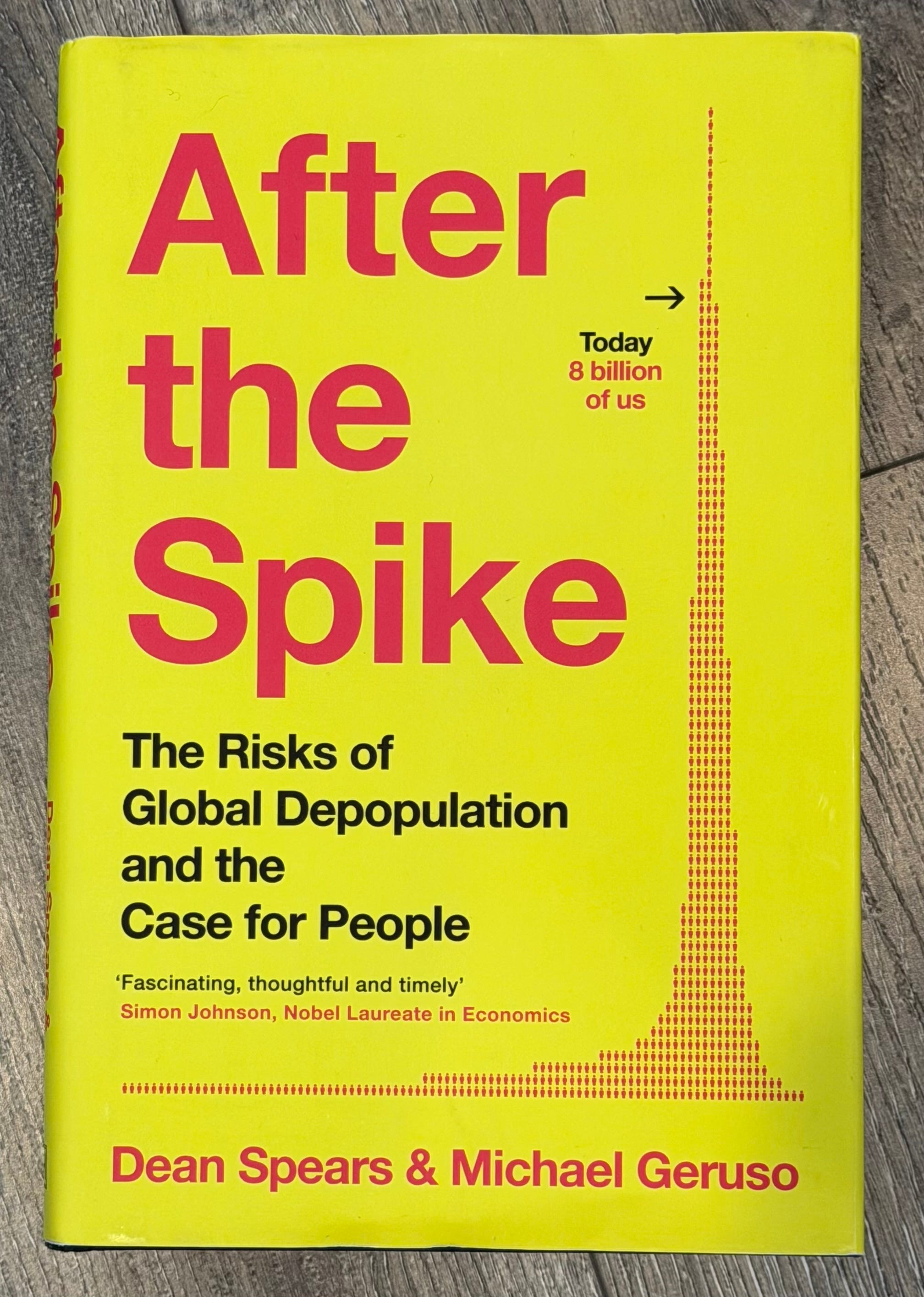
Review of "After the Spike: The Risks of Global Depopulation and the Case for People" by Dean Spears and Michael Geruso
I’ll be honest: I opened this book expecting to disagree with it. My stance was simple – that somewhat fewer people would probably be better for the planet – and the cover alone seems to argue for more people.
My views were that long-term, we’d be better off with a lower population, given we are arguably in significant overshoot in terms of sustainable resource consumption. Maybe humanity should, over the very long term, be a couple of billion? Or possibly even what we have today, if we managed resources much better? Enough to sustain civilization without wrecking everything else.
But more? Nope. The subtitle alone, “the case for people”, had me concerned, but I was open to changing my mind.
Spears and Geruso’s have a few central arguments, which are all pretty straightforward: global fertility rates are plummeting everywhere and the future is one of depopulation unless we dramatically reverse course; stabilization at replacement level (2.0) is harder than it looks; and depopulation carries risks we’re not taking seriously enough.
Fairly early on they lay to rest my worst fear – they are not, in fact, advocating for population growth. They are making the case for stabilization at some level, which is a different beast entirely – they don’t even take a stand on what number, exactly, the stabilization should level out to, but much higher than a billion or two anyway.
The book succeeds at one thing in particular: demolishing lazy thinking about population and climate. This, I believe, is a really important point considering there are many people who for ethical reasons do not want to have children. It’s often a heart-wrenching decision for them; climate scientists who really would want a family but don’t feel they can ethically have one.
I wish people who hold those views, as well as parents who feel guilty about having the children they already do, would read this book. Chances are their fears and anxiety will be significantly allayed by this.
Population change happens slowly; measured in generations, not years, and climate change requires urgent action that is incompatible with any tweaking of fertility rates. The math, which they go into quite some detail, is brutally clear: depopulation simply cannot arrive in time to substitute for better climate stewardship. We need to solve that challenge with other means.
There’s another inconvenient fact for the “fewer people = better world” narrative: by nearly every measure, human wellbeing has dramatically improved during the period of most explosive population growth. From 1950 to today, global population more than tripled while child mortality plummeted, literacy soared, and billions escaped poverty. The correlation isn’t causation, obviously, but it definitively demolishes the simple equation that more people automatically means worse outcomes. If that were true, the 20th century should have been a nightmare of declining human welfare. It wasn’t.
While much of the math is pretty elementary, the reminders are valuable; an average of 2.0 children per woman doesn’t mean everyone has two kids. It can even be a distribution where zero children might be the most common choice.
Many benefits of having more people are discussed, innovation being one among them. Some of these arguments are stronger than others. Yes, cities drive innovation. Yes, larger populations enable specialization and economies of scale that make everything from ethnic restaurants to advanced medical care viable. I’m sold on the general principle. But to claim that we get that much more innovation from 10 billion versus, say, 3 billion people? I’m not convinced the relationship is at all clear. Most people today are stuck in grinds that nowhere near maximize their potential; I think we could probably have achieved most of our current technological sophistication with substantially fewer people – just better-supported ones – and I don’t think the desire for more innovation makes for a particularly strong basis for having large global population.
There were some genuine surprises in store, such as the One Child Policy analysis. Check out this chart, from a chapter that discusses the difficulty of government policies in either increasing or decreasing birth rates. The chart is from when China had its famous “One Child Policy” in effect, and its neighbors. Which one is China?
Everything we’ve been told about the brutality and inhumanity of the policy would have one believe that it must show up as a dramatic drop in fertility rates. Instead, one literally cannot identify which country is China just from looking at fertility trends. The policy’s dramatic effect, on a population level, is largely mythological – which does not, btw, mean that it wasn’t brutal and inhumane and didn’t cause a lot of suffering. It did, but it didn’t move the needle much at all, making it that much worse.
This matters because it undermines simplistic beliefs about governments’ ability to control population through coercion - and by extension, their ability to solve depopulation through policy mandates.
The book is not without weaknesses. Among them, their treatment of environmental decoupling occasionally veers into techno-optimism without fully grappling with climate change’s impacts on food production. And while they’re right that we can produce enough calories for 10 billion people, that answer conveniently skips over that we empathetically cannot support 10 billion people consuming meat at Western levels.
Weaknesses notwithstanding, After the Spike successfully reframes the conversation. Standing for reproductive freedom and caring about a depopulating world aren’t in conflict - they’re both part of making a better future. The insight that we have time to think about this precisely because population change is slow is both reassuring and a call to action.

We should talk about it now, when we’re not desperate. The solutions, should we wish to avoid depopulation, are also the softer the earlier we start implementing them.
What are the solutions, you may ask? Good question, because we don’t know. Despite attempts otherwise, in none of the 26 countries where birth rates have fallen below 1.9 has there ever been a return above replacement. The long-term trend is very, very clearly towards depopulation.
So did I change my mind?
In parts, yes. I haven’t flipped around to “more people are always better“; shooting for infinite growth on a finite planet still sounds pretty firmly like a stupid idea to me. (and let me be clear - that isn’t what this book is arguing for either)
I have, however, shifted from “fewer people sounds like a good idea“ to “population stabilization at some reasonable level, maybe even what we have today, is probably better than unchecked depopulation. People do bring surprising benefits.”
Which level should we stabilize at, then?
That’s the trillion-dollar question the book leaves open, and rightfully so. We don’t fully understand the root causes of declining fertility, and we definitely don’t have The Solution.
But we do have time to figure it out, and the act of figuring it out starts by talking about. So let’s talk about it.
Rating: 4 out of 5
Dog-ear index: 8.2
Who is it for: Anyone who thinks population is a simple problem; climate activists who see depopulation as salvation; policy wonks who need better statistical literacy; and especially people who’ve written off having children as irresponsible without examining the actual numbers.
[reminder: I highlight important parts of the books I read, and dog-ear the really important pages. The dog-ear index is simply the average number of dog-eared pages per 100 pages]
Product link for reference only; please support your local bookstore where possible: https://www.amazon.com.au/After-Spike-Global-Depopulation-People/dp/1847928358/


