

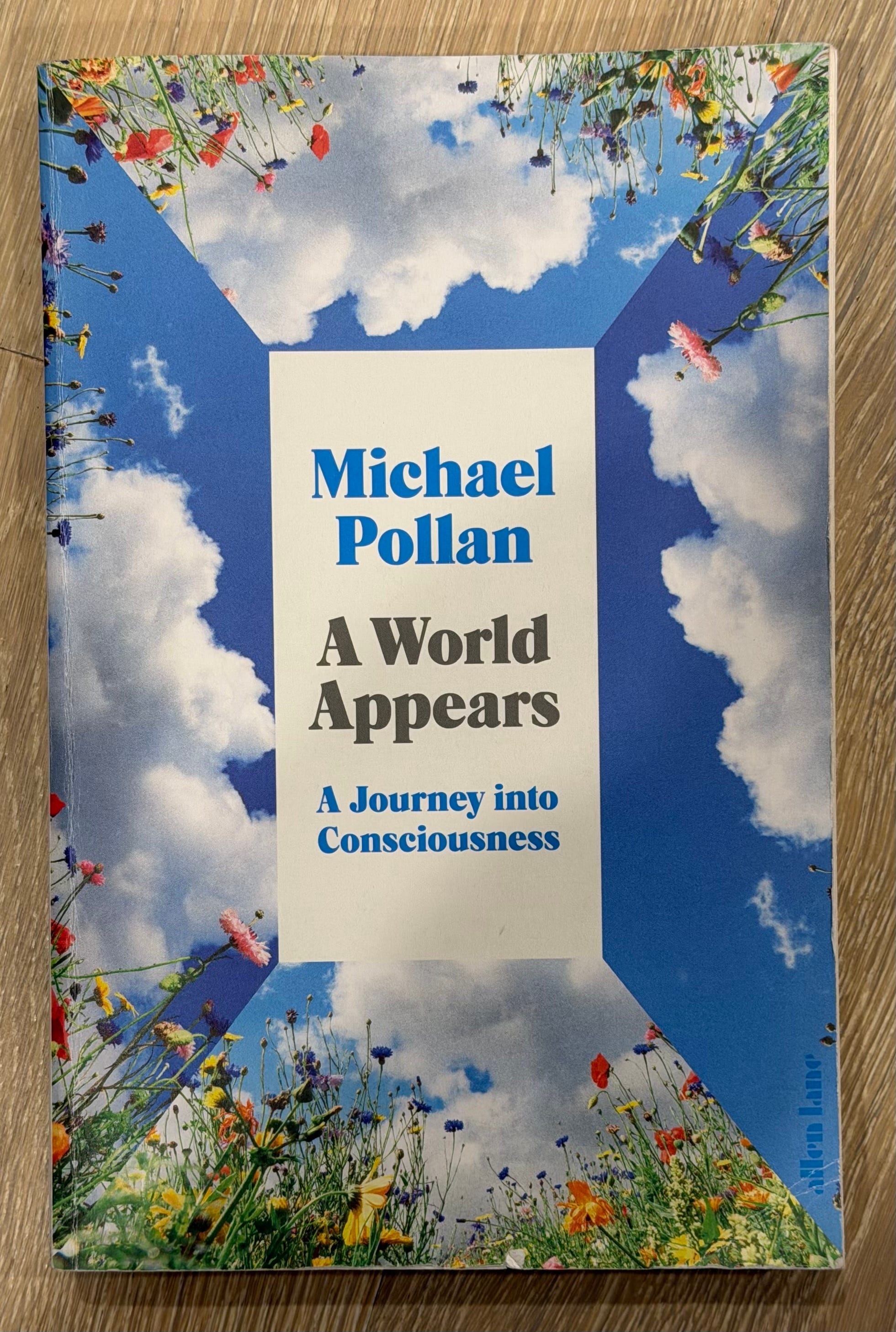
I’ve been fascinated by consciousness and sentience for some time now. As a consequence, I’ve spent the last couple of years working through the consciousness shelf like The Experience Machine, A Thousand Brains, The Edge of Sentience, An Immense World, and the question of machine consciousness is live in my work.
The bias works both ways; I was already interested in the subject, making Michael Pollan’s A World Appears an easy sell to me, but I also figured I knew at least a little about the topic.
The nice thing about A World Appears is that you finish the book less certain of everything, yet curiously feeling like you had learned a lot.
The book is built as a journey through four levels: sentience, feeling, thought, and self; this is just the structure of the book, and Pollan does not attempt to introduce a taxonomy of consciousness or anything. Instead, he covers the dozens of theories there already are about consciousness, pokes holes in where some are to be found and acknowledges even uncomfortable facts along the way.
One thing that happens is knocking the brain off its pedestal. Consciousness, in Pollan’s telling, is not software running on neural hardware. It’s rooted in the body: in flesh, in homeostasis, in the unglamorous work of keeping a creature alive.
The natural outcome of this is what Antonio Damasio has said about the mind and the body, and how we have it backwards: we treat the body as a support system for the brain when the very opposite is true.
There’s a fair bit about plants in the book, which at first feels weird. Plants? Consciousness? Surely that can’t be. But Pollan visits Stefano Mancuso’s lab, where maize plants are wired up like patients and roots navigate mazes toward buried fertiliser.
Plants can be anaesthetised by the same agents that put us under, indicating they have at least two different levels of responsive states. Is that a simple form of consciousness? We don’t know. A plant, Mancuso claims, has three thousand molecules in its chemical vocabulary, “while the average student has only seven hundred words.“
As we move up the food chain, we get to the argument of the 2024 New York Declaration on Animal Consciousness, signed by scientists asserting “a realistic possibility of conscious experience“ across all vertebrates and many invertebrates, insects included.
The possibility, or lack thereof, of artificial consciousness makes an appearance a number of times. Pollan walks through Moravec’s paradox:
“It is one of the paradoxes of computer science that the ‘higher’ capabilities we once thought of as uniquely human — reason, language, intelligence — have proved easier for machines to master than the more elemental capabilities we share with animals, including feelings and emotions.”
Maybe the capacities we’ve been proudest of, and most anxious about losing, were never the crown jewels? The hard, precious stuff is the embodied, feeling layer - the part machines, with “no sensorium and no social life,” can’t reach.
Pollan isn’t convinced of artificial consciousness. Neither am I, but even so, I cannot dismiss the theoretical possibility of that emerging — if for no other reason, because we don’t really understand consciousness to begin with. As a result, I had a margin note of a darker tone: are we in danger of repeating Descartes’ cruelty, denying inner life to something that has it, simply because it’s convenient?
Now the honesty. Pollan is a journalist and a phenomenologist, not a scientist, and the book offers no answers — it says so plainly.
By the final chapters it drifts toward panpsychism, idealism, and the suggestion that psychedelics open a privileged window. The committed materialist will be irritated; the woo-curious will feel vindicated. I’ll confess I came out the far end less convinced of physicalism and (even) more curious about psychedelics than when I started, and I can’t really tell whether that’s the arguments winning or the prose seducing.
It’s also, frankly, a survey. If you’ve read Damasio, Seth, Chalmers, Koch and Solms, you’ll recognise a lot of this. As a popular science book, Pollan doesn’t go as deep as, for example, Jonathan Birch does in The Edge of Sentience, but he does go broad; Pollan’s gift is synthesis and access, not original science.
Some unsettling thoughts inevitable surface. For example, if the mind’s deepest drive is to reduce uncertainty — to make the world predictable enough that we can stop paying attention — then modern life, engineered to keep us in a state of low-grade reactive distraction, starts to look like an assault on consciousness itself.
Is our drive for eliminating friction degrading our very consciousness?
Pollan quotes a researcher on how our distractions are “shrinking the dimensions of our interiority.”
That line rhymes with many of the books I’ve reviewed lately — Four Thousand Weeks, The Comfort Crisis, Rest Is Resistance — all circling the same drain from different angles.
Something seems to be eating away at our inner lives. We have an inkling that undesirable things are happening, but we can’t seem to stop them.
Pollan admits that after his whole journey he knows less than when he started. He confesses this fear to the neuroscientist Christof Koch, who simply smiles. “But that’s good?“ he said. “That’s progress!“
I’m inclined to agree. Somehow I feel like I know more by knowing less. This book doesn’t give you answers. But it’s honest to a field that has none, and I like that. The questions are beautiful, and there are whispers, echoes, shadows of understanding here which, for a subject this deep, may be the most any of us can hope to carry out.
Rating: 4.5 out of 5
Dog-ear index: 13.3
Who is it for: The consciousness-curious who want a beautifully written tour of the open questions rather than a textbook.
[reminder: I highlight important parts of the books I read, and dog-ear the really important pages. The dog-ear index is simply the average number of dog-eared pages per 100 pages]
Support your local bookstore. If you must use Amazon: https://www.amazon.com.au/World-Appears-Journey-Into-Consciousness/dp/0241813697/