

I used to love people-watching. I’ve mostly stopped, and you already know why: it’s boring, because everyone is on their phone all the time; on trains, at the bus stop, at cafes, even the couple at the next table at a restaurant who will spend the whole meal a metre apart and a continent away, each lost in a separate feed.
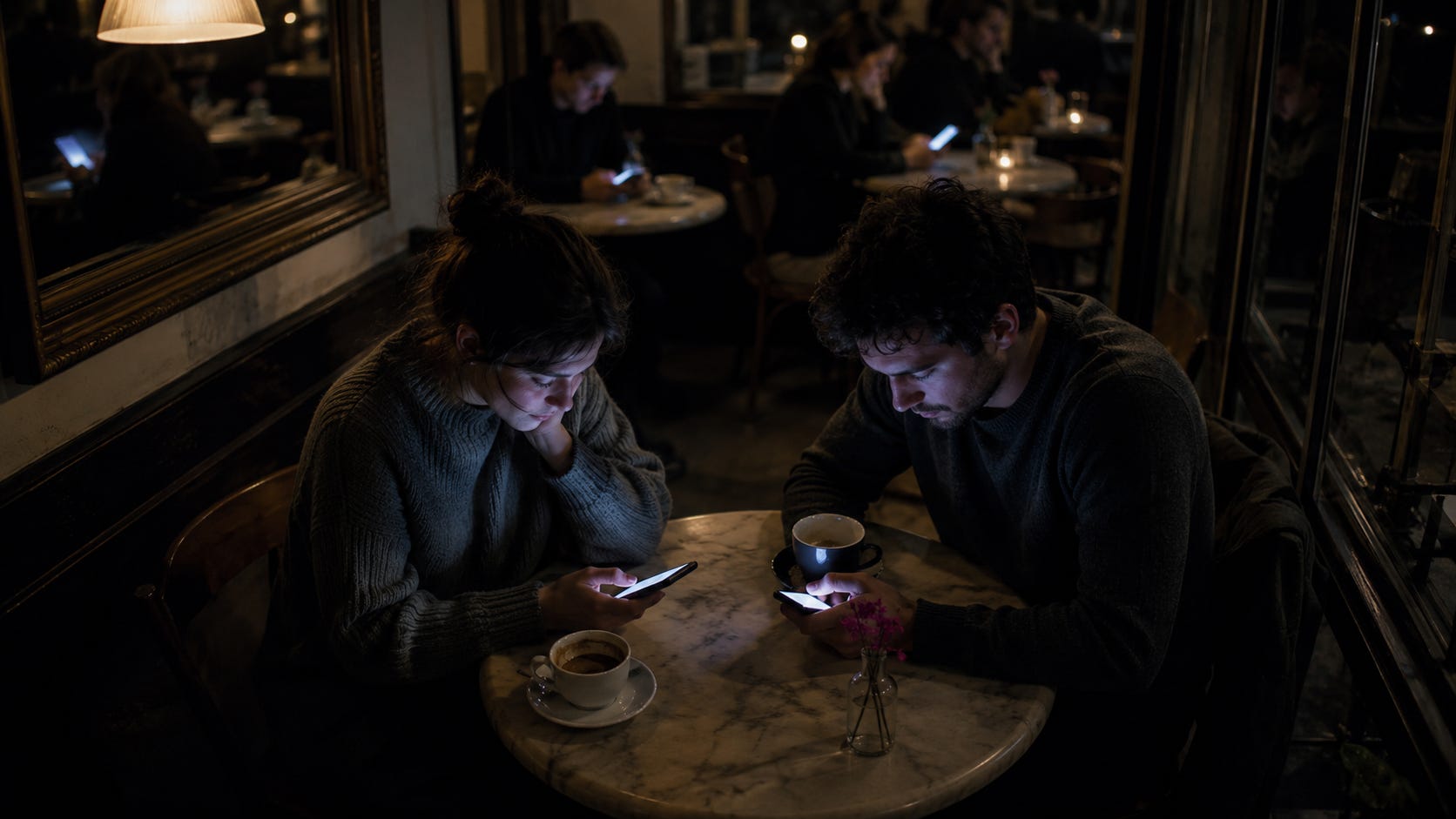
Everyone knows that part by now.
Most of us are a part of it.
Two years ago I co-wrote an essay for the Institute for the Future with Susanne Forchheimer and Lakshmi Rengarajan about AI and the future of romance. We mapped five scenarios — the AI wingman, the AI companion, the AI affair, the AI counsellor, the AI matchmaker — and asked who was controlling our romantic futures.
The diagnosis of the dating platforms has held up: they are engagement machines wearing matchmaker costumes, and “the dating app designed to be deleted“ is nothing more than a marketing slogan to fall for.
But we may have gotten the shape of things a little wrong. Two years on, none of our five scenarios compete — they all arrived. The wingman is here: a generation drafting its opening lines, its banter, its apologies through a model. The affair is here. The counsellor is here; asking a chatbot for relationship advice is now a very common thing to do, especially among younger users. And the companion, the one we feared most, is here too. And the AI matchmaker? There are multiple companies claiming to be just that.
Just two years on, all the scenarios are here – everything everywhere all at once, like we didn’t have enough issues to tackle.
But what none of them are is the disease.
They are all opportunistic infections, and they took hold because society was already immunocompromised.
What weakened the immune system
You don’t get an out-of-control opportunistic infection in a healthy body, nor do you get rapidly rolling waves of destabilising societal changes in a robust, healthy society.
You get it when the immune system is already on the floor.
What undermined the immune system? By now, we know part of the answer is a decade of social media optimised against our interests.
I won’t drown you in effect sizes; the causal evidence is contested, and anyone who tells you it’s settled is selling something. But the logic doesn’t need a meta-analysis. Build a machine whose single objective is to maximise the time a human spends staring at it, then discover — as every one of these companies did — that outrage, fear and contempt are the cheapest, most reliable fuel for that engine, and you have built something that profits from human beings at their worst.
Is it really any wonder it took us somewhere dark?
Even if you stripped the outrage out entirely, and imagined an online experience with no rage-bait or comparison spirals, you’d still be left with a person spending hours a day, every day, eyeing a small bright rectangle.
We did not evolve for that, and no amount of “it depends“ rescues the base case: more time in the feed is, for almost everyone, a worse life.
Think of your peak experiences from the past year or two. I can almost guarantee watching a reel or a TikTok doesn’t feature on that list.
Here I want to be precise, because the sloppy version of this argument is everywhere and it’s wrong. Social media is not the same as the Internet. The Internet is one of the great achievements of our species: it can help connect the isolated, educate the curious, give voice to the silenced, put the sum of human knowledge a query away. The rot isn’t the network. The rot is a specific layer built on top of it: products whose incentives are born entirely from engagement and advertising revenue, where your attention is the thing being farmed and sold.
Change the incentive and the same technology becomes something else. The medium was never the problem. The business model was.
I know the distinction isn’t theoretical, because I’ve lived the good version.
And no, I don’t just mean the 1990s when I formed relationships on IRC (Internet Relay Chat) that successfully extended into the ‘real’ world, although that did happen too.
The good versions can still be found today.
One great friendship I have today began in the depths of the pandemic, in an online Meetup group set up with a name that now reads like a quiet manifesto: Do you want to meet the other Real People? That was the internet too, just not the feed built to keep me scrolling, but a corner of the same network bent toward the opposite purpose: getting strangers into the same room with zero commercial interest from anyone.
Same technology. Opposite incentive. Opposite result.
And the damage runs deeper than lost hours. As Simon McCarthy-Jones argues in Freethinking, a system engineered to hold your attention isn’t only an attention problem, but a freedom-of-thought problem.
A mind kept in low-grade reactivity, attention span degraded, fed a stream optimised by someone else’s metrics, has quietly surrendered some of its capacity to reason deliberately and reflect deeply. The feed shapes what you are able to think about, and how, which makes the question of who sets its incentives a question about autonomy.
Why the infection took hold
By the time the more sophisticated AI tools arrived that everyone is panicking about now, they walked into a body with no defences — and that, more than the technology itself, is what should frighten us.
Each of our foreseen scenarios feeds on a different lost skill. We reach for the AI wingman because we’ve lost the nerve to write our own opening line. We ask the AI counsellor because we’ve lost the friends we’d once have asked. We drift toward the AI companion because the human alternative has become expensive, risky and effortful. And the cruelty of it is the loop: the weaker the social muscle, the more indispensable the prosthetic, and every use of the prosthetic wastes the muscle a little more.
It is another case of skill degradation that is the thread running through this entire site.
Consider what it now costs a young person to do the thing my generation did without thinking. The third places where you used to meet people casually have been hollowed out. The muscles you’d use to strike up a conversation with a stranger have atrophied; partly because half of us wear headphones as a do-not-disturb sign to the entire species, partly because a generation raised on text has had less practice at the live, unscripted, slightly terrifying work of talking to someone whose response you can’t predict or edit.
And the bitter irony is that we know the trade is a bad one. Joe Keohane built a whole book around it — The Power of Strangers — and the research at its heart is some of the most quietly devastating in social psychology: when Nicholas Epley and Juliana Schroeder put commuters on Chicago trains and told some to talk to a stranger, the ones who did had a measurably better journey, and almost every one of them had predicted the opposite.
We expect connection to go badly and yet it almost always goes well.
Jamil Zaki names this in Hope for Cynics: a broken forecast about other people, a reflexive cynicism we mistake for realism, when the better-calibrated read of the actual data is that strangers are warmer, deeper and more willing than our defences will let us believe.
The prosthetic, meanwhile, is right there, frictionless, promising we never have to test the forecast at all – and, worse, probably feeding us a twisted narrative framing that person we might’ve considered talking to as our enemy.
That’s the offer: no rejection. No awkwardness. No risk that the other person has a bad day, a competing claim on their time, an inner life that doesn’t revolve around you. Against an expensive, risky, effortful human, it is methadone for a loneliness nobody is treating.
The magenta line, for the heart
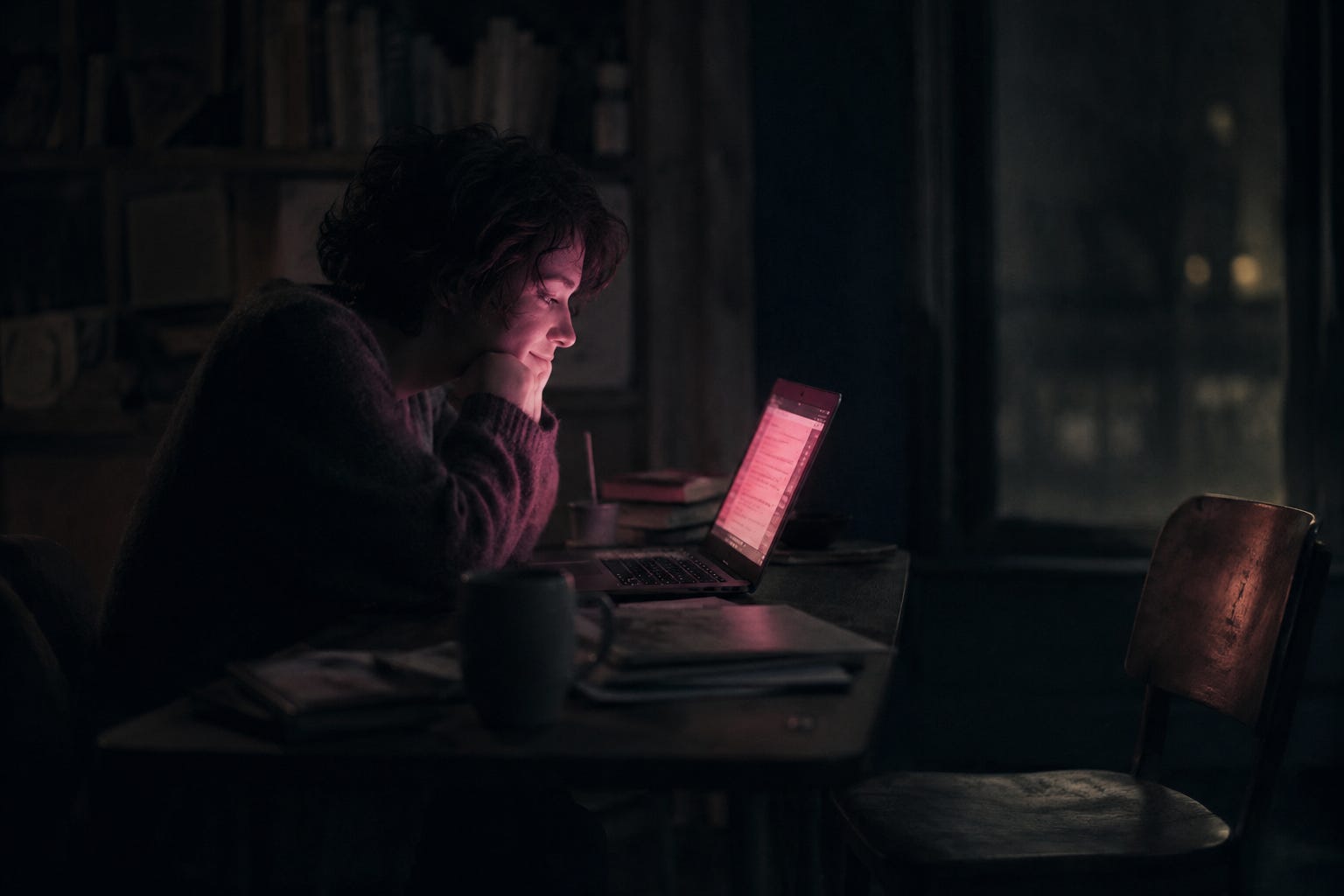
Long-time readers know where I’m going with this.
The “children of the magenta“ are the pilots who grew accustomed to flying by following the magenta line on the flight management computer; to manage the automation rather than fly the aircraft.
It works beautifully right up until the automation quits or does something unexpected, at which point the skill that should have caught the fall has quietly wasted away from disuse.
The danger was never the autopilot. It was the atrophy.
These tools are the magenta line for human connection. Every time one of them smooths over the friction — supplies the perfect reply, absorbs the bad mood without complaint, never once needs you to be brave — it is flying the relationship for you.
A generation that learns intimacy from a system that never imposes load will find itself, one day, with the automation disengaged and no hands left that know how to fly. Is it, then, any wonder that young people today are less likely to have sex and more likely to opt out of relationships altogether?
I think you’ll find it’s a bit more complicated than that
If the argument stopped there it would be an easy moral panic, and I won’t write one.
For some people, these technologies aren’t the infection, they are the medicine. The genuinely isolated, the socially injured, the disabled, the housebound, the person whose anxiety makes the Chicago-train experiment a cruelty rather than a delight; for them, an always-available, non-judgmental, infinitely patient interlocutor can be the difference between some connection and none.
The benefit of LLMs is perhaps best evidenced for neurodivergent people. A growing body of research finds autistic adults describing these tools as a non-judgmental space to handle daily problems without the social tax of asking a person, a tireless coach for translating neurotypical communication and carrying some of the executive load. For people with ADHD the language shifts to task initiation: one diary study called ChatGPT “a little bit of a life raft,” and the refrain across the studies is simply “it helps me start.” These are not trivial conveniences. For someone who has spent a lifetime being misread, an interlocutor that is patient, available at 3am, and indifferent to social missteps can be genuinely emancipating.
The same goes for the Internet at large, which for countless people who couldn’t find their tribe in the physical world has been nothing short of liberation.
Any honest account holds both truths at once: that for many young people these tools risk becoming a net-destructive trap, and that for a real and non-trivial minority they are a lifeline.
What actually has teeth
Two years ago we ended our essay with a wish: replace the video-game executives running the dating apps with humanists and futurists. I winced a little rereading it. It was a hope, not a strategy, and it dodges the structural problem we’d correctly diagnosed three paragraphs earlier. So let me do better, and do it cold:
Change what the law lets these systems optimise for. Don’t swap the CEO; change the objective function any CEO is permitted to pursue. This applies to all of it: social-media feeds, dating apps, companion AI, any platform whose revenue is your attention. A fiduciary-style standard; the company must be able to demonstrate it is optimising toward the user’s own stated goals, not retention and time-on-app. Make the engagement metric the liability, not the KPI.
Mandate friction. We already accept that some products are built to exploit compulsion and so require cooling-off periods, hard stops, audited off-ramps. An infinite-scroll feed engineered to keep you swiping and a companion AI engineered to keep you soothed are no different in kind. Build the brakes in by law, not by the goodwill of the people selling the accelerator.
Ban companion AI for minors. We age-gate alcohol, gambling and cigarettes because some products simply are not for children, however much they want them; a synthetic relationship engineered to be more available and less demanding than any human one belongs on that list. I have made the full case for this elsewhere. The lawsuits are already arriving, for the worst possible reasons. We should not need a body count to act.
None of this is simple, because stated user goals can be gamed too; but that is a design and enforcement problem, not an excuse to keep pretending engagement is a neutral metric.
And the one that matters most, the one no chatbot regulation will fix: rebuild the substrate. Regulate every companion app out of existence tomorrow and a lonely, broke, contact-starved twenty-three-year-old still has nowhere to walk toward. The third places, the casual encounters, the affordable rituals of being in the same room as other people; if we don’t fund and defend those, we simply leave the door open for the next opportunistic infection, whatever it turns out to be.
Back to the café

I wrote something in 2021, in the thick of the pandemic, that was almost a prayer: let the world reopen. Fill the cafés. Get people travelling, congregating, talking to strangers, because it’s good for us, I said, and I meant it.
The disconnection then was forced on us by a virus, and I could not wait for it to be over.
Well, it’s over. The world reopened.
And we stayed inside anyway. Not because anyone forced us to this time, but because in the years between, we built machines that make solitude more comfortable than company and feeds more reliable than friends.
So when I go back to my café and try to people-watch, and I already know what I’ll see. Nobody chose this in the way that matters. It was chosen for them, by incentives they never voted on, and it is quietly removing from an entire generation the one skill no machine can practise on their behalf: the dangerous, unprofitable, irreplaceable act of turning toward the person across the table.
I try to practice what I preach. Another of my closest friends I first met in a queue outside a café; both of us waiting on coffees, neither of us obliged to say a single word, but we did.
The entire apparatus I’ve spent this essay describing exists, in the end, to make sure that small, unprofitable moment never happens.
That the queue stays silent.
That the eyes stay down.
That the friend never gets made.
As one of those with colourful earphones that I plug into my ears so nobody speaks to me at the spa, I have to say, reading this made me pity myself. I have always thought I am protecting my peace, now I know I am robbing my life of potentially special encounters! Thank you for this!