Best Books of 2025
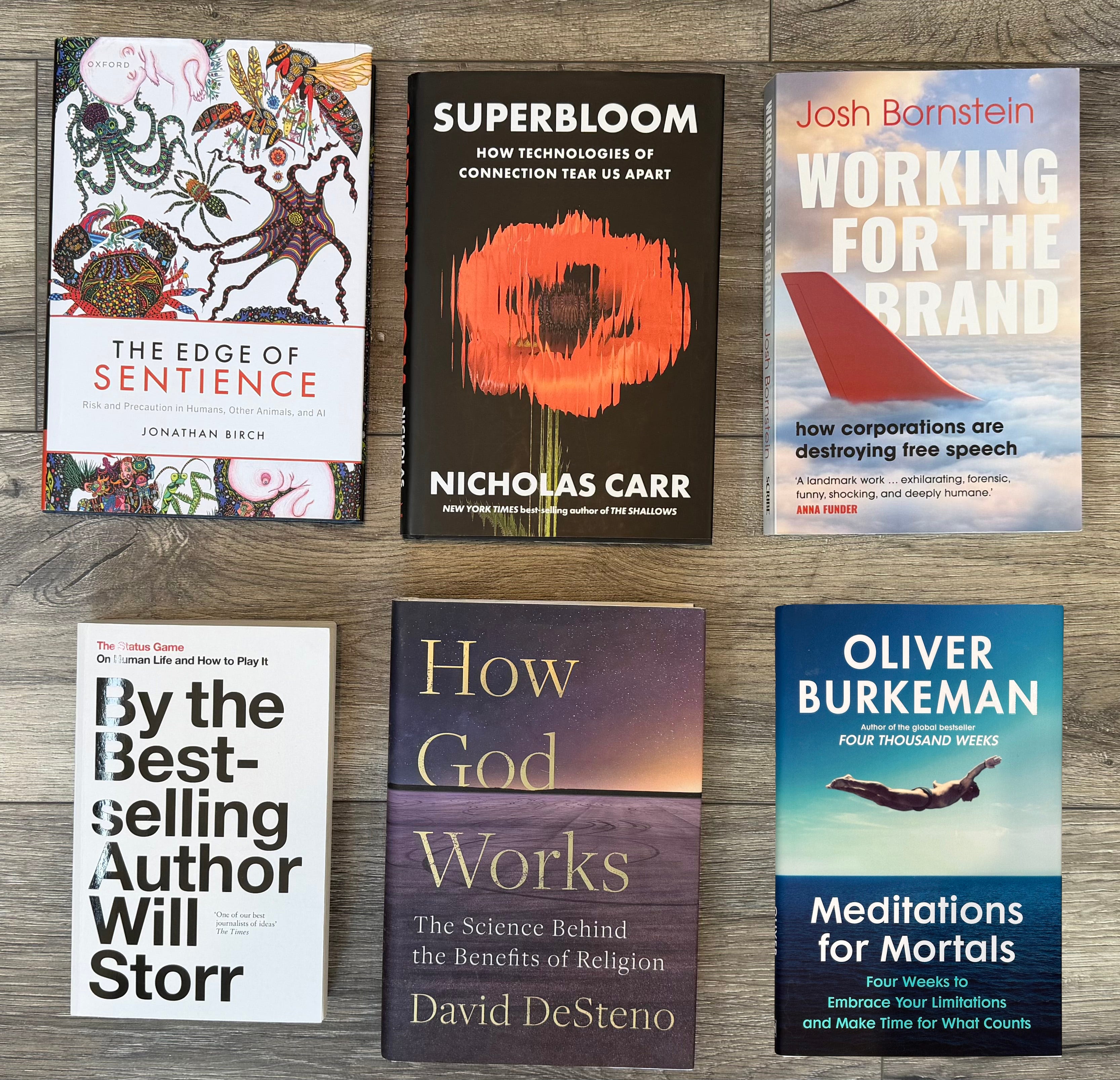
Last year was another stellar year of quality books. I read 46 books last year, many of which were excellent, with so many standouts that I just could not bring myself to making a Top 5 - so here’s the Top 6 books of 2025, in no particular order:
Meditations for Mortals (by Oliver Burkeman): Brief daily reflections that tear down lazy thinking about achievement and success while offering radical permission to embrace human limitations. Most memorable quotes: “You are free to do whatever you like. You need only face the consequence”, and that “The truth is that it’s almost never literally the case that you have to meet a work deadline, honor a commitment, answer an email, fulfill a family obligation, or anything else.”
Working for the Brand (by Josh Bornstein): This will speak to the many consequences that do arise when you speak up. A searing exposé of how corporations sacrifice employees at the altar of brand protection, systematically suppressing speech through vague contract clauses while demanding absolute loyalty. Essential reading for understanding how organizational power curtails democratic discourse and worse.
The Edge of Sentience (by Jonathan Birch): Forces you to redraw your moral map by examining which beings - from cephalopods to AI systems - might be or become sentient and thus deserve moral consideration. Proposes a precautionary framework for democratic decision-making on consciousness that we urgently need.
The Status Game (by Will Storr): Shines a spotlight onto the fact how every aspect of human life involves playing status games; from hotel lifts to social movements and why recognizing which game you’re in matters more than pretending you’re above it all. The protection lies in diversification: play multiple games, never invest everything in just one.
Superbloom (by Nicholas Carr): On how each communication technology from the telegraph to TikTok follows the same arc: utopian promises, corporate capture, social fragmentation, and now the realization that mass connection might be fundamentally incompatible with human psychology. We’ve built a world where reality has become a distraction from media, and that’s…not great.
How God Works (by David DeSteno): Treats religious practices as “spiritual technologies” worthy of scientific study regardless of theological truth, revealing that thousands of years of religious practice have discovered psychological tools that demonstrably work. Dismissing all of it because you don’t believe in the particular metaphysics interpretations would be like refusing antibiotics because you don’t believe in the four humors.
What’s in store for 2026?
The to-read shelf has grown to a bit of an antilibrary with 43 books on it. Here’s just a small sample to show the variety that is ahead:


