

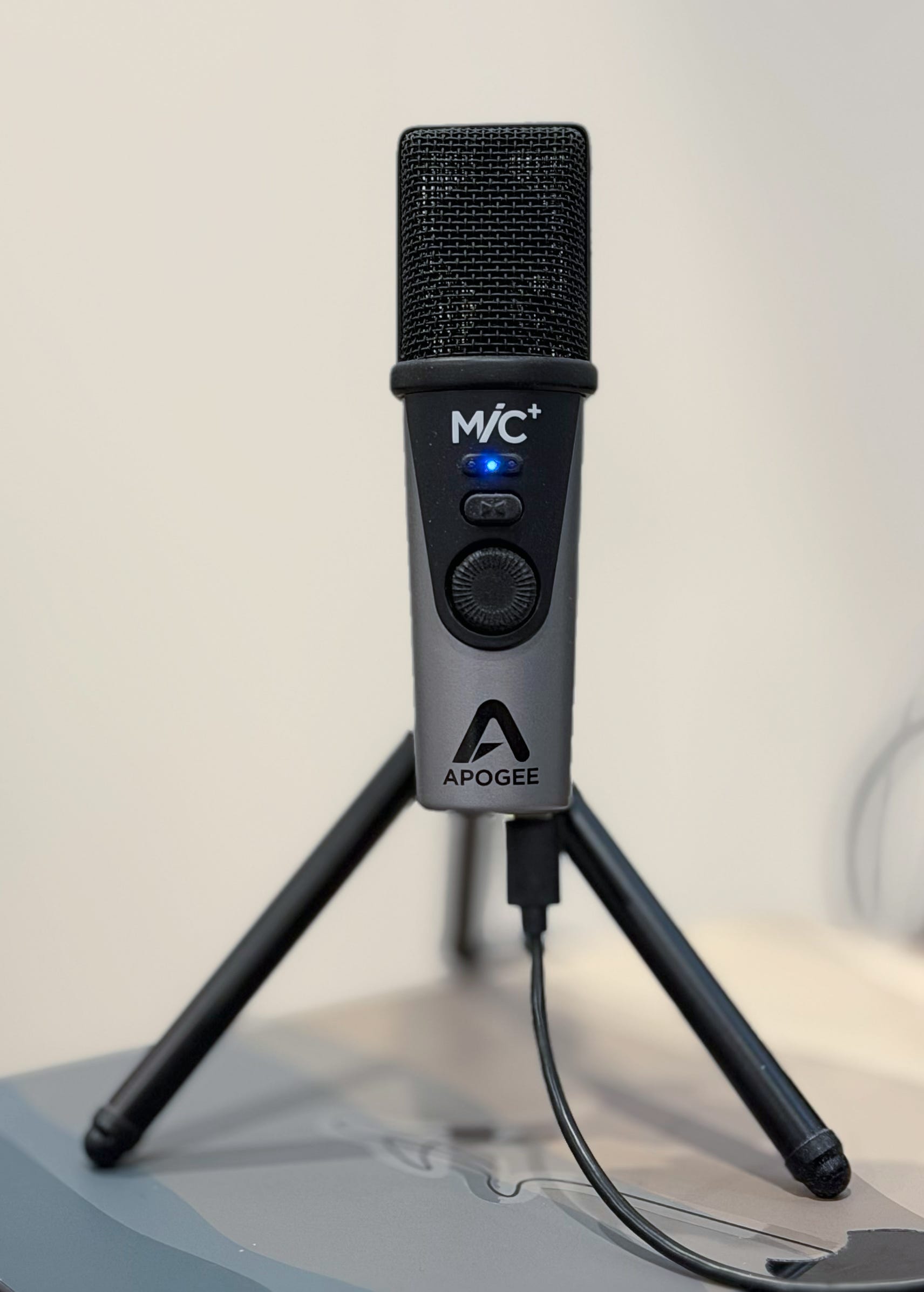
On my desk sits an Apogee MiC+, a studio-grade USB condenser I bought during COVID. It had nothing to do with AI, which didn’t meaningfully exist yet, but I bought it because the kids needed to record music performances for school.
The pandemic recitals are - thank god - long over.
The microphone, meanwhile, has become the best AI productivity tool I own.
What does your office environment look like?
Six people in a huddle room (which will soon run out of fresh air, but that’s another story). Maybe there’s a lousy room-based system dialed into Teams, or someone’s laptop, its microphone built to a price point of roughly nothing.
The HVAC hums, someone has joined from a car, and two people are talking over each other about whether to ship in June. This is the recording your AI summariser then gets to work with. It attends the acoustic crime scene and delivers confidently, fluently, and nicely formatted, and wrong.
Everyone files it. Nobody reads the transcript.
This is a little tragic, because meeting summaries and even semi-automated action point-harvesting are one of the genuinely great uses of AI at work — if, and only if, they work, they’re the closest thing to a free lunch the technology currently offers.
Which makes it remarkable how much effort organizations put into making sure they don’t work.
A meeting summary is a three-stage pipeline.
First, a microphone captures audio, the bit everyone assumes is a solved problem, because everything has a microphone in it.
Next, a speech recognition model turns audio into a transcript; some will diarize it for you, too.
Finally, a large language model turns the transcript into a useful summary.
Each stage can only work with what the previous one delivered; information lost at stage one is unrecoverable at stage three. Audio engineers have known this forever.
Where does the corporate attention go?
If anything, it’s the LLM, stage three, that gets debated for a quarter. The transcription model, stage two, gets a passing thought, maybe, and usually based on similar criteria as the LLM - cost-first. Performance? Pfft, who needs that, they’re all good enough, right?
Umm, no.
But that’s not all. The microphone gets nothing. I have yet to see a single organization — not one — that treats high-quality audio capture as part of its AI strategy.
Companies will happily pay US$30 per user per month for their mediocre Copilot, and precisely $0 for the thing that determines whether Copilot has anything real to work with.
The defaults compound the problem. Built-in platform summaries like Teams, Zoom, and the lot pair middling speech recognition with a middling language model, because that’s what runs at scale for cheap.
They are far from the best available; they are the most conveniently billed. It wouldn’t matter much if the “good enough” threshold was much lower, but it’s not.
Yet in most organizations, “we have AI meeting summaries” means exactly this: a mediocre stage two feeding a mediocre stage three, fed in turn by a laptop microphone that was an afterthought at design time.
Bad input doesn’t produce a visibly bad summary. “We agreed to ship” and “we agreed not to ship” sit one degraded phoneme apart, and the language model will smooth over whichever version the transcript happens to contain.
Names get mangled. Numbers get transposed. And with one table-edge microphone on a corporate Windows laptop, speaker attribution collapses — the model knows something was decided, but not by whom, so it guesses.
A summary that assigns your commitment to someone else isn’t a productivity gain; sooner or later people will notice that, and we come back to the point above - nobody reads them or uses them - with good reason, because it would often be worse if they did rely on them - all the same, a bunch of tokens get burned on this productivity theatre.
As per Jon Ostrower’s phrase “There’s always an aviation angle”, I will offer one. You are welcome to skip this:
Aviation learned this lesson early and expensively. An airliner does not merely have a pitot tube (the sensor); it has multiple air-data sources, systems that compare them, warnings when they disagree, and procedures for deciding what can still be trusted. Even so, accidents have occurred when one blocked probe supplied plausible but false airspeed data and the automation faithfully acted on it. The industry response was to treat input integrity, disagreement detection and graceful failure as part of the system itself.
Your microphone plays the same role in an AI workflow as that pitot tube - a critical first part in a chain that could lead to bad things happening if it doesn’t provide good data. Bad audio does not stay bad audio: it becomes bad transcription, then a polished and potentially authoritative false summary. The model at the end of the chain cannot recover words the sensor at the beginning never captured.
Which brings us to my mic. Cleaner transcripts, sharper summaries, dictation that actually works (dictation that actually works feels like magic and as close to a game-changer as you’ll ever hear me saying anything is), because a mic engineered to capture a cello faithfully turns out to capture consonants very nicely too.
The organizational version of the fix is just as insultingly simple, which is presumably why nobody does it.
In order of impact:
Buy decent audio capture; proper mics for every individual employee, including for their working from home setups, and a proper conference microphone for meeting rooms. They cost less than a single day of the meetings it records.
Choose your transcription model deliberately; the gap between mediocre and state-of-the-art speech recognition is wider than most of the LLM-versus-LLM gaps people argue about.
Then, and only then, have the great LLM debate.
“Buy better microphones” will never headline an AI strategy deck.
Well, it may headline mine, but you get the drift.
Still, it doesn’t demo well, and no vendor will fly you to a conference over it. It is merely the highest-leverage AI investment most organizations could make this year, and they could make it for less than the catering budget of the offsite where they’re discussing their AI transformation.
Ps. Yes there are complexities here: data privacy, recording consent, transcript retention, local-vs-cloud models, and a dozen other things. That's what you hire me to figure out. Let’s talk.